Water remediation is the full process of removing water, drying structural materials, and eliminating contaminants after a flood or leak. Speed is everything: mold can begin growing within the first day or two after water intrudes, and according to Gallagher's 2024 report, water damage accounts for 24% of all U.S. homeowners insurance claims.
Flooding and leaks happen more often than most homeowners expect. 47% of all U.S. homes show signs of dampness or mold, according to research from Lawrence Berkeley National Laboratory. Wait too long and a manageable drying job turns into a mold problem that reaches behind walls, into subfloors, and through structural framing.
This guide walks you through every phase of the professional water remediation process, from stopping the moisture source to final sanitization, so you know what to expect at each stage.
What Is Water Remediation and How Does It Differ from Mitigation?
Water remediation covers the complete restoration of a property after water intrusion: extraction, structural drying, mold prevention, and sanitization. The goal is to return the property to a safe, dry, pre-loss condition.
Mitigation and remediation are related but not the same. Mitigation focuses on the immediate response: shutting off the water source, moving contents, and beginning extraction as fast as possible. Remediation covers the deeper work of drying materials, treating affected surfaces, and confirming the environment is clean and stable.
A third phase follows remediation. It involves rebuilding or repairing what was removed or damaged: replacing drywall, laying new flooring, repainting. Some companies handle all three phases; others specialize in one.
You can read a detailed breakdown of what each phase covers on the water damage services page, which explains how these stages connect in practice for South Florida properties.
A company that handles the full scope, from first extraction through post-remediation verification, gives you one accountable point of contact throughout.
Moisture that would take a week to cause problems in a drier climate can fuel mold growth in 24 to 48 hours here. That distinction between water remediation and mitigation is not just terminology: it determines how aggressively your technician needs to act from the moment they arrive.
Water Contamination Categories and Damage Classes Explained
Before any drying begins, a trained technician assesses two things: what type of water caused the damage and how far it has spread. These two factors, contamination category and damage class, determine the equipment, timeline, and safety protocols for the entire job.
Contamination categories describe the cleanliness of the water involved:
| Category | Source | Health Risk |
|---|---|---|
| Category 1 (Clean Water) | Broken supply lines, overflowing sinks, rainwater | Low |
| Category 2 (Gray Water) | Washing machine overflow, dishwasher leaks, toilet overflow without feces | Moderate |
| Category 3 (Black Water) | Sewage backup, floodwater from rivers or storm drains | High |
Standing water that is not extracted promptly can become increasingly contaminated, especially in South Florida's heat. Category 3 events require full personal protective equipment, containment barriers, and antimicrobial treatment before any drying begins.
Damage classes describe how much moisture has been absorbed and how difficult it will be to dry:
- Class 1: Minimal absorption. Only part of a room is affected, and materials have low porosity.
- Class 2: Significant absorption into carpet, cushions, and structural materials throughout an entire room.
- Class 3: Water has saturated walls, insulation, and ceilings.
- Class 4: Specialty drying is required for dense materials like hardwood, concrete, or plaster that resist evaporation.
Higher damage classes require more equipment, longer drying times, and closer moisture monitoring. A Class 4 situation in a Miami home with poured-concrete walls is a fundamentally different job than a Class 1 supply-line leak in a utility room.
Why Acting Within 24 to 48 Hours Prevents Mold Growth
The professional guideline in water damage work is clear: mold can begin to take hold within the first 24 to 48 hours after moisture intrudes. In South Florida, where indoor humidity stays elevated year-round, that window closes even faster. By the time you see a dark patch on drywall or smell something musty, mold has already been growing out of sight for days.
The financial stakes match the health stakes. According to iPropertyManagement's 2026 research, the total cost of home flooding in the U.S. reaches up to $34.30 billion annually. That figure reflects what happens when water damage goes unaddressed or is treated too slowly.
In your home, mold needs only three things to take hold: moisture, a surface, and time. Porous materials like drywall, insulation, and wood framing absorb water quickly and hold it long enough for colonies to establish. Once mold spreads behind walls or into subfloor cavities, the scope of work expands significantly.
Waiting even a few days to begin remediation can turn a straightforward drying job into a full mold remediation project. If you are in Broward County and already dealing with visible mold alongside water damage, the Doral Mold Removal & Remediation Services page covers what that combined scope of work involves.
The 24 to 48 hour window is not a scare tactic. It is the practical reason why professional water remediation companies offer around-the-clock response. Every hour of delay in South Florida's climate adds risk to the structure and to the people inside it.
How to Dry Out a Flooded Home: The Remediation Process
Professional water remediation follows a specific sequence. Skipping steps or reordering them leads to incomplete drying, hidden moisture pockets, and mold growth that shows up weeks later. Here is what trained technicians do, in the order they do it.
-
Identify and stop the water source. Nothing else matters until the water stops. Technicians locate the moisture source, whether a burst pipe, failed appliance line, roof intrusion, or storm drain backup, and confirm it is fully shut off before any extraction begins. If the source is still active, extraction is pointless. For storm-related flooding, it may mean waiting for conditions to stabilize before full work can begin.
-
Perform a professional damage assessment. Once the source is controlled, technicians assess the contamination category and damage class covered in the previous section. They use moisture meters and thermal imaging cameras to map where water has traveled, including inside wall cavities and under flooring that looks dry on the surface. This assessment drives every decision that follows: how much equipment to deploy, how long drying will take, and whether any materials need to be removed before drying can proceed.
-
Extract standing water using industrial pumps and vacuums. Truck-mounted or portable extraction units pull out standing water fast. This step reduces the total drying time significantly because the more liquid water removed mechanically, the less work the drying equipment has to do. Category 3 events require full protective gear during extraction, and contaminated materials may be bagged and removed rather than dried in place.
-
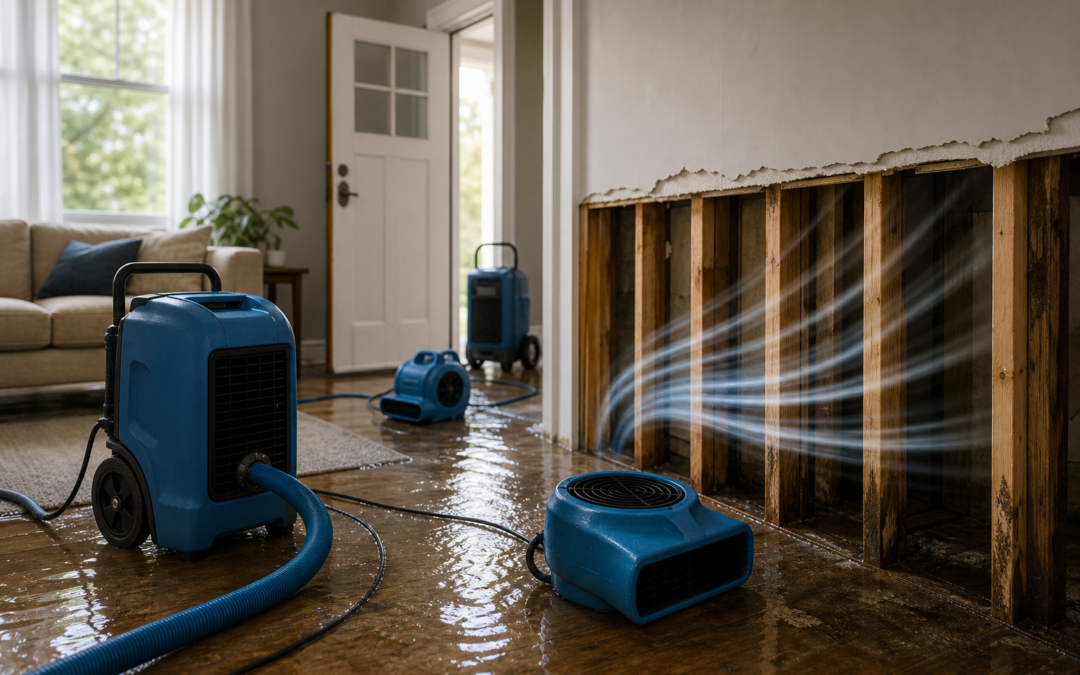
Dehumidify and dry all affected areas with high-powered air movers. This is where two essential pieces of equipment work together. Industrial air movers are high-velocity fans positioned to push air across wet surfaces at angles that pull moisture up and away from the material. They accelerate evaporation in drywall, framing, and flooring that cannot be extracted mechanically. LGR dehumidifiers run continuously alongside the air movers to capture that evaporated moisture before it re-deposits on other surfaces. Commercial-grade LGR units are required for significant water intrusion; residential dehumidifiers do not move enough volume to keep pace. Technicians monitor temperature, relative humidity, and material moisture content daily, adjusting equipment placement as readings change. Drying typically takes three to five days for a Class 2 event, longer for Class 3 or 4.
-
Clean and sanitize the environment using antimicrobial treatments. Once materials reach target dryness, technicians apply antimicrobial solutions to all affected surfaces to eliminate bacteria, inhibit mold growth, and neutralize odors from Category 2 or 3 water. HEPA air scrubbers run during this phase to capture any airborne spores disturbed during the process. A post-remediation verification check confirms that moisture readings are within acceptable limits before equipment is removed and the space is cleared for restoration work.
| Tool | Purpose | Used In Step |
|---|---|---|
| Industrial Air Movers | Circulate air across wet surfaces to accelerate evaporation | Step 4 |
| LGR Dehumidifiers | Remove moisture from the air to maintain low humidity during drying | Step 4 |
For a deeper look at what the mitigation phase covers before this process begins, see Water Damage Mitigation: What the Full Process Covers.
What Does Water Remediation Cost?
Water remediation cost varies based on contamination category, damage class, affected square footage, and how quickly work begins. There is no flat rate, but industry data gives a useful benchmark.
ISO data cited in a 2024 report shows the average severity for water damage and freezing insurance claims between 2019 and 2023 was $15,400. That figure covers claims across all damage types and regions, so your actual cost may fall well below or above it depending on the scope. The same data shows water damage and freezing generates 1.50 claims per 100 house-years of coverage, meaning it is one of the most common property loss events insurers handle.
Several factors push costs higher. Category 3 events, like sewage backups or storm floodwater, require protective equipment, antimicrobial treatment, and material removal that clean-water jobs do not. Class 3 and 4 damage means more equipment running for more days. Homes with concrete block construction, common across South Florida, can require specialty drying techniques that extend the timeline and the bill.
Costs also rise when remediation is delayed. A job that starts within hours of the event is almost always less expensive than one that starts three days later. Secondary mold growth adds a separate scope of work on top of the drying, and that scope is rarely small.
Get a written estimate that breaks out extraction, drying, and sanitization separately. That detail matters when you file an insurance claim and need to document exactly what was done and why.
Does Homeowners Insurance Cover Water Remediation?
Standard homeowners insurance covers sudden and accidental water damage in most cases. A pipe that bursts overnight, an appliance supply line that fails, or a roof leak caused by a named storm typically falls within coverage. According to Gallagher's 2024 report, water damage accounts for 24% of all homeowners insurance claims nationally, which means insurers are experienced at handling these events.
What standard policies exclude is equally important to understand. Gradual leaks, meaning a slow drip behind a wall that went unnoticed for months, are routinely denied on the grounds that the damage was not sudden. Flooding from storm surge or rising groundwater requires a separate flood insurance policy, typically through the National Flood Insurance Program. In South Florida, where hurricane season runs June through November, that distinction can determine whether your claim is paid at all.
Contamination category also affects coverage. Category 1 claims are straightforward. Category 3 events involving sewage backup often require a specific endorsement on your policy. If you do not have that rider, the remediation costs may fall entirely on you.
Document everything before work begins. Photograph standing water, affected materials, and any visible damage from multiple angles. Keep records of when the event occurred and when you reported it. Ask your remediation company for a detailed scope of work and daily moisture logs. Insurers often require this documentation to process the claim, and gaps in the record can delay or reduce your payout.
Can You Do Water Remediation Yourself?
For small, clean-water incidents, limited DIY action makes sense before professionals arrive. If a supply line drips onto a tile floor and you catch it within an hour, mopping up the water and running a household fan is a reasonable first response. Think of it as slowing the damage while you wait for a technician, not fixing it.
Beyond that narrow scenario, DIY remediation creates more problems than it solves. Household fans and consumer dehumidifiers do not move enough air volume to dry wall cavities, subfloor assemblies, or insulation. They circulate moisture rather than remove it, which can spread the affected area rather than shrink it. A floor that feels dry underfoot can hold enough moisture inside the subfloor to fuel mold growth for weeks, and you cannot see that without moisture meters and thermal imaging.
Category 2 and Category 3 events are never safe for DIY work. Gray water contains chemical and biological contaminants. Black water, from sewage or storm flooding, carries pathogens that require full protective equipment and professional-grade antimicrobial treatment to handle safely.
For serious water intrusion, stop the source, move contents out of the affected area, and call a certified technician immediately. Royal Mold Specialist is a water damage and mold remediation company serving more than 20 cities across South Florida that responds to water damage events around the clock. The faster a professional assessment happens, the narrower the scope of work stays.
If you are weighing the DIY decision more carefully, Expert Water Removal: What Sets a Pro Apart From DIY covers the specific gaps in equipment and technique that make professional response necessary for most water events.
Prices and plan limits verified as of November 2026.
FAQs
What is the meaning of water remediation?
Water remediation covers everything from initial extraction through sanitization and post-remediation verification. The goal is to return the property to a safe, dry, pre-loss condition and prevent secondary damage like mold growth.
How long does water remediation take?
A Class 2 event, meaning water has saturated carpet and structural materials throughout a room, typically takes three to five days of active drying. Class 3 or Class 4 damage, where water has penetrated walls, ceilings, or dense materials like concrete, can take longer. The timeline depends on contamination category, how quickly work begins, and how much moisture the building materials absorbed before extraction started.
What certifications should a water remediation company have?
Look for technicians trained through an industry-recognized certification body that covers water damage restoration protocols. Certification confirms that technicians understand contamination categories, damage classes, and proper drying procedures rather than guessing on the job. Ask any company you consider whether their technicians hold current credentials and whether the company carries liability insurance and workers' compensation coverage.
Is water remediation the same as water damage restoration?
No. Remediation covers extraction, drying, and sanitization. Restoration is the phase that follows: rebuilding what was removed or damaged, such as replacing drywall, laying new flooring, or repainting. Some companies handle both under one contract; others specialize in one or the other. Knowing which phase a company covers helps you avoid gaps in the scope of work.
What is the difference between gray water and black water damage?
Gray water (Category 2) comes from sources like washing machine overflow or dishwasher leaks. It contains chemical or biological contaminants but not raw sewage. Black water (Category 3) comes from sewage backups, floodwater, or storm drain overflow. It carries pathogens and hazardous waste that require full protective equipment and antimicrobial treatment before any drying begins. Category 3 events also affect insurance coverage, often requiring a specific policy endorsement.
Conclusion
Water remediation is not a single task. It is a sequence: stop the moisture source, assess the damage, extract standing water, dry the structure, and sanitize the environment. Each step depends on the one before it. Skip any of them and the moisture you leave behind becomes mold.
If your home has taken on water, start by stopping the source and moving contents out of the affected area. Then call a certified technician as quickly as possible. The first 24 to 48 hours determine whether you are dealing with a drying job or a full mold remediation project. The sooner a professional assessment happens, the more of your home, and your budget, you protect.