
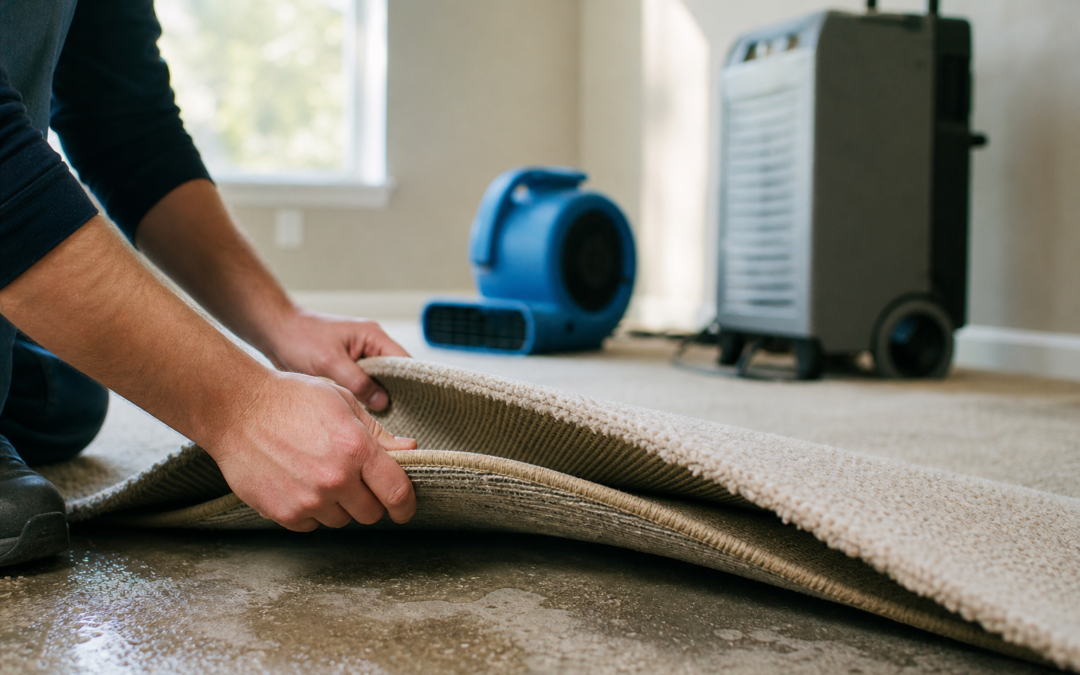
To get water out of carpet, stop the water source, remove standing water with towels or a wet/dry vacuum, lift a corner to check the padding, and run fans and a dehumidifier continuously. Aim to get everything dry within 24 to 48 hours. After that, mold can start growing, and soaked carpet may need to be discarded.
This guide covers one wet carpet, not a whole flooded home. A spill, a leaking appliance, or a burst supply line soaking one room is a smaller job than a full flood. If water has spread through several rooms, start with water remediation: how to dry out a flooded home fast instead. For a single wet carpet, you have a clear window and a clear method.
Below you get the step-by-step method, plus what most guides skip: how to dry carpet without a wet vac, how to judge severity, and how to spot early mold signs and know when to stop drying and call a professional.
Before You Start: Stay Safe and Identify the Water Type
Safety checks come first, because wet carpet and electricity do not mix. The water type decides whether you can handle this yourself at all.
Start with these checks before you touch anything:
- Electricity. If water reached outlets, power strips, or appliances, shut off power to that area at the breaker before you step in. Do not stand in standing water near anything plugged in.
- Protective gear. If the water came from a washer, drain, toilet, or outdoors, wear rubber gloves, waterproof boots, and a mask [S1].
- The source. Find where the water came from. You cannot dry anything while it keeps coming.
Next, identify the water type. It sets the rules for cleanup:
- Clean water. This comes from a broken supply line, a overflowing sink or tub with no waste in it, or rain through a leak. It is the best case, and DIY drying is realistic if you act fast.
- Gray water. This is used water from a washing machine, dishwasher, or shower drain. It carries soap, skin oils, and bacteria. Small areas can sometimes be handled with gloves and care, but the carpet and padding are a higher risk.
- Black water. This includes sewage backup, toilet overflow with waste, and floodwater from outside. It carries pathogens. Do not try DIY cleanup of black water. Keep people and pets out of the room and call a professional.
Clean water left sitting also changes category. After a day or two, it picks up bacteria from the carpet and the room. When you are unsure which type you have, treat it as the more contaminated one.
Is My Carpet Ruined If It Gets Wet? The 24 to 48 Hour Window
Wet carpet is not automatically ruined. Carpet fibers dry out fine. The real problem is the padding underneath and the clock that starts the moment water soaks in.
The US EPA says mold will not grow in most cases if wet or damp items are dried within 24 to 48 hours. Trapped moisture in carpet can promote mold and mildew growth inside that same window. In South Florida, where indoor humidity already runs high, you should treat the 48-hour mark as a hard limit, not a target.
UC Irvine Environmental Health and Safety gives the same limit for carpet: dry it thoroughly within no more than 48 hours, and if that is not possible, discard it. That is the line between a fixable problem and a replacement.
So the answer depends on three things:
- How fast you act. Carpet pulled dry inside the window is usually saved.
- What kind of water it was. Clean water gives you room to work. Gray and black water do not.
- How much reached the padding. Surface-wet carpet is easier than carpet with a saturated pad.
What about carpet wet for 3 days? You have passed the 48-hour limit. At that point, a normal DIY dry-out is unlikely to work. Expect mold growth to be possible, and plan for either discarding the carpet and padding or having a professional assess the room before you decide. Do not assume it looks fine and move on. Mold often starts underneath, out of sight.
How to Get Water Out of Carpet Fast: Step by Step
These steps work for getting water out of carpet at home when the water is clean and the area is limited. Do them in this order, and move fast.
- Make the area safe. Turn off electricity to the affected area if the water is extensive, and put on protective gear if the water may be contaminated [S1].
- Stop the water source. Shut off a valve, fix the leak, or wait for outside flooding to subside before you start cleanup [S2]. Drying while water still comes in only wastes time.
- Clear the room. Get furniture and loose items out of the wet area as quickly as you can [S3]. If a heavy piece has to stay, lift its legs onto foil or plastic blocks so wood and fabric do not sit in the wet.
- Extract standing water. Blot with towels first to pull up the bulk of it. Then run a wet/dry vacuum over the carpet and go over the area multiple times until no more water comes out [S4]. Work in slow passes, because speed leaves water behind.
- Lift a corner and check the padding. Pull up a corner of the carpet and feel the padding underneath. If it is heavily saturated, remove and replace it, because it is impractical to fully dry [S5].
- Set up airflow. Place high-velocity fans around the wet area, and open windows and doors to speed evaporation [S6]. In humid South Florida weather, outside air can be as damp as the room, so lean on equipment over open windows during storm season.
- Run a dehumidifier. Keep one or more dehumidifiers running continuously in the room to pull moisture out of the air [S7]. Fans move moisture off the carpet. The dehumidifier removes it from the room.
- Clean and monitor. Once everything is dry, clean and sanitize the carpet with a suitable carpet cleaner or antimicrobial solution. Then keep checking the area for musty smells or mold signs [S8].
A note on equipment: a wet/dry vacuum or a dehumidifier can be rented, and rental costs vary by location and rental period, so check with local rental shops before you commit.
Check the carpet by touch every few hours. If it still feels damp at the 48-hour mark, stop treating this as a DIY job.
How to Get Water Out of Carpet Without a Wet Vac
You can get water out of carpet without a wet vac, but it takes more passes and more patience. The goal is the same: pull water out of the fibers and padding faster than it can settle in.
Use these methods in order, starting with the one that removes the most water:
- Towels. Lay thick, dry towels over the wet area and press down hard. Cotton bath towels absorb the most. Swap them out as soon as they soak through, and keep going until fresh towels come up barely damp.
- Weight and pressure. Stand on the towels, or stack a few heavy books on them for a few minutes. Pressure pushes water up out of the padding and into the towel. Do not scrub or rub, because that works water deeper into the fibers.
- Squeegee or mop. On a shallow puddle, pull the water toward a drain, a doorway, or a bucket before you blot.
- Airflow. Once the standing water is gone, set fans low and aimed across the carpet surface, and open windows and doors if the outside air is drier than the room [S6].
A fan alone is slow. A hardware store or rental shop can supply a wet/dry vacuum or a dehumidifier, and you will stay inside the 24 to 48 hour window more easily if you can borrow or rent one.
How to Check the Carpet Padding and When to Replace It
The padding is where wet carpet goes wrong. Carpet fibers dry quickly. Padding acts like a sponge, holds water against the subfloor, and dries slowly.
To check it, pull up a corner of the carpet at a wall edge or doorway. Most carpet is held by tack strips, so use pliers and pull firmly. Press your hand into the padding. Look for three things:
- Water you can squeeze out. If you can wring moisture out of it, it is saturated.
- Darkening or staining. Dark patches mean water has been sitting there a while.
- A musty smell. That points to mold or mildew already working in the pad.
If the padding is heavily saturated, remove and replace it, because it is impractical to fully dry [S5]. Cut the old pad into strips, bag it, and toss it. Replacement pad is a small part of the cost compared with mold remediation later.
Carpet that is clean and only surface-wet can often go back down after the subfloor and carpet dry completely. Carpet that sat on saturated padding past the 48-hour mark should be discarded. If the water was gray or black, replace both carpet and padding, no matter how quickly you moved.
Drying Wet Carpet: Fans, Dehumidifiers and Baking Soda
Will wet carpet dry on its own? Surface-damp carpet in a dry, ventilated room sometimes does. A soaked carpet with padding underneath will not dry in time, and in South Florida's humidity it usually will not dry at all. Moisture trapped in that carpet can promote mold within 24 to 48 hours, so waiting is the wrong plan.
What actually speeds up drying:
- High-velocity fans. Put them around the wet area, aimed across the carpet and under any lifted corner, so air moves over the damp surface [S6].
- A dehumidifier, running continuously. It removes the moisture the fans lift into the air [S7]. Close the room doors and windows while it runs, so it pulls water from the room instead of the outdoors.
- Time you track. Your target is dry carpet and padding inside the 24 to 48 hour window. A small spill dries faster than a soaked room, and a deep flood takes longer, but do not count on a specific number of hours. Keep checking by touch until nothing feels cool or damp.
Now the baking soda question. Searches like drying wet carpet with baking soda and baking soda on wet carpet overnight are common, but nothing here shows that baking soda dries carpet. At most, it helps with odor. If you want to use it, sprinkle it on carpet that is already mostly dry, leave it for several hours or overnight, and vacuum it up. Do not sprinkle it on soaked carpet and walk away. Wet baking soda clumps, and it does nothing about the water in the padding or the moisture source.
How to Get Water Out of Carpet in a Car
A wet car carpet follows the same 24 to 48 hour clock as a wet carpet at home, and it has less room for error because the space is small and sealed. Start by parking the car somewhere dry and shaded.
Pull out the floor mats and take them outside to dry. Then blot the carpet with thick towels, pressing down hard, and use a wet/dry vacuum if you have one. Lift the carpet edges where you can and check the padding underneath, since it holds water the way house padding does. Run fans through open doors, or use a small dehumidifier inside a closed car. Check the floor by touch until it feels fully dry, and chase any musty smell right away.
How to Tell If Mold Has Started and When to Call a Professional
Mold under carpet usually shows itself by smell before you see it. A musty, earthy odor that returns after you air out the room is the clearest sign. Also look for dark or greenish spotting on the carpet backing or padding, staining that spreads, and carpet that still feels cool or damp to the touch. If you see any of these after the 48-hour mark, you are past a simple dry-out.
If the odor comes back after the carpet and padding are dry and cleaned, treat that as mold, not as a cleaning problem.
Some situations should go straight to a professional:
- Gray or black water. Sewage, toilet overflow with waste, and outside floodwater carry pathogens and are not DIY work.
- A large affected area. Water that reached several rooms or soaked a whole floor is beyond a fan-and-towel job.
- Still wet after 48 hours. A carpet that stays damp this long is rarely worth saving.
- Any sign of mold. Visible growth or a persistent musty smell means moisture is still hiding somewhere.
If you are in South Florida, Royal Mold Specialist handles water damage treatment and mold inspection. A technician can find the moisture source and tell you what is salvageable.
FAQs
What will absorb water out of carpet?
Thick cotton towels absorb the most, especially when you press down hard or stand on them. A wet/dry vacuum pulls out more than any cloth can. Swap towels as soon as they soak through, and finish with fans and a dehumidifier to remove what the towels leave behind.
Will a wet carpet dry on its own?
Only if it is barely damp and the room is dry and ventilated. Soaked carpet with wet padding will not dry in time on its own, especially in humid South Florida weather. Trapped moisture can promote mold quickly, so use fans and a dehumidifier.
Is my carpet ruined if it gets wet?
Not necessarily. Carpet dried thoroughly in time can usually be saved if the water was clean. Carpet that stays wet past that point, or that took on gray or black water, should be discarded or assessed by a professional.
How long does it take for wet carpet to dry?
It depends on how much water soaked in, the water type, and the humidity. A small spill dries faster than a soaked room, so keep checking by touch until nothing feels damp or cool. If the carpet and padding are still wet at the two-day mark, stop the DIY dry-out.
How do you get water out of carpet in a car?
Take out the floor mats, blot the carpet with towels, and use a wet/dry vacuum if you have one. Lift the carpet edges to check the padding, then run fans through open doors or a small dehumidifier in the closed car. Aim to finish within the same window as a wet carpet at home.
Can baking soda help dry a wet carpet?
No source shows that baking soda dries carpet. It can help with odor on carpet that is already mostly dry. Sprinkle it on, leave it for several hours or overnight, and vacuum it up. Extraction, airflow, and a dehumidifier do the actual drying.
Conclusion
Wet carpet is fixable if you stop the water, pull out the standing water, check the padding, and keep fans and a dehumidifier running until everything is dry within 24 to 48 hours. Past that window, or with gray or black water, plan on discarding the carpet or getting a professional assessment instead of pushing on with a DIY dry-out.
Start today by touching the carpet and lifting one corner to feel the padding. If it is soaked, decide right then whether you can finish drying inside the window, and make the call to a professional if you can't.