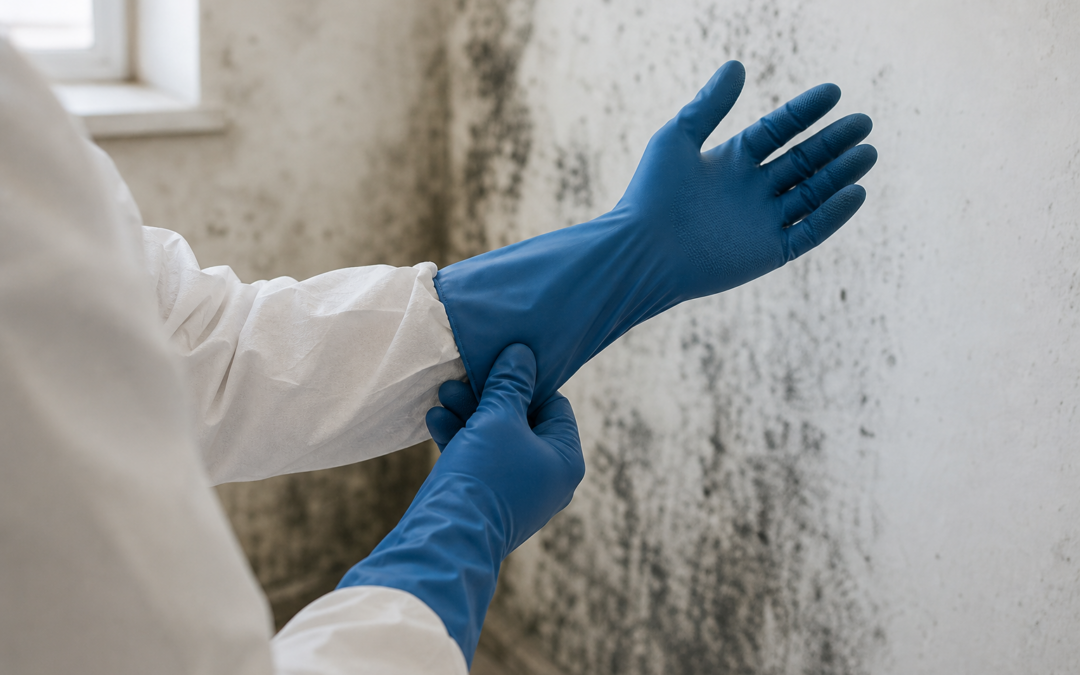
For mold removal, wear nitrile or PVC gloves rated for the cleaner you use, with a long cuff reaching mid-forearm. Choose about 8 mil nitrile for scrubbing and debris, avoid thin vinyl and latex when using bleach, and pair gloves with a NIOSH-approved N95 and unvented goggles.
You found mold, and now you need to decide what goes on your hands before you touch it. The wrong glove fails fast. Bleach eats through some materials, wet scrubbing runs water down a short cuff, and drywall edges tear thin disposables. If the patch is bigger than a small cleanup, a professional crew handling mold removal Miami FL properties is a better call than any glove.
This guide covers the glove material, thickness, cuff length, other protective gear, and job-size limits.
Which Gloves Are Best for Mold Removal: Nitrile, Latex or Vinyl?
The best gloves for mold removal are nitrile or PVC, because both hold up against the cleaning solutions used on mold. Latex and thin vinyl are the weaker choices once bleach enters the job: latex breaks down in bleach and carries allergy risk, while thin vinyl tears easily and lets liquid through.
The glove has to match the cleaner, not the mold. Mold itself does not eat through a glove. The chemical in your bucket does. Chlorine bleach is the most common cleaner, and it exposes weak glove materials fastest.
Here is how the three materials compare for mold work:
- Nitrile. A synthetic rubber that resists bleach, resists punctures better than vinyl, and suits people with latex allergies. It is the default pick.
- PVC. A heavier, reusable material that holds up to chlorine bleach. It is stiffer, but it lasts through a long scrubbing shift.
- Latex. Flexible and comfortable, but it carries allergy risk and is a poor match for bleach-based cleaning.
- Vinyl. Cheap and loose-fitting. Thin vinyl tears easily and gives the least protection when bleach is in the bucket.
The evidence favors nitrile. Vendor testing by Medline found that nitrile gloves resisted permeation from a 10 to 13% sodium hypochlorite solution for more than 480 minutes. Sodium hypochlorite is the active ingredient in household bleach. That result is vendor-reported and covers nitrile only, so treat it as a strong sign rather than a guarantee for every brand.
Mix the solution correctly, too. The CDC recommends no more than 1 cup of bleach for every 1 gallon of water for mold cleanup. A stronger mix does not clean better. It stresses your gloves, your lungs, and your skin.
Bleach is not the only cleaner, and it is not the right one for every surface. Whatever you use, read its label and pick a glove material that suits it. That is the first step: select the glove material based on the cleaning agent, with nitrile or PVC for chlorine bleach [S1].
How Thick Should Mold Removal Gloves Be? Mil Ratings and Top Picks
For wiping and light scrubbing, 6 mil nitrile works. For demolition, wet debris, or anything with sharp edges, go to 8 mil. A mil is one thousandth of an inch, so more mils means a thicker wall and a glove that resists punctures longer.
Thickness trades off against feel. Thicker gloves protect better but dull your sense of a screw or a tool handle. A raised texture helps with grip when everything is wet.
One limit applies to every disposable nitrile glove. It does not protect you from cuts. Sharp drywall edges, splintered wood, and exposed fasteners can slice or tear it. If you pull wet drywall, the glove keeps spores and cleaner off your skin, but it will not stop a cut. For demolition, wear a sturdier outer glove over it or hand the job to a crew.
The three options below are all heavy-duty disposable nitrile.
| Thickness | Best use | Price tier |
|---|---|---|
| GLOVEWORKS 8 Mil Orange Nitrile Disposable Gloves: 8 mil with a raised diamond texture for grip on wet tools and surfaces | Scrubbing and debris handling where grip matters | Budget tier |
| Venom Steel Orange 8 Mil Nitrile Gloves: 8 mil, high-visibility orange that makes tears and cross-contamination easier to spot | Dirty, slippery cleanup and demolition debris | Budget tier |
| Inspire Black Nitrile Heavy Duty 6 Mil: 6 mil, thinner than the other two | Moderate mold removal and wiping; riskier around drywall fasteners | Premium tier |
A few notes on these picks. The GLOVEWORKS standard cuff gives less forearm coverage than reusable long-cuff gloves, and nitrile breakthrough time can drop by up to 31% during repetitive hand movements. That is a real concern on a long scrubbing session, which is another reason to swap gloves often.
The orange color on the Venom Steel pair is a practical advantage. A tear shows up against dark debris, so you spot it before your hand does.
The Inspire pair is thinner than the 8 mil options, which raises puncture risk when you handle sharp construction debris like drywall fasteners. Its label says budget-friendly, but it sits in a higher price tier here, so compare before you buy. Match the glove to the task: 6 mil for wiping, 8 mil when you are tearing out material.
Why Cuff Length Matters for Wet Scrubbing
A cuff that reaches the middle of your forearm keeps runoff out of the glove [S2]. Wet scrubbing sends water and cleaner down your arm, and a short cuff funnels it straight inside.
Picture scrubbing a bathroom wall with your arms raised. Gravity pulls the solution down your wrist toward the cuff. A short wrist-length glove leaves a gap, and once liquid pools inside, it sits against your skin, the exact exposure you wore the glove to avoid. It also makes the glove harder to pull off and easier to tear.
Long-cuff gloves, usually reusable PVC or heavy rubber, solve this. They cover the wrist and most of the forearm, so there is no exposed band of skin where runoff can enter. Standard disposable nitrile is shorter, which is a trade-off for the lower price.
You can close the gap on disposables without buying a different glove:
- Wear long sleeves. Pull the glove cuff over the sleeve end so water runs onto the glove, not under it.
- Tape the seam. A band of tape at the wrist holds the cuff against the sleeve on overhead work.
- Roll the cuff up slightly. A rolled bead of material at the cuff acts as a gutter and catches drips before they run in.
- Work with your hands low when you can. Gravity does the rest of the job for you.
Cuff length also matters after the scrub. A longer glove lets you peel it off from the forearm without touching the contaminated outer surface with bare skin. The removal steps later in this guide build on that.
Do I Need a Mask and Goggles Too? Pairing Gloves With Other PPE
Yes. Gloves protect your hands, but disturbed mold sends spores into the air, and your lungs and eyes are exposed too. A NIOSH-approved N95 respirator and unvented goggles belong in the same kit as your gloves. NIOSH is the federal agency that tests and certifies respirators. An N95 is a respirator that filters most airborne particles.
Think of protection as layers. Each piece covers a different way mold reaches you:
- N95 respirator. Filters spores and dust you would otherwise breathe in while scrubbing or tearing out material.
- Unvented goggles. Seal around your eyes so splashes of cleaner and airborne spores cannot get in. Vented goggles let both through the holes.
- Long sleeves and pants. Keep spores and runoff off your arms and legs, and give your glove cuffs something to seal against.
How can mold affect workers who skip these? Spores landing on skin, in the eyes, or in the airways can cause irritation, sneezing, coughing, and watery or red eyes. People with asthma or allergies tend to react faster. Cleaning chemicals add their own irritation on top.
Your respirator only works if it is the real thing and it seals. Check the facepiece for the approval holder's name and the "TC" approval number, which confirms NIOSH certification [S4]. Counterfeit masks exist, and a mask without those markings may not filter what it claims to.
The seal matters as much as the certification. NIOSH data indicates facial hair under the respirator seal can increase air leakage by 20 to 1000 times compared with a clean-shaven user. That figure is vendor-reported, but the direction is clear: a beard or stubble along the sealing edge lets unfiltered air bypass the filter. If you plan to wear an N95, shave the sealing area first.
Discard the respirator immediately if it becomes damaged, soiled, or hard to breathe through [S3]. Do not rinse and reuse a mask that has been soaked on a wet job.
How Big Is the Job? Matching Protection to Mold Area
The size of the affected area decides how much protection you need, and whether DIY is still the right call. A small patch needs gloves, an N95, and goggles. A large one needs containment and equipment that a hardware-store kit cannot give you.
A common rule of thumb splits jobs at roughly 10 square feet and 100 square feet. Use it as a guide to your own judgment, not a legal line. If the moisture source is still active or you are unsure how far the mold runs, treat the job as bigger than it looks.
| Affected area | Typical protection | DIY or pro |
|---|---|---|
| Under 10 sq ft | Nitrile gloves, N95, unvented goggles, long sleeves | DIY is reasonable once the moisture source is fixed |
| 10 to 100 sq ft | Heavier 8 mil gloves or reusable long-cuff gloves, N95, goggles, disposable coveralls | DIY is possible, but think hard about hiring a pro |
| Over 100 sq ft | Full containment, HEPA air filtration, and respiratory protection beyond an N95 | Hire a professional crew |
| Inside or around an AC system | Same as the size above, plus no running the system | Pro, because spores spread through ductwork |
HEPA stands for high-efficiency particulate air. A HEPA filter traps tiny particles that standard filters pass back into your rooms.
AC mold needs its own caution. When mold grows in an air handler, coil, or duct, turning the system on pushes spores through every room it serves. In South Florida's humidity, condensation in an AC system is a frequent cause. If you see mold at a vent or smell it when the system starts, shut the unit off and get it assessed. People searching for AC mold removal in Hollywood, FL are usually dealing with exactly this, and ductwork is not a job for a glove and a spray bottle.
When the job grows past the small-patch range, hand it to a team that works with containment and air filtration daily. A professional crew for mold removal Miami FL properties fixes the source, not just the stain. If you are weighing a smaller job yourself, our guide on whether it is safe to clean black mold yourself walks through the limits.
How to Choose, Wear and Remove Mold Removal Gloves Step by Step
Follow these steps in order, from picking the glove to washing up. Doing them in sequence keeps spores and cleaner off your skin and out of the rest of your home.
- Pick the glove material for your cleaner. Choose nitrile or PVC if you use chlorine bleach [S1].
- Check the cuff. Use long-cuff gloves that reach the middle of your forearm for wet scrubbing, or seal disposables over your sleeves [S2].
- Suit up in order. Put on long sleeves, goggles, and your N95 first, then pull the gloves over your sleeve ends last.
- Verify your respirator. Look for the approval holder's name and "TC" number, and confirm a clean seal [S4].
- Work, and inspect as you go. Stop if a glove tears, a mask clogs, or the cuff lets water in. Replace the damaged item [S3].
- Remove gloves without touching the outside. Pinch one glove at the wrist and peel it off inside out, then slide a bare finger under the second cuff and peel it over the first.
- Discard and wash. Bag disposable gloves before they leave the work area, then wash your hands and forearms with soap and water.
On a long shift, switch from disposables to reusable gloves. Disposable nitrile wears down during repetitive scrubbing, and breakthrough time can drop by up to 31% with constant hand movement. A reusable long-cuff PVC glove holds up through hours of work. Rinse reusable pairs with clean water after use, let them dry fully, and retire any that crack or stay sticky.
How do you know if you got sick from mold? Watch for coughing, wheezing, sneezing, a sore throat, itchy or watery eyes, or skin irritation that starts or worsens after cleanup. Symptoms that persist or get worse deserve a call to a doctor, not another round of scrubbing.
When Gloves Aren’t Enough: The Professional Mold Remediation Process
Gloves only protect your hands, and how long they last depends on the chemical. The result of more than 480 minutes of permeation resistance applies to nitrile against a 10 to 13% bleach solution, and other cleaners behave differently. When the area is large, the moisture source is still active, or the mold sits in an AC system, a licensed team has to handle it. Royal Mold Specialist is a mold remediation company that serves South Florida properties, and its technicians follow the full mold remediation process: inspection, containment, removal, and cleanup of the affected area.
Prices and plan limits verified as of November 2026.
FAQs
Do I need a mask to clean mold?
Yes. Disturbed mold puts spores into the air, and gloves do nothing for your lungs. Wear a NIOSH-approved N95 and confirm the approval holder's name and "TC" number on the facepiece. Shave the sealing area first, because facial hair can increase air leakage by 20 to 1000 times. Discard the mask if it gets damaged, soiled, or hard to breathe through.
How do I know if I get sick from mold?
Watch for coughing, wheezing, sneezing, a sore throat, itchy or watery eyes, or skin irritation that starts or worsens after cleanup. People with asthma or allergies often react first. If symptoms persist or get worse after you stop working, call a doctor instead of scrubbing again.
Can you wipe mold off leather?
Yes, on small spots. Wear nitrile gloves and a mask, take the item outside, and wipe the surface with a cloth dampened with a mild cleaner. Dry it fully in open air. Skip bleach on leather, since it stains and damages the finish. If mold has soaked deep into the material or returns, the item may not be recoverable.
How to get mold out of a baseball glove?
Wear nitrile gloves, take the baseball glove outside, and brush off loose growth. Wipe the leather with a cloth lightly dampened with a mild cleaner, then let it dry completely away from direct heat. Condition the leather afterward. Store it somewhere dry, because South Florida humidity brings mold back quickly.
Can I reuse gloves after mold cleanup?
Disposable nitrile gloves are single use, so bag them and throw them away. Reusable long-cuff PVC gloves can be reused if you rinse them with clean water, let them dry fully, and check for cracks. Retire any pair that feels sticky, brittle, or torn.
Should I use AC mold removal in Hollywood, FL professionals or DIY?
Use professionals. Mold in an air handler, coil, or duct spreads spores to every room once the system runs. Shut the unit off and get it assessed. A small, visible patch on a bathroom wall is a reasonable DIY job. Mold inside the AC system is not.
Conclusion
Nitrile or PVC gloves with a mid-forearm cuff handle most small mold cleanups, with 6 mil for wiping and 8 mil for scrubbing and debris. Gloves are one layer, so pair them with a verified N95 and unvented goggles. Disposable gloves will not stop a cut from drywall or splintered wood.
Before you start, check the size of the area and whether the moisture source is fixed. If the mold covers more than a small patch or sits inside your AC system, stop and have a professional crew assess it.