
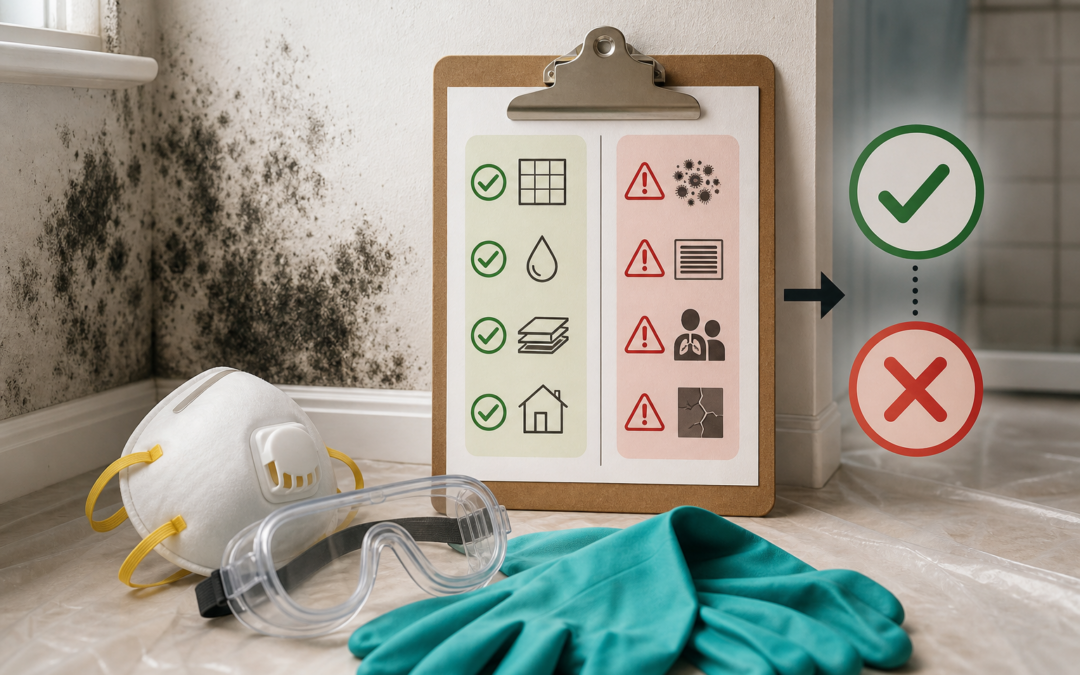
Is it safe to clean black mold yourself? It can be, if the patch is under 10 square feet, sits on a hard surface, and nobody sensitive to mold lives in the home. You need an N95 respirator, goggles and gloves, and you must fix the moisture source. Larger areas, porous materials, HVAC involvement or health risks call for a professional.
You found a dark patch on a bathroom ceiling, behind a vanity, or along a window frame. The question now is narrower than "what is this?" It is whether you can handle it yourself or whether touching it makes things worse. This article gives you a go/no-go check first, then the cleanup order if you pass it.
Is it safe to clean black mold yourself? The 10 square foot rule
Cleaning black mold yourself is generally safe only when the affected area is small. The guideline most health agencies use is 10 square feet, roughly a 3-by-3-foot patch. The Louisiana Department of Health says homeowners can typically manage DIY cleanup below that size. Treat it as a guideline, not a legal line. A patch of 8 square feet that sits above a leaking pipe is a different job than 8 square feet on a tile wall.
Size is only the first gate. Before you measure anything, confirm what you are looking at. Dark staining on a ceiling can be mold, mildew, soot, or old water damage, and each needs a different response. Our guide on how to identify black mold in my home without a lab test walks through the visual and smell clues. Do that before you pick up a sponge.
Then measure. Count every visible patch, not just the biggest one. Two 6-square-foot spots on opposite walls add up to 12, and you are over the line. Also look past the surface. Mold on the face of drywall often means moisture inside the wall cavity.
In South Florida, this check matters more than it does in drier states. Humidity runs high most of the year, and storm season from June through November brings roof leaks and failed window seals. A patch that looks small can be the visible edge of a bigger problem. If your measurement lands near 10 square feet, treat it as over the limit and keep reading before you decide.
DIY or professional? A go/no-go checklist before you touch anything
Use the table below to match your situation to a decision. One "call a professional" answer outweighs any number of "DIY" answers. If any row points to a professional, stop and make that call.
| Condition | DIY may be reasonable | Call a professional |
|---|---|---|
| Size | Under 10 square feet total | 10 square feet or more, or several patches adding up to it |
| Surface | Hard, nonporous (tile, glass, sealed countertop) | Drywall, ceiling board, insulation, carpet, wood |
| Moisture source | Found, fixed, and dry | Unknown, ongoing, or hidden in a wall |
| HVAC | Not involved | Mold on vents, ducts, or the air handler |
| Water type | Clean water from a small leak | Sewage or major flooding |
| People in the home | Healthy adults only | Asthma, allergies, weakened immune system, infants, older adults |
| Recurrence | First occurrence | Mold has returned after cleaning |
Treat the health row seriously. People with asthma, mold allergies, or weakened immune systems can react strongly to disturbed spores. If one of them lives in the home, they should not do the cleanup, and they should leave the house while it happens. Have someone else do the work, or call a professional.
Is black mold on a ceiling dangerous? Often the mold itself matters less than what it signals: a roof leak, a failed bathroom fan, or condensation from a cold duct. Ceiling board is porous, so growth can sit well below the painted surface. Scrubbing overhead also drops spores and debris onto your face.
You also can't skip the protective gear. Cleaning without a mask is not a minor risk. Scrubbing sends spores into the air, and breathing them can bring on coughing, wheezing, throat and eye irritation, and flare-ups in people with respiratory conditions. If you can't get the right gear, don't start.
What precautions should I take when cleaning mold?
Before you start, set up your gear and your space. These are the minimum precautions to protect your lungs, skin, and eyes, and to keep spores out of the rest of the house.
- N95 respirator. The minimum respiratory protection for any mold cleaning task is an N95 respirator approved by NIOSH, the federal agency that certifies respirators. A paper dust mask or cloth face covering does not filter fine spores the same way. Fit it snugly against your face with no gaps at the nose or chin.
- Goggles without ventilation holes. Spores and cleaning solution can reach your eyes through vented goggles. Choose a pair that seals.
- Long rubber or nitrile gloves. Pick gloves that reach the forearm. Bare skin contact can cause irritation and rashes.
- Disposable coveralls or clothes you can wash right away. Change out of them before you walk through the house. Wash them separately in hot water.
- Closed-off work area. Shut the door to the room and seal gaps with plastic sheeting and tape. Turn off the HVAC system so it does not pull spores through your ducts.
- Fresh air path. Open a window in the work room and point a fan outward, not into the house.
- Heavy trash bags. Have them open and ready before you start so contaminated material goes straight in.
Gather all of this before the first wipe. Stopping mid-job to hunt for gloves means walking spores through your home. If the gear list feels like more than you can manage, reconsider whether this is a DIY job.
How to use vinegar to remove black mold (and what kills mold permanently)
Vinegar and detergent work on hard, nonporous surfaces like tile, glass, and sealed fixtures. Nothing you spray kills mold instantly or permanently. What stops mold from returning is removing the moisture it feeds on.
Start with what not to use. Bleach is a poor default on porous materials such as drywall, ceiling board, and wood. The water in the mixture soaks into the material while the chlorine stays mostly on the surface, so the roots survive and the growth comes back. Skip it on anything that absorbs liquid.
To remove black mold from a hard surface with vinegar, use undiluted white vinegar. Spray it on, let it sit for an hour or so, then scrub with a stiff brush and wipe with a damp cloth. Don't flood the area with water to rinse it, and don't mix vinegar with other cleaners. Combined with bleach, it releases toxic gas.
Hydrogen peroxide also works on hard surfaces. Standard drugstore peroxide goes on the same way: spray, let it sit, scrub, and wipe clean. Test it on a hidden spot first, since it can lighten some finishes and painted surfaces.
A scrub with dish soap and water also removes surface growth from nonporous materials. The scrubbing and wiping do most of the real work, because the goal is to lift the mold off, not just discolor it.
So what kills mold permanently? Only a dry environment. Spores float in the air of every South Florida home and stay dormant until they find moisture. If the leak, condensation, or humidity is still there, mold will return no matter which product you chose. The same goes for anything that claims to kill black mold instantly: it sells you a feeling of progress, not a result.
Porous materials are a different category. If mold has grown into ceiling board or drywall, cleaning the surface won't reach it. That material usually has to be cut out and thrown away, which is the point where many jobs move past DIY.
How to clean black mold yourself, step by step (including from a ceiling without damaging paint)
If your patch passed the go/no-go check and you have your gear ready, follow these steps in order. Doing them out of order, especially cleaning before you fix the leak, wastes your effort.
- Identify and stop the moisture source. Find the leak, condensation, or humidity problem and fix it first. A dripping pipe, a failed bathroom fan, or a cold duct sweating above the ceiling will grow new mold within days.
- Isolate the area and disable air circulation. Close the room door, seal gaps with plastic sheeting and tape, and turn off the HVAC system. This keeps disturbed spores from traveling into the rest of the house.
- Put on your protective gear. Fit the N95 respirator, goggles, and long gloves before you touch anything.
- Discard porous materials you cannot clean. Ceiling board, drywall, insulation, and carpet that carry mold usually have to go. Mold on the visible surface of a wet-damaged material has often grown inside it. A controlled study on gypsum wallboard found growth did not extend beyond 6 inches from the visible margin, so if you do cut material out, removing a margin around the visible edge is a practical guide.
- Wipe away residue and seal waste in bags. Clean the hard surfaces with a damp cloth and your cleaner, then double-bag everything you removed and the cloths you used. Tie the bags closed inside the work room before carrying them out.
- Dry the area thoroughly within 48 hours. Run a fan and a dehumidifier, and open a window if outdoor air is drier than indoor air. Anything left damp invites regrowth.
Ceilings call for extra care. To remove mold from a ceiling without damaging the paint, don't soak the surface. Lightly mist a cloth with your cleaner instead of spraying overhead, since drips run into your eyes and saturate the board. Wipe in one direction with light pressure, then follow with a cloth dampened with plain water. Work in small sections so the surface never stays wet.
If paint bubbles, peels, or flakes away, moisture has reached the layer beneath it. That means the ceiling board is compromised and needs inspection or replacement, not a fresh coat. Painting over mold hides it and traps the moisture.
The steps for basic mold cleanup guide covers the same sequence in more detail.
Why does mold keep coming back on a bathroom ceiling?
Mold keeps coming back on a bathroom ceiling because the moisture never left. Showers push warm, wet air upward, and it settles on the coolest surface in the room, usually the ceiling. If that surface stays damp, any spores that survived cleaning have everything they need.
Timing matters. Fungal experts state that significant mold can begin growing within 48 hours of a water intrusion. That is your drying window. After a leak, a pipe burst, or a roof drip, you have roughly two days to get materials dry. Some growth is slower: in a study of wet untreated gypsum wallboard, mold was first detected at 2 weeks. Don't read that as permission to wait. A South Florida bathroom is warmer and wetter than a controlled test.
To stop recurrence, work on humidity and airflow:
- Keep indoor humidity between 30% and 50%. The Louisiana Department of Health gives that range for preventing mold growth. A small humidity meter costs little and tells you where you stand.
- Run the exhaust fan during every shower and for a while afterward. Confirm it vents outside, not into the attic. A fan that dumps into the attic just moves the problem.
- Wipe down wet surfaces. A quick pass with a towel or squeegee after showering removes the water before it soaks in.
- Use a dehumidifier or air conditioning. In summer, running the AC does more than any cleaner can.
- Check for hidden sources. A slow roof leak or a sweating duct above the bathroom keeps the ceiling wet from the other side.
To get rid of mold spores in the air naturally, remove the damp surface they came from, ventilate the room, bring humidity down, and then vacuum with a HEPA filter. HEPA stands for high-efficiency particulate air, a filter rated to trap very fine particles. A regular vacuum can blow spores back into the room.
If mold returns after you have dried the area and fixed the fan, the source is likely inside the ceiling. Read why ceiling mold keeps coming back before you scrub again.
When to stop and call a mold professional
Stop and call a professional when the problem is bigger than the surface you can see. The guideline of 10 square feet is your first limit. Past it, you face more material, more spores, and a higher chance that mold has spread inside walls or above the ceiling.
These situations should end the DIY attempt:
- Large or spreading growth. More than 10 square feet in total, or patches that reappear after you clean them.
- HVAC involvement. Mold on vents, ducts, or the air handler spreads spores through every room. Cleaning it takes containment and equipment you don't have.
- Sewage or major water damage. Contaminated water adds bacteria to the mold problem, and wet materials need to come out fast.
- A moisture source you can't find. If the ceiling keeps getting damp and you can't say why, something is leaking out of sight.
- Health symptoms. Persistent coughing, wheezing, or irritation, or anyone in the home with asthma or a weakened immune system.
A professional job follows a different order than a DIY cleanup. A technician inspects the property, finds the moisture source, sets up containment with negative air pressure (a setup that pulls air out of the work area so spores don't drift into the rest of the home), and removes affected material with HEPA filtration running. Afterward, post-remediation verification confirms the area is actually clean.
Royal Mold Specialist is a mold remediation company that inspects and removes mold for homes and businesses across South Florida, and you can book by phone or online. To check whether your problem has outgrown a DIY fix, see the mold identification and health articles.
FAQs
What happens if you clean black mold without a mask?
Scrubbing releases spores into the air, and without a respirator you breathe them in. That can cause coughing, wheezing, and throat and eye irritation, and it can trigger flare-ups in people with asthma or allergies. The minimum protection is an N95 respirator approved by NIOSH. If you don't have one, wait until you do.
Does hydrogen peroxide kill black mold?
Standard drugstore hydrogen peroxide works on hard, nonporous surfaces. Spray it on, let it sit, scrub, and wipe clean. It will not reach mold growing inside drywall or ceiling board, and it does not stop regrowth if moisture is still present. Test it on a hidden spot first, since it can lighten some finishes.
Is black mold on the ceiling dangerous?
It can be, mainly because of what it signals and what happens when you disturb it. Ceiling mold usually points to a roof leak, a failed bathroom fan, or condensation, and ceiling board is porous, so growth can sit below the paint. Scrubbing overhead also drops spores toward your face. Larger patches or any health concern call for a professional.
How do I get rid of mold spores in the air naturally?
Remove the damp surface they came from, then ventilate the room and lower humidity to between 30% and 50%. Running air conditioning or a dehumidifier helps. Finish by vacuuming with a HEPA-filter vacuum, which traps fine particles that a regular vacuum blows back into the room.
Can I paint over black mold on a ceiling?
No. Paint hides the mold and traps moisture underneath, so the growth continues behind it. Fix the moisture source, clean or remove the affected material, and let the area dry completely before you paint. If paint bubbles or peels, treat that as a sign the ceiling board is damp inside.
How long does it take for mold to grow after water damage?
Fungal experts state that significant mold can begin growing within 48 hours of a water intrusion. Some materials show growth more slowly. In one study of wet untreated gypsum wallboard, mold was first detected at 2 weeks. In South Florida's warm, humid conditions, plan to dry everything within two days.
Conclusion
You can clean a small patch of mold yourself if it is under 10 square feet, sits on a hard surface, and no one sensitive to mold lives in the home. In every other case, the safer move is to stop and bring in a professional. Even a successful cleanup only lasts if you fix the moisture source behind it.
Before you buy any cleaner, measure the patch, find where the water is coming from, and check your protective gear. If the measurement is close to the limit or the source is unclear, treat that as your answer and get the area inspected.