
- Why Florida Homes Need a Different Approach
- The Full Mold Inspection Checklist
- 1. Visual Assessment of the Entire Property
- 2. Moisture Readings Throughout the Property
- 3. HVAC System and Ductwork
- 4. Bathrooms and Kitchens
- 5. Attic Inspection
- 6. Crawl Spaces and Under-Slab Areas
- 7. Laundry Areas
- 8. Garage and Utility Spaces
- 9. Air Quality and Mold Sampling
- 10. Exterior Envelope and Entry Points
- What the Inspector Delivers at the End
- What Inspectors Are Not Looking For
- Preparing Your Home Before the Inspector Arrives
- When to Schedule a Mold Inspection in Florida
- Working With a Specialist in South Florida
- Frequently Asked Questions
- The Bottom Line
A mold inspection in Florida is not the same as one in Ohio or Colorado. The heat, the humidity, the hurricane seasons, the slab construction — all of it creates conditions where mold can take hold faster and spread further than most homeowners expect. If you're preparing for an inspection, or just trying to understand what a thorough one actually involves, this checklist walks through every major area inspectors examine, what they're looking for, and why it matters specifically in a South Florida home.
Whether you've spotted something suspicious on a wall, dealt with a recent water leak, or need an inspection report before closing on a property, knowing what a professional checks gives you a clearer picture of what you're paying for — and what questions to ask.
Why Florida Homes Need a Different Approach
Florida's climate is the root cause of why mold is such a persistent problem here. High year-round humidity, frequent afternoon rain, and the aftermath of tropical storms create moisture conditions that simply don't exist in most of the country. Layer in air conditioning systems that run almost continuously, and you have a reliable recipe for condensation buildup inside walls, under floors, and in attics.
Inspectors working in Broward, Miami-Dade, and Palm Beach Counties know these patterns well. A good inspector isn't just looking for visible mold — they're looking for the moisture conditions that produce it. Visible mold is often a late symptom, not the starting point.
The Full Mold Inspection Checklist
1. Visual Assessment of the Entire Property
Every inspection starts with a full visual walkthrough. The inspector is looking for discoloration, staining, or surface irregularities that suggest mold growth. That includes:
- Dark spots or fuzzy growth on walls, ceilings, and floors
- Water stains or tide marks indicating past moisture intrusion
- Peeling or bubbling paint, which often signals moisture trapped beneath the surface
- Warped baseboards, swollen drywall, or buckled flooring
- Visible efflorescence — white mineral deposits on concrete or block walls — which points to water migration
In Florida homes, inspectors pay particular attention to exterior walls, especially north-facing and shaded sides of the structure where moisture tends to linger.
2. Moisture Readings Throughout the Property
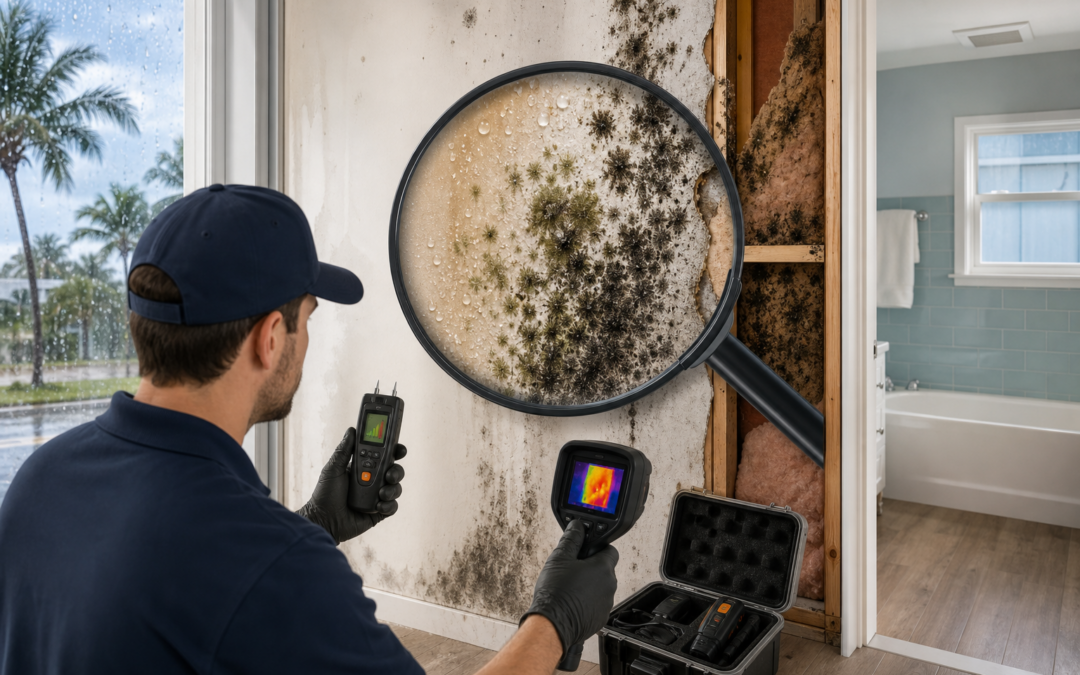
Visual assessment alone doesn't tell the whole story. Inspectors use moisture meters to measure water content inside walls, ceilings, and floors. Elevated readings in areas that look dry to the eye are a strong indicator that mold may be growing inside the building envelope.
Thorough inspectors also use thermal imaging cameras. Infrared technology reveals temperature differentials that point to moisture pockets hidden behind finished surfaces. A cool spot on a warm wall often means water is sitting there — and in Florida, where water sits, mold follows.
3. HVAC System and Ductwork
The HVAC system is one of the most common mold sources in South Florida homes and one of the most overlooked. Inspectors check:
- The air handler unit for visible mold growth on the coil, drain pan, and blower
- The condensate drain line for blockages that cause water to back up into the unit
- Supply and return vents for visible growth or musty odors
- Flexible ductwork for moisture accumulation, particularly in attic spaces where ducts can sweat in the heat
Because air conditioning runs so frequently here, any mold inside the HVAC system gets distributed throughout the entire living space. Duct inspection isn't optional — it's a core part of any thorough Florida mold inspection.
4. Bathrooms and Kitchens
These rooms produce moisture daily, and ventilation is most often inadequate in both. Inspectors examine:
- Ceiling and wall surfaces around showers, tubs, and sinks
- Grout lines and caulking for mold that has penetrated porous surfaces
- Under-sink cabinets for slow leaks from supply lines or drain connections
- Exhaust fan function — whether it actually vents to the exterior or just recirculates air into the attic
- Around and behind toilets for slow seepage from the wax ring or supply line
In older South Florida homes, bathroom exhaust fans that vent into the attic rather than outside are a recurring problem. They push humid air directly into an already warm attic space, creating conditions for mold to develop on roof decking and insulation.
5. Attic Inspection
Florida attics are hot, and when humid air gets into them — from bathroom fans, inadequate soffit venting, or roof leaks — they become mold-prone fast. Inspectors look for:
- Mold growth on the underside of roof sheathing
- Leak staining on rafters and decking
- Blocked or inadequate soffit vents that restrict airflow
- Insulation that has absorbed moisture and is holding it against the wood structure
After any significant storm, attic inspection is especially important. Even small roof penetrations that don't cause visible ceiling leaks can allow enough moisture intrusion to start mold growth on the structure above.
6. Crawl Spaces and Under-Slab Areas
Most South Florida homes are built on concrete slabs, but some older properties — particularly in parts of Broward County and further north into Palm Beach County — have crawl spaces. Where they exist, they're high-risk areas. Inspectors check:
- Ground-level moisture and standing water
- Vapor barrier condition and coverage
- Mold growth on floor joists and subfloor material
- Ventilation adequacy
For slab-on-grade construction, inspectors focus on the perimeter where the slab meets the exterior walls, looking for moisture wicking up through the concrete and into the wall framing.
7. Laundry Areas
A dryer vent, a washing machine drain connection, and water supply lines in one room make laundry areas a frequent mold source. Inspectors check:
- Behind and under the washing machine for slow leaks
- The dryer vent connection for blockages that trap humid air
- Wall surfaces behind the appliances, which homeowners rarely clean or inspect
- The floor and baseboard area for moisture damage
8. Garage and Utility Spaces
Garages in South Florida are often semi-conditioned spaces where humidity can quietly accumulate. Inspectors look at:
- Walls shared with the living space, particularly where plumbing runs through
- Water heater connections and the pan beneath the unit for evidence of past leaks
- Storage that may be blocking airflow and trapping moisture against walls
9. Air Quality and Mold Sampling
A visual inspection tells you where mold is visible and where conditions are favorable. Air and surface sampling tell you what species are present and at what concentration. Inspectors may collect:
- Air samples from inside the home compared to an outdoor baseline
- Surface swab samples from areas of visible growth
- Tape lift samples from suspicious surfaces
Samples go to an accredited laboratory for analysis. Results identify the mold species and spore count, which helps determine the scope of any remediation needed and whether the mold type poses particular health concerns.
Not every inspection includes lab sampling by default. In some cases, visible mold in a clearly defined area may not require lab confirmation before remediation can proceed. A good inspector will explain when sampling adds value and when it isn't necessary.
10. Exterior Envelope and Entry Points
Mold problems inside a home almost always trace back to a moisture entry point on the exterior. Inspectors examine:
- Window and door frames for failed caulking or flashing
- Roof edges, fascia, and soffits for signs of water intrusion
- Stucco surfaces for cracks that allow water to penetrate to the framing
- Irrigation systems that spray against the foundation or exterior walls
- Landscaping that directs water toward the structure rather than away from it
Irrigation systems are a surprisingly common cause of chronic exterior wall moisture in South Florida. A sprinkler head aimed at a stucco wall for years can saturate the wall assembly from the outside in.
What the Inspector Delivers at the End
A professional mold inspection should produce a written report — not just a verbal summary. That report should include:
- A description of every area inspected
- Moisture readings and any elevated measurements
- Photographs of visible mold, moisture damage, and problem areas
- Lab results if sampling was performed, with interpretation
- A recommended scope of work if remediation is needed
The report is what you use to get remediation quotes, document the condition for insurance purposes, or disclose findings in a real estate transaction. If an inspector hands you a one-page summary with no photos, ask for more.
What Inspectors Are Not Looking For
A mold inspection is not a general home inspection. The inspector is focused specifically on mold and moisture conditions — not the electrical system, the roof's structural integrity, or plumbing beyond what relates to moisture. If you need a general home inspection, that's a separate engagement.
A mold inspector is also not a remediator. In Florida, keeping inspection and remediation separate is considered best practice for a reason: you don't want the company finding the problem to also be the one deciding how large and expensive the fix needs to be. Some companies handle both services but maintain a clear separation between the assessment and the remediation scope.
Preparing Your Home Before the Inspector Arrives
A few simple steps can help the inspection go more smoothly:
- Clear access to the attic hatch, under-sink cabinets, and the laundry area
- Make sure the HVAC system isn't blocked by storage
- Note any areas where you've noticed musty smells, even if you can't see anything
- Pull together records of past water leaks, roof repairs, or plumbing work — that context helps the inspector prioritize
One important thing to avoid: don't clean or paint over suspected mold before the inspection. Surface-level cleaning can remove visible growth while leaving the underlying colony intact, and it makes accurate assessment significantly harder.
When to Schedule a Mold Inspection in Florida
The short answer: sooner than you think. Common triggers include:
- Any water intrusion event — flooding, pipe leaks, or roof leaks
- A musty smell that doesn't go away after cleaning
- Unexplained respiratory symptoms or allergy-like reactions in household members
- Before purchasing a home, particularly older properties or those that have been vacant
- After a hurricane or tropical storm, even when visible damage appears minor
- As part of a real estate transaction where the buyer or lender requires documentation
In Florida's climate, waiting to see if a moisture problem resolves on its own is rarely a good strategy. Under the right temperature and humidity conditions, mold can establish visible colonies within 24 to 48 hours of a moisture event.
Working With a Specialist in South Florida
A generalist home inspector can perform a basic mold assessment, but a company that focuses specifically on mold brings a different level of depth. They know the local construction patterns, the most common failure points in South Florida homes, and the mold species most frequently found in this region.
Royal Mold Specialist has been working in South Florida for over 12 years, serving residential and commercial properties across Broward, Miami-Dade, and Palm Beach Counties. The team handles the full scope — from initial inspection through remediation, water damage treatment, and sanitizing — which means the findings from your inspection translate directly into a clear plan of action, not a referral to a different company.
You can book an inspection appointment directly through the website. Pricing is provided on-site after the inspector has assessed the actual conditions, rather than quoting a number before anyone has looked at your property.
Frequently Asked Questions
What does a mold inspector actually check during a Florida home inspection?
A thorough mold inspection covers the entire property: all living areas, the attic, HVAC system, bathrooms, kitchen, laundry room, garage, and the exterior envelope. Inspectors use moisture meters and thermal imaging to find hidden moisture, and may collect air or surface samples for laboratory analysis.
How long does a mold inspection take?
Most residential inspections take between one and three hours, depending on the size of the property and how many areas require detailed investigation. Larger homes or properties with a known water damage history may take longer.
Do I need to be home during the inspection?
It's strongly recommended. Being present lets you point out areas of concern, ask questions in real time, and understand the inspector's findings as they go. You'll also need to provide access to the attic, utility areas, and any locked spaces.
What's the difference between a mold inspection and mold testing?
A mold inspection is the visual and moisture assessment of the property. Mold testing refers specifically to collecting air or surface samples for laboratory analysis. Testing is often part of an inspection but can also be done independently. Not every inspection requires lab sampling.
Can I do a mold inspection myself?
You can do a basic visual check, but you won't have the tools to detect hidden moisture, access to laboratory analysis, or the trained eye to recognize early-stage growth or moisture patterns that indicate risk. A professional inspection is the only way to get a documented, defensible assessment.
How soon after a water leak should I get a mold inspection?
As soon as possible. Under Florida's temperature and humidity conditions, mold can begin growing within 24 to 48 hours of a moisture event. Even if you've dried out the visible water, moisture trapped inside walls or under flooring can sustain mold growth for weeks.
What should a mold inspection report include?
The report should document every area inspected, include moisture readings, provide photographs of problem areas, and include laboratory results if sampling was performed. It should also outline a recommended remediation scope if mold or significant moisture damage is found.
The Bottom Line
A mold inspection checklist is only as useful as the inspector applying it. In Florida, the conditions that produce mold are specific to this climate, and a thorough inspection reflects that. Every area covered in this checklist represents a real failure point in South Florida homes — not a theoretical one.
If you're dealing with a moisture event, a suspicious smell, or a real estate transaction that requires documentation, a professional inspection is the step that tells you what you're actually dealing with. Everything after that is a matter of scope and execution.
For mold inspection and remediation services across South Florida, visit royalmoldfl.com.