
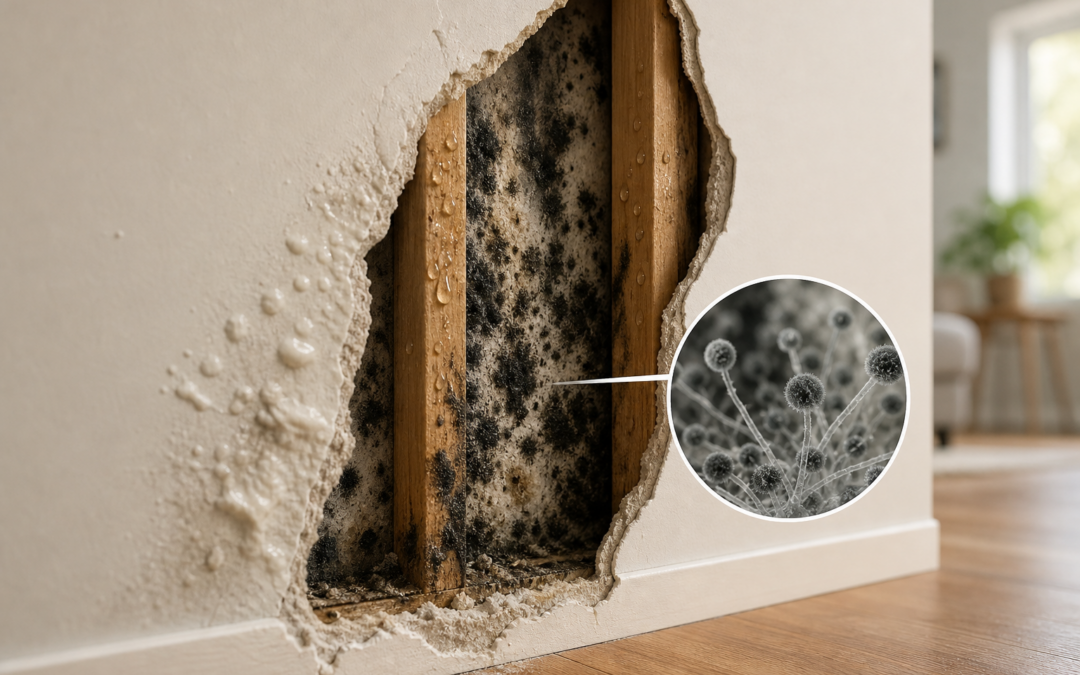
Mold behind drywall grows within 24 to 48 hours of moisture exposure and often hides until paint bubbles, soft spots appear, or a musty odor develops. Small patches under 10 square feet may be manageable yourself; larger or black mold infestations require professional remediation to protect your health and prevent spread.
Hidden mold is a common problem in South Florida homes, where humidity and seasonal storms create near-constant moisture risk. It can stay out of sight for weeks while quietly weakening drywall, rotting framing, and releasing spores into the air your family breathes. This guide covers every stage: spotting the warning signs, understanding the health risks, deciding whether to clean or replace, and knowing when to call a professional.
How to Spot Mold Behind Drywall
Mold behind drywall rarely announces itself with a visible patch. It usually shows up as a cluster of subtle clues that are easy to dismiss until the problem has spread.
According to moldguide.com's 2026 data, at least 45 million buildings in the U.S. carry unhealthy mold levels, which means hidden growth is far more common than most homeowners expect. Knowing what to look for can help you catch it early.
Watch for these warning signs, working from the most obvious to the most subtle:
- Musty or earthy odor. A persistent smell that doesn't clear with ventilation, especially in bathrooms, basements, or rooms near exterior walls, is one of the earliest signs of mold growing out of sight.
- Bubbling, cracking, or peeling paint. Moisture trapped behind the wall surface breaks the bond between paint and drywall. Bubbles or blisters that keep returning after repainting point to an ongoing moisture problem underneath.
- Soft or spongy wall texture. Press gently along the wall surface. Drywall that flexes, feels damp, or gives slightly under pressure has likely absorbed water, and mold may already be colonizing the paper facing.
- Discoloration or staining. Yellow, brown, or grayish stains that bleed through paint, especially in corners or near baseboards, often trace back to moisture wicking through from the cavity behind.
- Warped or buckled drywall. Panels that bow outward or show uneven seams have usually been wet long enough for the gypsum core to swell, which means mold has had time to establish itself.
- Allergy symptoms that improve when you leave home. Sneezing, eye irritation, or a runny nose that clears up when you spend time outside can signal airborne spores circulating indoors.
For a broader look at how mold presents in different areas of the home, the Royal Mold Specialist mold identification blog covers additional scenarios and inspection guidance.
If you notice two or more of these signs together, treat that combination as a strong indicator that mold is present and move to the next steps in this guide.
Is Mold Behind Drywall Dangerous to Your Health?
Yes, mold behind drywall poses real health risks, and those risks grow the longer exposure continues. Airborne spores and mycotoxins pass through wall gaps, outlets, and HVAC systems into the rooms where people live and sleep.
Respiratory effects are the most documented concern. A study of over 40,000 U.S. children found that nearly 11% of those living in mold-exposed homes developed asthma, compared to 7% in non-exposed homes, according to Harvard Health's 2025 report. Chronic exposure also inflames the upper airways, triggering persistent coughing, wheezing, and sinus congestion even in people without a prior diagnosis.
People with compromised immune systems, young children, and the elderly face the greatest risk of serious complications.
Black mold behind drywall draws particular concern. The term usually refers to Stachybotrys chartarum, a slow-growing species that thrives on wet cellulose materials like drywall paper and wood. A 2026 analysis of 1,300 air quality samples found Stachybotrys in 16% of cases, while Penicillium and Aspergillus, both capable of triggering respiratory illness, appeared in 38%. Black mold is not always the most common species, but it is among the most toxic and the hardest to remove without professional equipment.
Skin irritation, headaches, and eye redness are also reported by people living with hidden mold. If household members have unexplained symptoms that ease when they leave the building, mold exposure should be near the top of the list of possible causes.
Why the 24 to 48 Hour Window Matters for Mold Growth
Act within two days of any water intrusion. The EPA advises that water-damaged areas must be dried within 24 to 48 hours to prevent mold from taking hold. Miss that window, and spores already present on drywall paper, wood framing, and insulation have enough moisture and organic material to begin colonizing.
Drywall is particularly vulnerable because its paper facing is an ideal food source for mold. By the time paint starts to bubble or a smell develops, mold has often been growing for days or weeks.
The timeline matters for your decisions, too. Industry findings from Mold Remediation Hotline suggest that roughly 65% of drywall left wet for more than 72 hours cannot be cleaned and must be fully replaced. That figure represents a general industry pattern rather than a universal rule, but it illustrates how quickly the situation shifts from cleanable to replace-only.
Checking your home after any water event, a burst pipe, a roof leak, or even a prolonged stretch of high indoor humidity, within the first day is the single most effective thing you can do to keep a small moisture problem from becoming a mold problem.
Should You Clean or Replace Mold-Damaged Drywall?
Whether you clean or replace mold-damaged drywall depends on three factors: how much surface area is affected, how long the material stayed wet, and what condition the drywall is in now.
The EPA states that homeowners can typically handle mold cleanup themselves when the affected area is under 10 square feet, roughly the size of a standard interior door. Beyond that threshold, the scope of contamination and the risk of spreading spores during removal make professional remediation the safer choice.
Use the table below to match your situation to the right action.
| Condition | Recommended Action |
|---|---|
| Affected area under 10 sq ft, drywall firm | Clean with detergent; let dry fully before repainting |
| Affected area under 10 sq ft, drywall soft or crumbling | Replace the panel; drywall that has lost structural integrity cannot be cleaned reliably |
| Material was wet for more than 72 hours | Replace; industry findings suggest roughly 65% of cases in this category require full panel removal |
| Black or dark green mold visible on the surface | Call a professional; Stachybotrys and similar species require containment equipment |
| Mold has reached insulation or framing | Replace drywall and insulation; treat framing before closing the wall |
| HVAC ducts run through the affected cavity | Call a professional; disturbing the cavity can push spores through the duct system |
Two points are worth keeping in mind. First, every case is different: a wall that stayed wet for just over 72 hours in a well-ventilated space may fare better than one that stayed wet for the same period in a sealed cavity. Second, neither bleach nor vinegar fully penetrates porous drywall. Surface treatment may kill visible mold on the face of the panel, but spores embedded in the gypsum core or paper backing often survive, so when you are unsure whether cleaning is enough, replacement is the lower-risk option.
How to Remove Mold Behind Drywall: Step-by-Step
DIY removal is appropriate only when the affected area is under 10 square feet, the drywall is firm, and no black mold is present. If your situation meets those criteria, follow these steps in order.
-
Identify and fix the moisture source. Repair the leak, seal the intrusion point, or correct the drainage issue before touching the drywall. Removing mold without stopping the water guarantees it comes back.
-
Map the moisture boundaries and inspect the cavity. Use a pinless moisture meter to scan the wall surface at hand height. A pinless moisture meter reads elevated moisture levels without requiring you to cut into the wall first, so you can define the full wet zone before you start cutting. Drill a small inspection hole and use a borescope to look into the cavity and confirm the extent of mold growth.
-
Isolate the workspace. Seal the room with heavy-duty plastic sheeting across doorways and cover every HVAC vent in the area. Disturbing mold-covered drywall releases large numbers of spores into the air; containment keeps them from spreading to other rooms. Wear an N-95 respirator, safety glasses, and disposable gloves throughout.
-
Cut out the contaminated drywall. Extend your cuts at least 12 inches beyond the last visible sign of mold or water staining. Mold grows ahead of the visible edge, so cutting to the visible boundary alone leaves contaminated material behind. Score and snap rather than sawing aggressively to reduce airborne dust.
-
Remove and bag wet or moldy insulation. Seal all removed insulation and drywall pieces in heavy plastic bags before carrying them out of the room. Double-bag if the material is visibly moldy.
-
Clean the framing and dry the cavity. Scrub sound wood framing with detergent and water, then run a dehumidifier in the space until the wood reaches a moisture content at or below 16 percent. A pinless moisture meter confirms when you have hit that target. Do not close the wall before the framing reaches this level; sealing damp wood traps residual moisture and mold can restart.
Throughout the cutting and cleaning phases, use a HEPA vacuum to capture fine dust and spores from surfaces and from the air near the work area. A standard shop vacuum will not filter spores small enough to cause respiratory harm; a true HEPA-rated unit is required for this task, per inspectandtest.net.
Once framing reads at or below 16 percent moisture and shows no remaining mold, the cavity is ready for new insulation and drywall.
Choosing Mold-Resistant Drywall When You Rebuild
Standard drywall has a paper facing on both sides, and that paper is exactly what mold feeds on. When you close the wall after remediation, replacing standard panels with mold-resistant drywall removes that food source and reduces the chance of recurrence.
Two broad categories of mold-resistant drywall are available at most building supply stores.
Moisture-resistant gypsum board (sometimes called "green board" or "blue board") uses a treated paper facing and a moisture-resistant gypsum core. It performs better than standard drywall in humid conditions, but the paper facing still provides some organic material that mold can colonize if the wall gets wet again. It is a reasonable upgrade for low-risk areas like laundry rooms or interior bathroom walls.
Paperless fiberglass-faced board replaces the paper facing entirely with a fiberglass mat. Because fiberglass is inorganic, it gives mold almost nothing to feed on. These panels cost more than moisture-resistant gypsum board, but they are the better choice for any wall that has a history of moisture problems, sits on an exterior surface, or is near plumbing. Products in this category are sold under several brand names; the most important distinction is facing material and core composition, not brand.
Pair whichever board you choose with mold-resistant joint compound and primer at the seams and fastener dimples, since those spots absorb moisture first and can undermine an otherwise sound repair.
When Should You Call a Professional Mold Remediation Company?
Some mold situations go beyond what a homeowner can safely handle. Recognizing those triggers early prevents a manageable problem from becoming a serious one.
Call a professional when any of the following apply:
- The affected area is 10 square feet or larger. The EPA's guidance sets this as the upper limit for DIY cleanup. Above that size, the volume of disturbed spores and the complexity of containment make professional equipment and training necessary.
- You see or suspect black mold behind drywall. Stachybotrys and similar dark-colored species require full containment protocols and specialized disposal that go beyond standard DIY methods.
- HVAC ducts run through or near the affected wall cavity. Opening that cavity without proper containment can push spores through the duct system and into every room in the house.
- Household members are experiencing respiratory symptoms, fatigue, or persistent headaches that ease when they leave the building. Active health effects mean the exposure level is already high enough to warrant professional assessment.
- The moisture source was a sewage backup or contaminated water. Category 3 water intrusions introduce pathogens alongside mold and require a different remediation approach entirely.
- The mold has reached structural framing across a wide area, or you cannot confirm the full extent of growth.
Royal Mold Specialist is a mold inspection and remediation company that has served residential and commercial properties across more than 20 cities in South Florida for over 15 years. Trained technicians handle everything from the initial inspection through full remediation, water damage treatment, and sanitizing. You can book an appointment online or by phone.
Prices and plan limits verified as of October 2026.
FAQs
Can mold grow through drywall and spread to other rooms?
Mold does not physically push through solid drywall, but it spreads through spores. Spores travel through gaps around electrical outlets, HVAC vents, and unsealed wall penetrations, and once airborne they can settle and colonize in adjacent rooms if moisture is present. This is why containment during removal matters: disturbing mold-covered drywall without sealing the workspace releases large numbers of spores that can establish new growth elsewhere in the home.
Is bleach or vinegar more effective at killing black mold on surfaces?
Neither bleach nor vinegar fully penetrates porous materials like drywall. Both can kill mold on hard, non-porous surfaces such as tile or glass, but on drywall, the active ingredient cannot reach spores embedded in the gypsum core or paper backing. Surface treatment may remove visible growth while leaving viable spores behind. For mold on drywall, the more reliable fix is removal and replacement of the affected panel rather than surface treatment with either product.
What are common signs of mold toxicity in people living in an affected home?
Symptoms linked to mold exposure include persistent coughing, wheezing, sinus congestion, eye and skin irritation, headaches, fatigue, and difficulty concentrating. These overlap with many other conditions, which makes mold exposure easy to miss. Watch for symptoms that improve noticeably when a person spends extended time outside the home or travels overnight, then return when they come back. That pattern points to an indoor air quality problem worth investigating.
What time of year is mold growth behind walls most likely to worsen?
In South Florida, mold risk stays elevated year-round because of high baseline humidity, but it peaks during hurricane season, roughly June through November. Heavy rain events, roof leaks, and storm-driven water intrusion all create the moisture conditions mold needs. Warm indoor temperatures combined with high outdoor humidity also make it harder to keep wall cavities dry even without a direct leak. After any storm that brings water into contact with your walls, inspect within 24 to 48 hours.
How long does professional mold remediation typically take?
The timeline depends on the size of the affected area and how far the mold has spread. A contained single-wall repair in one room often takes one to three days. Larger infestations involving multiple rooms, structural framing, or HVAC systems can take a week or more. The drying phase, where framing must reach a safe moisture level before the wall is closed, often determines the total duration. A professional remediation company can give you a more specific estimate after an initial inspection.
Conclusion
Mold behind drywall is a hidden problem that moves fast. Spores begin colonizing within 24 to 48 hours of moisture exposure, drywall left wet beyond 72 hours often needs full replacement, and the health effects of chronic exposure range from respiratory inflammation to fatigue and cognitive symptoms. Patches under 10 square feet on firm, dry drywall are manageable with careful DIY work; anything larger, darker, or tied to ongoing symptoms warrants professional help.
Your next step depends on what you found. If you spotted one or two warning signs, start with a moisture meter scan to define the wet zone before cutting anything. If the area is large, the mold is dark, or people in the home are already feeling effects, skip the DIY assessment and book a professional inspection. Getting the moisture source fixed first, before any drywall work, is the one step that applies in every case.