Hire an air duct cleaner who holds NADCA certification, employs at least one certified ASCS, proves contamination with a camera inspection before starting, and puts the full scope and total cost in writing. Skip ultra-cheap whole-house specials. And clean your ducts only when you see mold, pests, or heavy renovation dust.
Air duct cleaning is a high-scam, low-regulation purchase. No federal license exists, and a van with a logo proves nothing. The steps below walk you through vetting a company in the order you do it, so you spend money only when the job is justified and only with someone who can show their work. Each step builds on the one before it.
Does Cleaning Air Ducts Really Make a Difference?
Cleaning makes a real difference when your ducts hold a specific problem, and very little difference when they don't. Routine, calendar-based cleaning is where most of the upselling happens.
Cleaning is justified when you can point to one of these triggers:
- Visible mold. Growth you can see inside ducts or on the vent covers, or a persistent musty smell when the system runs.
- Pests. Droppings, nesting material, or evidence that rodents or insects got into the ductwork.
- Heavy renovation dust. Drywall dust or construction debris pulled into the system during a remodel.
Without one of those, a few years of normal dust is not an emergency. Be skeptical of any company that tells you your ducts are "full of contaminants" over the phone, before anyone has looked inside.
Be careful with health promises too. A company that guarantees relief from asthma or allergy symptoms is selling a claim nobody has proven.
The business side explains the pressure you may feel. According to Dataintelo's report, the global air duct cleaning market reached $6.1 billion in 2025 and is projected to hit $10.39 billion by 2034. Dataintelo is a vendor, and the number says nothing about whether cleaning works. It does tell you a lot of companies want your booking, which is why vetting matters.
Step 1: Build a Shortlist of Local Air Duct Cleaners
Start by finding three to five local companies you can compare. Search online for air duct cleaners in your city, then cross-check against the NADCA directory (NADCA is the National Air Duct Cleaners Association, the industry's main trade group) [S1].
The market is crowded. One industry database counts 23,663 air duct cleaning businesses in the U.S. as of late 2026, and Florida holds the largest share, roughly 13.4% of all such businesses. In South Florida you will find no shortage of options, and that is the problem: more choices means more low-quality operators competing on price.
If you also see national names while you search, here is how they differ:
- DUCTZ. A franchise that does only HVAC cleaning and restoration, using high-powered vacuums with HEPA filtration (a filter that traps very small particles).
- Stanley Steemer. Known for customer service and a large national footprint, but duct cleaning is often sold as a secondary service to its carpet cleaning.
- ServPro. Offers duct cleaning within a wider disaster restoration business that includes mold and water damage. As a franchise network, quality and staffing can vary a lot between independently owned locations.
- The Home Depot (Pro Referral). A referral service, not a cleaner. It matches you with local professionals and verifies their licenses and insurance, though the pros are independent contractors.
None of these is an automatic pick, and a franchise name does not replace the checks in the next steps. Treat each company on your shortlist, national or local, the same way: confirm credentials, ask for proof, and get terms in writing.
Steps 2 and 3: Do You Need a Certified Duct Cleaner?
You are not legally required to hire a certified cleaner, because certification is not required in most places. That is exactly why you should check. With no license standing between you and an untrained operator, credentials are the best quality signal you have.
Two credentials matter:
- NADCA membership. Confirm the company holds a NADCA certification [S2]. NADCA sets cleaning standards for the industry, and members agree to follow them.
- A certified ASCS on staff. An ASCS (Air Systems Cleaning Specialist) is an individual who has passed NADCA's technical exam. Ask whether at least one ASCS works at the company [S3]. A company can be a NADCA member without anyone on the crew holding this credential.
Verification takes five minutes. Look the company up in the NADCA directory instead of trusting a logo, since logos are easy to copy. Then ask for the ASCS holder's name and who will actually be at your house on the day.
Ask the questions plainly. A legitimate company answers without hesitation. Skip any company that gets vague or defensive, or that says certification "doesn't really matter." It matters because no one else is checking.
Passing these two checks does not prove the work will be good. The camera inspection in Step 4 is where you test that.
Step 4: Ask for a Camera Inspection Before Any Work Begins
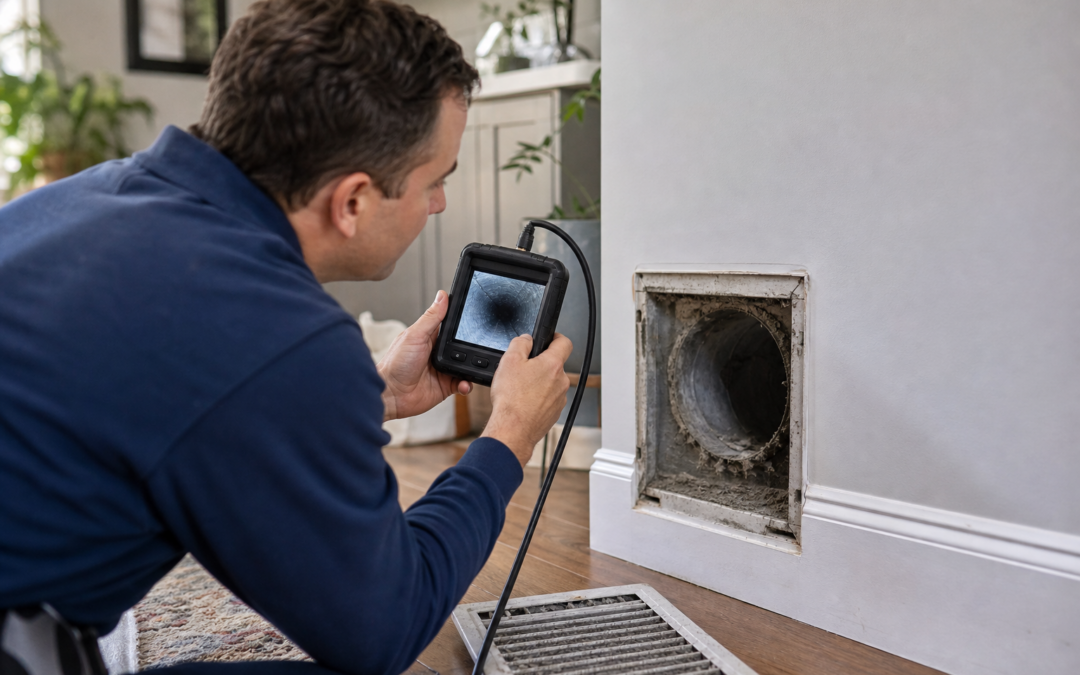
A reputable cleaner shows you the problem before charging you to fix it. Ask for a visual inspection of your ducts with a camera, so you can see contamination on screen before any work begins [S4]. A technician feeds a small camera through a vent or access point and shows you the footage or photos. If the ducts look clean, you've saved yourself a bill.
Treat a company that refuses to show you anything as a red flag. "Trust us, it's bad in there" is not evidence.
Ask how the company cleans your type of ductwork. The method differs, and a good technician explains why:
- Rigid metal ducts. These tolerate agitation tools and brushes that loosen debris for the vacuum to pull out.
- Flexible ducts. These have a thin inner lining that tears easily. Aggressive brushing can damage it, so technicians use gentler methods or recommend replacing badly contaminated runs.
Be cautious with chemical add-ons. The EPA generally warns against chemical biocides (products that kill microbes) and duct sealants (coatings sprayed inside to lock in dust) because there's little evidence they help and the risks to your indoor air haven't been settled. If a company pushes either as standard, ask what problem it solves. If the answer is vague, decline.
A camera also tells you whether the problem is dust or something bigger. Visible mold growth is a different job, covered below.
Step 5: How Much Does Duct Cleaning Cost and What Goes in Writing?
Expect to pay a few hundred dollars for a typical home, and more for a full heating and cooling system with many runs. Angi data shows most homeowners pay about $390, with a typical range of $271 to $509. The EPA estimates professional cleaning of a full heating and cooling system at $450 to $1,000. Providers commonly price by size at $0.15 to $0.30 per square foot.
Run the same math for a 2,000 sq ft house and the size-based pricing lands between $300 and $600. That sits at or below the low end of the EPA's full-system estimate, which makes sense: a smaller or simpler system costs less than one with many runs.
A price that falls far below these ranges usually means a rushed job or an upsell waiting after the technician arrives. A price far above them deserves an itemized explanation.
Once you pick a company, obtain a written agreement before anyone starts [S5]. It should list:
- Scope. Every supply vent, return vent, and the furnace or air handler, plus any dryer vent if you want it included.
- Total cost. One number, with no per-vent surprises added on site.
- Method and equipment. Whether the company uses a negative-pressure vacuum and what it does to protect your flooring.
- Add-ons. Any biocide or sealant, listed separately so you can refuse it.
- Credentials. The NADCA certification and the ASCS holder's name.
If the company won't put the scope and total in writing, walk away.
Red Flags That Signal a Duct Cleaning Scam
Scams in this industry follow familiar patterns. Use this list on the phone, on the doorstep, or while you read an estimate:
- Cheap whole-house specials. A flat, rock-bottom price for the entire house is usually a hook. The real price appears once the technician is inside, with add-ons stacked on top. Compare it against the ranges in Step 5.
- No camera inspection. If no one will show you the inside of your ducts, you can't verify that cleaning is needed or done.
- Scare tactics. Claims that your ducts are full of mold or "toxic" dust, made before anyone has inspected them.
- Unsolicited visits or calls. Door-knockers and cold callers offering a free inspection often work from a script built to find something wrong.
- Pressure to decide today. Legitimate companies give you time to compare quotes.
- Health guarantees. Promises to cure allergies or asthma have no solid research behind them.
- Vague credentials. A NADCA logo with no directory listing, or no ASCS they can name.
- Mandatory add-ons. Biocide sprays or sealants presented as required rather than optional.
One more point, since it comes up in the dryer vent conversation: dryer vents are a separate job from HVAC ducts, and a legitimate company will say so. The National Fire Protection Association attributes 32 percent of residential dryer fires, about 4,470 incidents a year, to failing to clean the equipment. That statistic is about dryer vent cleaning, not your air ducts, so don't let anyone use it to sell you a whole-house duct package.
When It’s Mold, Not Dust: Standard Cleaning vs. Decontamination
Standard air duct cleaning removes dust and debris. Decontamination deals with something that grows, such as mold or, in older buildings, asbestos-containing material. The two jobs call for different training, containment, and protocols, and a duct cleaner's vacuum and brushes are built for the first one only.
If your camera inspection shows visible mold, don't book a routine cleaning. Brushing and vacuuming a contaminated duct can spread spores through the rest of the system. The moisture source feeding the growth, often a slow condensate leak or sweating ductwork in South Florida's humidity, has to be found and fixed first. Otherwise the mold returns.
That is mold remediation, and it's where a specialist like Royal Mold Specialist fits. Royal Mold Specialist is a Florida mold remediation company that inspects for mold, identifies the moisture source, and remediates affected areas. It does not do routine air duct cleaning, so it isn't a pick for the dust-only job in the steps above.
Dryer vents are their own category. They are a separate, fire-relevant cleaning job, and a company that quotes your ducts doesn't automatically cover them. Ask for dryer vent service by name, in writing.
FAQs
Does cleaning air ducts really make a difference?
It does when your ducts hold a specific problem, such as visible mold, pests, or heavy renovation dust. Without one of those triggers, routine cleaning offers little proven benefit. A camera inspection before any work tells you which situation you're in.
Do you need to be certified to do duct cleaning?
No. Certification isn't legally required in most places, and no federal license exists. That makes credentials your best quality signal. Look for NADCA membership and at least one certified ASCS on staff, and verify both in the NADCA directory rather than trusting a logo.
Does Lowe’s do dryer vent cleaning?
We can't confirm that from the sources behind this guide, so call your local store and ask. For comparison, The Home Depot's Pro Referral matches homeowners with independent local professionals for duct and dryer vent cleaning. Whoever you choose, get the dryer vent job listed separately in the written agreement.
Does duct cleaning improve allergies or other medical conditions?
Some people notice less dust after a cleaning, but no solid evidence shows it relieves allergies or asthma. Treat any company that guarantees health results as a red flag, and talk to your doctor about symptoms.
Are chemical biocides or sealants safe to use in my ducts?
The EPA generally cautions against them. Little evidence shows they help, and how they affect your indoor air hasn't been settled. If a company lists a biocide or sealant as standard, ask what problem it solves, and decline it when the answer is vague.
Is cleaning flexible ductwork different from cleaning rigid metal ducts?
Yes. Rigid metal ducts tolerate brushes and agitation tools. Flexible ducts have a thin lining that tears easily, so technicians use gentler methods or recommend replacing badly contaminated runs. Ask how a company handles your duct type before you hire it.
Conclusion
Hire an air duct cleaner only if your ducts have a real problem: visible mold, pests, or heavy renovation dust. Then pick a company with NADCA membership, a certified ASCS on staff, a camera inspection before work, and the full scope and total price in writing. If the camera shows mold, call a remediation specialist instead of booking a standard cleaning.
Before you book anyone, look up the company in the NADCA directory and ask for the ASCS holder's name. Then ask for the camera inspection before you agree to any price.