
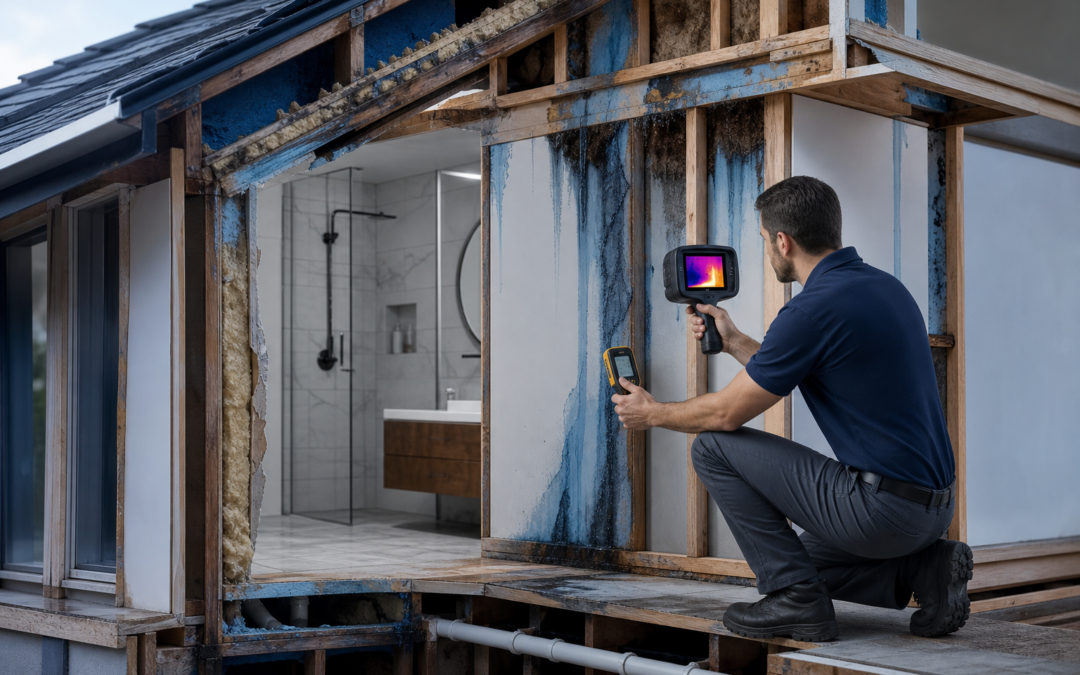
A water intrusion specialist is a forensic investigator trained to find the exact source of moisture penetration using tools like thermal imaging and ASTM-standard testing, not just patch visible damage. To choose the right one, verify IICRC or PCA credentials, confirm they follow ASTM E2128, and ensure they provide a written investigation report before any repairs begin.
Most water damage problems look simple on the surface. A stain on the ceiling, a damp baseboard, a musty smell after rain. By the time those signs appear, water has often been moving through your building envelope for months. Hiring the wrong professional means paying to fix the wrong thing. This guide walks you through five concrete steps to find a specialist who will locate the actual source, document it properly, and give you a report you can use.
What Does a Water Intrusion Specialist Actually Do?
A water intrusion specialist investigates the cause and path of moisture penetration. That is a different job from fixing a burst pipe or patching a roof. The distinction matters when you are trying to stop a problem that keeps coming back.
A plumber follows water to a mechanical failure: a cracked fitting, a failed valve, a corroded supply line. A general contractor patches what is visible and moves on. A water intrusion specialist works like a forensic investigator, tracing moisture back through the building envelope to its origin. That origin is often a failure point that is completely out of sight.
Common failure points include window and door flashing that was installed incorrectly, parapet walls on flat commercial roofs where coping caps have separated, deteriorated sealant joints at curtain walls, and gaps in the building envelope where two different materials meet. Water rarely enters where it shows up. It travels along framing, behind cladding, and through capillary action before it becomes visible.
The benchmark for this investigation work is ASTM E2128, a standard published by ASTM International that defines how a forensic water intrusion investigation should be structured. A specialist following this standard does not guess. They build a documented case: review construction records, map moisture, isolate leak paths through controlled testing, and probe only when the evidence supports it.
This forensic approach matters because roughly 14,000 U.S. residents deal with a water damage emergency every day. Many of those cases involve repeat failures because the original moisture source was never correctly identified. A specialist's job is to make sure that does not happen to you.
Step 1: Verify Credentials, Licensing, and Insurance
Credentials tell you whether a specialist has been trained to a recognized standard. Before you schedule an inspection, confirm each of the following.
- IICRC certification. The IICRC (Institute of Inspection, Cleaning and Restoration Certification) certifies technicians in moisture science and drying protocols. Ask which specific credential the specialist holds and verify it directly with the IICRC.
- Forensic or building envelope credentials. Beyond IICRC, look for specialists who hold a building envelope or forensic consultant designation from a recognized trade organization. Ask the specialist directly which credentialing body issued their certification and verify it with that body.
- State contractor licensing. Florida requires contractors to hold a state license issued by the Department of Business and Professional Regulation. Ask for the license number and check it at the DBPR's online lookup. An unlicensed specialist cannot legally perform certain types of work in Florida, and you have no recourse if something goes wrong.
- General liability insurance. Confirm they carry general liability coverage. Ask for a certificate of insurance naming you as an additional insured for the duration of the investigation. This protects you if controlled destructive probing causes incidental damage.
- Errors and omissions (E&O) insurance. A forensic specialist who produces written reports that influence insurance claims or litigation should carry E&O coverage. This is standard for independent forensic consultants. If they do not have it, ask why.
Finding the right specialist means going beyond a Google search. Ask for references from past forensic investigations, not just repair jobs. Request a sample report so you can see how they document findings.
Step 2: Confirm They Follow a Recognized Investigation Standard
A qualified specialist follows a structured sequence, not a walk-around and a guess. ASTM E2128 is the standard that defines this sequence for evaluating water leakage in building walls. Here is what a compliant investigation looks like, in the order it happens:
-
Review building design and construction documents to understand the original water management plan. This tells the specialist what was intended, so they can identify where execution or materials deviated from that intent.
-
Perform a visual inspection and moisture mapping to document the extent of water penetration. This step uses moisture meters and, where appropriate, thermal imaging to find wet areas that are not yet visible to the eye.
-
Create a written test plan that isolates specific possible leak paths using recognized standards. The test plan names which areas will be tested, which methods will be used, and what results would confirm or rule out each hypothesis.
-
Analyze results and perform controlled destructive probes if necessary to see internal framing and flashing. Probes are small, targeted openings made only where the evidence already points. A specialist who opens walls before completing steps one through three is not following a forensic process.
-
Develop a remediation plan and repair scope based on the verified cause of failure. The repair scope should follow directly from the documented findings, not from a general estimate of what might be wrong.
Ask any candidate whether they follow ASTM E2128 by name. If they are unfamiliar with it, that tells you something. The standard exists precisely to separate systematic investigation from surface-level guesswork. A specialist who cannot show you a prior written investigation report is not doing forensic work.
Step 3: Ask About Diagnostic Technology
The tools a specialist brings reveal how thorough the investigation will be. A visual inspection alone misses most of what matters. Moisture travels behind walls, under flooring, and through structural cavities long before it surfaces. The right equipment is what separates a forensic investigation from a contractor's walk-through.
Three technologies matter most.
Thermal imaging. An infrared camera detects temperature differences across wall and ceiling surfaces. Wet materials retain heat differently than dry ones, so a thermal scan can show moisture patterns that are completely invisible to the eye. This is not a definitive moisture test on its own, but it tells the specialist exactly where to focus the next steps. Ask whether they use a calibrated infrared camera and whether they will include thermal images in the written report.
Moisture meters and mapping. Pin-type and pinless moisture meters give actual readings at specific locations. A qualified specialist does not take one reading and move on. They map moisture levels across the affected area systematically, creating a documented baseline that shows the extent of penetration and helps track whether conditions improve after remediation.
Controlled water testing. When a window, door, or curtain wall is a suspected failure point, controlled water spray testing under recognized standards isolates specific components to confirm or rule out each as a leak source. Not every investigation requires it, but when it applies, it produces objective, reproducible results. A specialist who relies only on visual observation and skips controlled testing cannot give you a defensible cause-and-origin finding.
Ask every candidate for a written equipment list before you hire them. If they cannot name the standards their testing follows, their findings will not hold up in an insurance dispute or litigation.
Step 4: Choose Between an Independent Tester and a Repair Contractor
Some water intrusion specialists do only investigation and reporting. Others investigate and then perform the repairs. Neither model is wrong, but each fits different situations. Understanding the trade-offs helps you choose the right structure for your job.
Water damage and freezing accounted for 27.6% of all homeowners insurance claims in 2022, and the average claim for water damage reached $15,400 between 2019 and 2023. At that dollar level, the quality and objectivity of your investigation report can determine whether your claim is paid in full, disputed, or denied.
Use this table to match your situation to the right model.
| Factor | Independent Forensic Tester | Specialist Who Also Repairs |
|---|---|---|
| Objectivity | High, no financial stake in repair scope | Potential conflict of interest; ask for itemized findings |
| Best for | Litigation, insurance disputes, large commercial buildings | Residential jobs where speed and single-vendor convenience matter |
| Report detail | Typically delivers a full written forensic report | Quality varies; always request a written cause-and-origin report |
| Cost structure | Fee for investigation only | Investigation may be bundled with or waived toward repair contract |
If your situation involves an insurance dispute, a lawsuit, or a large commercial building where the repair contract will be substantial, an independent tester removes any question of bias. Their report carries more weight precisely because they have no financial stake in what the repairs cost.
For a residential property where you want one company to find the problem and fix it, a specialist who also performs remediation can work well, provided you require a written cause-and-origin report before any repair work begins. Never accept a bundled proposal where the investigation findings are folded into a repair estimate without being documented separately.
Step 5: Use Your Specialist’s Report to Support an Insurance Claim
A written investigation report is not just a summary of findings. It establishes cause and origin, and insurers require that documentation to process a water damage claim correctly.
The average water damage claim runs $15,400, and national data suggests that 15 to 25% of water damage insurance claims are denied by carriers, with documentation gaps as a leading reason. The policyholder cannot show when the damage started, what caused it, or whether it resulted from a sudden event versus long-term neglect. A forensic specialist's report addresses all three directly.
Here is what the report needs to include to be useful for a claim:
- A documented moisture map showing the extent and location of water penetration at the time of investigation
- Photographic and thermal imaging evidence tied to specific locations in the building
- A clear statement of cause and origin: what failed, where, and why
- Test results from any controlled water spray testing or other diagnostic testing performed
- A timeline, where the evidence supports one, showing when the failure likely began
Submit the report to your insurer before repairs start. Carriers can dispute a claim far more easily once the physical evidence has been altered by repair work. Your specialist's findings, documented before the first wall is opened, give the insurer what they need to evaluate the claim and give you a record if it is challenged.
For complex claims, consider hiring a public adjuster who can use the forensic report to negotiate on your behalf. You can also review Does Insurance Cover Mold Remediation in Florida Homes? for guidance on what Florida policies typically cover when water damage leads to mold growth.
When to Call a Mold and Water Damage Remediation Company
A forensic investigation tells you where water entered and why. What it cannot do is remediate the damage that moisture left behind. Once your specialist's report confirms the cause, the next question is whether mold or structural damage has already taken hold.
Mold begins growing within 24 to 48 hours of moisture exposure. By the time a water intrusion investigation is complete, affected materials may already be colonized, even if nothing is visible yet. That is when you need a remediation company, not just a repair contractor.
Royal Mold Specialist is a mold and water damage remediation company that sends trained technicians to inspect, remediate, and eliminate mold in residential and commercial properties across more than 20 cities in South Florida. The company handles the full sequence after investigation: mold inspection, containment, full remediation, water damage treatment, and sanitizing. South Florida's humidity and storm season accelerate mold growth after a water intrusion event, so a remediation company working in the region should be equipped to respond quickly once a forensic report confirms moisture in porous materials. For properties across the region, water damage Dade County response is part of what the company covers.
If your specialist's report shows moisture penetration into porous materials like drywall, insulation, or wood framing, schedule a mold inspection before repairs seal those areas off. You can also explore professional mold remediation services in South Florida to understand what that process involves.
FAQs
How much does a water intrusion investigation typically cost?
Investigation costs vary based on building size, the number of suspected leak points, and whether controlled testing like ASTM E1105 water spray testing is required. Residential forensic investigations generally run less than commercial ones, where multiple facade systems and larger square footage increase the scope. Always get a written fee agreement before work begins, and confirm whether the investigation fee applies toward any repair contract.
How can I find where an underground water line is leaking?
Underground leaks require specialized acoustic detection equipment that picks up the sound of pressurized water escaping a pipe. A water intrusion specialist handles building envelope failures, not pressurized supply lines, so an underground leak typically falls to a licensed plumber with leak detection equipment. If that leak has caused moisture to migrate into your foundation or slab, a forensic specialist can document the secondary damage once the plumber confirms the source.
How do I stop water intrusion in a basement or crawl space?
You stop it by finding the moisture source first. Basement and crawl space water comes from three places: surface water migrating through the foundation, condensation from humid air, or a plumbing failure. A specialist maps moisture levels and traces the path before recommending a fix. Applying sealant or installing a sump pump before the source is confirmed treats the symptom and leaves the cause intact.
What are the most common building envelope failure points?
The most common failure points are window and door flashing installed without proper overlap or sealant, parapet walls on flat roofs where coping caps have separated or sealant has cracked, curtain wall joints where dissimilar materials meet and movement has broken the seal, and penetrations through the exterior wall for pipes, conduit, or HVAC equipment that were never properly flashed. In South Florida, hurricane-season wind-driven rain puts all of these under pressure simultaneously, which is why failures that were dormant for years can surface after a single storm.
Does homeowners insurance cover water intrusion damage?
Coverage depends on cause and origin. Sudden, accidental water damage from a burst pipe or storm-driven intrusion is typically covered. Long-term seepage or damage from deferred maintenance is typically excluded. That distinction is exactly why a forensic specialist's report matters: it documents when the failure began and what caused it, which is the information your insurer needs to classify the claim. Between 15 and 25% of water damage insurance claims are denied, and documentation gaps are a leading reason.
Conclusion
Choosing the right water intrusion specialist comes down to three things: verified credentials, a structured investigation process that follows ASTM E2128, and a written cause-and-origin report before any repairs begin. A specialist who skips any of those three steps is doing repair work, not forensic investigation.
Start by confirming state licensing and IICRC certification, then ask directly whether the candidate follows ASTM E2128 and can show you a sample investigation report. If your findings reveal mold or moisture damage in porous materials, line up a remediation company before repairs seal those areas off. The report your specialist produces is the most useful document you will have, whether you are filing an insurance claim, negotiating repairs, or making sure the problem does not come back.
If your findings reveal mold or moisture damage in porous materials, line up a remediation company before repairs seal those areas off.