When you search for a water damage restoration service near me, the results flood your screen fast, but the right choice depends on scope, speed, and what the local crew can actually do. The top five services are SERVPRO, ServiceMaster Restore, PuroClean, Paul Davis Restoration, and 911 Restoration. Each offers 24/7 emergency response, technicians trained to industry standards, and insurance claim support, but they differ in reconstruction depth and technology. Match your choice to the scope of your damage, not just the brand name.
How Do You Choose the Right Water Damage Restoration Service Near Me?
Water damage moves fast. The longer standing water sits, the deeper it seeps into subfloors, wall cavities, and framing, and the harder the job becomes. Choosing the wrong company adds time and cost you cannot afford.
This list ranks five national restoration companies on four criteria: emergency availability, technician certification (IICRC stands for Institute of Inspection, Cleaning and Restoration Certification, the industry's primary credentialing body), reconstruction scope, and insurance claim support. SERVPRO ranks first because it scores well across all four and has the widest geographic coverage. Each step down the list reflects a narrower scope, a more specialized focus, or less consistent availability. The ranking falls from there based on how many criteria each service meets and how completely it meets them.
A few things to know before you hire. National franchises vary by location, and the profiles below note where that variation is most likely to affect you. If you need water damage restoration in Dade County, the local coverage and response time of whoever shows up matters as much as the corporate name on the truck.
According to poidata.io's 2026 report, there are 22,410 verified water damage restoration businesses operating in the United States, and Florida accounts for 11.2% of all active services nationally. More options means more room for error. Use this comparison to narrow the field.
Comparison Table: Top 5 Water Damage Restoration Services
Before diving into each profile, here is a side-by-side snapshot across the criteria that matter most at the moment of hiring.
| Service | Emergency Availability | IICRC Certified | Reconstruction Scope | Insurance Support | Price Tier |
|---|---|---|---|---|---|
| SERVPRO | 24/7 | Verify locally | Full reconstruction | Yes | Budget-tier |
| ServiceMaster Restore | 24/7 | Verify locally | Full reconstruction | Yes | Premium-tier |
| PuroClean | 24/7 | Verify locally | Mitigation and drying | Yes | Budget-tier |
| Paul Davis Restoration | 24/7 | Verify locally | Full reconstruction + in-house rebuild | Yes | Not publicly listed |
| 911 Restoration | 24/7 | Verify locally | Mitigation-focused | Yes | Not publicly listed |
IICRC certification is the standard to confirm with any provider before you sign a contract. Ask for documentation at the initial call, not after work begins.
1. SERVPRO: Nationwide Network With 24/7 Emergency Response
SERVPRO ranks first because of its combination of scale, speed, and full-service capability. With franchises across every major metro area, it is the most likely of the five to have a crew available within hours, not days. That speed matters most when you are dealing with a burst pipe, appliance failure, or storm intrusion that is still spreading.
The service covers water extraction, structural drying, mold remediation, and full reconstruction. SERVPRO uses proprietary DryBook software to log moisture readings at each stage, which creates a documented drying record your insurance adjuster can use directly. That documentation often shortens the claims process.
A few honest caveats. SERVPRO franchises are independently owned, so quality varies by location. Some customers report difficulty resolving disputes with local franchise owners when work falls short. Pricing sits at a budget-tier level for the category, but per modernize.com and bukrestoration.com, it can run higher than competitors depending on the scope and the franchise.
Before you book, call the local franchise directly and ask two questions: how soon can a crew arrive, and does the technician carry current IICRC credentials? A reputable franchise answers both without hesitation. If the answer is vague, that tells you something.
For large-scale emergencies, SERVPRO's national logistics network means it can mobilize equipment from neighboring markets when local capacity is stretched, which is a real advantage after a regional storm event.
2. ServiceMaster Restore: Premium Full-Service Restoration
ServiceMaster Restore ranks second because it covers the full scope of damage, from emergency mitigation through final reconstruction, and pairs that with dedicated insurance claim assistance. Where SERVPRO competes on speed and scale, ServiceMaster competes on depth of service and documentation.
The company handles water, fire, and mold damage under one roof. That matters when a single event causes overlapping damage types, which is common after a major storm intrusion or a slow leak that went undetected long enough to feed mold growth. Rather than coordinating two separate contractors, you work with one team from extraction through rebuild.
Insurance documentation is a core part of what ServiceMaster Restore provides. Getting a full payout depends on thorough documentation: moisture maps, photo logs, and written scope of work that adjusters can verify. ServiceMaster's process is built around producing that paper trail at every stage.
The tradeoffs are real. ServiceMaster Restore operates across 2,000-plus U.S. locations, and service consistency varies across that network, per modernize.com and bobvila.com. After a regional disaster, crews can be stretched thin and response times may slip. Pricing sits at a premium-tier level, which reflects the comprehensive service model but may exceed what a straightforward water loss actually requires.
If your damage involves multiple systems, a large affected area, or a complex insurance claim, ServiceMaster Restore's full-service approach justifies the premium. For a contained water loss with clear cause and minimal structural impact, a faster, leaner option may serve you better.
3. PuroClean: Rapid Response With Thermal Imaging Technology
PuroClean ranks third on the strength of its technology and its focus on speed at the assessment stage. Most restoration companies arrive, look around, and estimate. PuroClean uses thermal imaging cameras and moisture-tracking equipment to map exactly where water has traveled inside walls, under floors, and behind ceilings before any work begins.
That matters because hidden moisture is where long-term damage originates. Water that reaches a wall cavity but never gets extracted feeds structural decay and creates conditions for mold to take hold, often out of sight for weeks. Catching it on day one changes the outcome.
The company specializes in rapid water extraction and structural drying, and it gives customers real-time access to drying logs through an online portal. You can see the moisture readings at each monitoring point as the drying progresses, which also gives your insurance adjuster a timestamped record without waiting for a final report.
PuroClean's pricing sits at a budget-tier level for standard clean-water losses, per modernize.com and bukrestoration.com. Category 3 events, meaning sewage or contaminated water, carry higher costs because of the biohazard protocols involved. That is standard across the industry, not specific to PuroClean.
The service model is mitigation and drying focused rather than full reconstruction. If your damage requires structural rebuilding after the water is gone, you may need a second contractor. For water intrusion where the primary goal is fast, thorough extraction and verified drying, PuroClean's thermal imaging approach gives it a clear edge over companies that rely on visual inspection alone.
4. Paul Davis Restoration: Integrated Mitigation and Full Reconstruction
Paul Davis Restoration ranks fourth, and it is the strongest option on this list for major structural damage. The distinction is in-house capacity. Paul Davis staffs carpenters and restoration technicians under the same company, so the crew that extracts water and dries the structure is connected to the crew that rebuilds it. No handoff to a subcontractor, no gap between mitigation and reconstruction.
That integration matters when the scope of damage is serious. FEMA data shows that as little as one inch of floodwater can cause $25,000 in damage to a standard home. At that scale, coordinating separate mitigation and construction contractors adds time, creates accountability gaps, and complicates insurance documentation. Paul Davis eliminates that problem by keeping the entire project under one scope of work.
Insurers recognize this. Per modernize.com and bukrestoration.com, Paul Davis is often the preferred option for large-loss claims that require heavy reconstruction, because a single contractor managing the full project simplifies the adjuster's review.
Pricing is not publicly listed, which is common for large-loss specialists whose scopes vary widely by project. Get a written estimate before work begins and confirm what is included from extraction through final rebuild.
The one limitation is that Paul Davis's strength is also its scope. For a contained water loss that needs only extraction and drying, the integrated model may be more than the job requires. But if you are looking at gutted walls, damaged framing, or flooring that needs full replacement, Paul Davis handles the entire project without the coordination risk that comes with splitting the work.
5. 911 Restoration: Fresh Start Approach for Water, Fire, and Mold
911 Restoration ranks fifth, and it is the right call when the human side of a property emergency matters as much as the technical side. The company built its service model around what it calls a "Fresh Start" approach, which means technicians are trained to treat customers as people in a stressful situation, not just as a job ticket.
The service covers water damage mitigation, fire and smoke cleanup, and mold remediation. That multi-hazard coverage is useful when a single event causes overlapping damage, such as a roof intrusion that brings water and then mold, or a kitchen fire that leaves both smoke and water damage behind.
911 Restoration operates 24/7 and responds to emergencies around the clock. Where it differs from Paul Davis and ServiceMaster is in scope. This is a mitigation-focused service, not a full reconstruction operation. Once the water is extracted, the structure is dried, and the affected materials are removed, you may need a separate contractor to rebuild. That is worth knowing before you call.
Pricing is not publicly listed, per bestpickreports.com, modernize.com, and angi.com. Get a written estimate at the assessment stage and confirm exactly what the quote covers.
For homeowners who want a responsive, supportive crew that handles the immediate crisis well, 911 Restoration delivers. For large-scale structural losses that need full reconstruction, look higher on this list.
What Does a Water Damage Restoration Service Near Me Actually Do?
Every company on this list follows the same basic sequence, whether they call it mitigation, remediation, or restoration. Knowing the steps lets you ask better questions and catch a crew that skips one.
The worldwide property restoration market was valued at $32.5 billion in 2023. That scale reflects how many homes and businesses go through this process each year, and how standardized it has become. Industry reports also show that labor shortages currently affect 75 percent of property restoration companies, which is why asking about crew availability before you book matters.
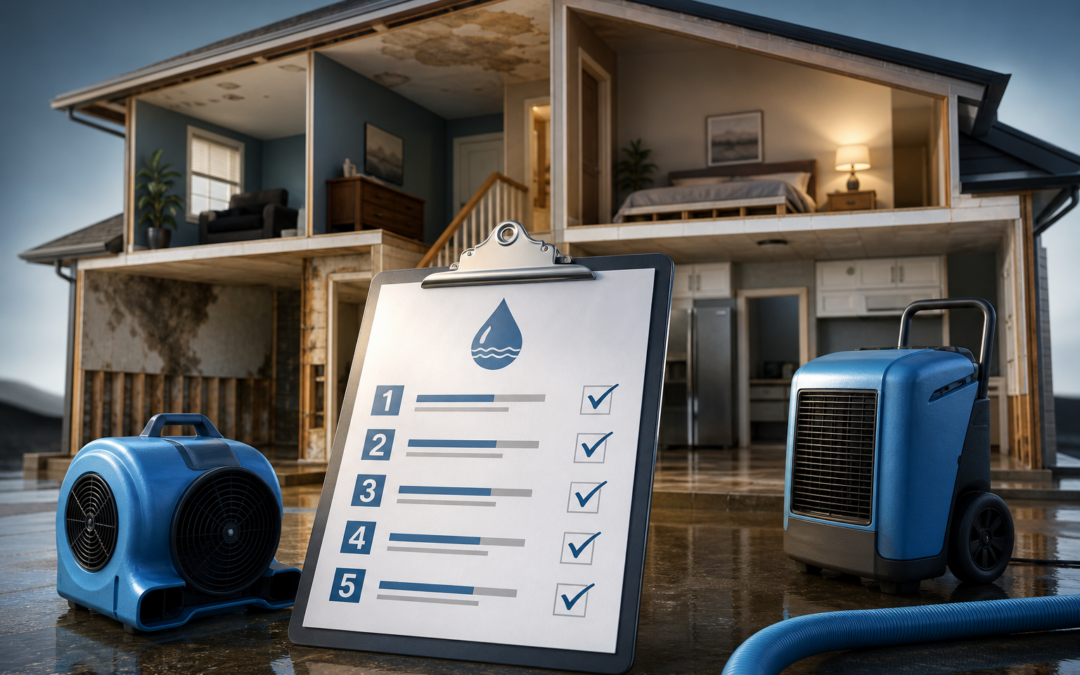
Here is what a professional crew does from arrival to rebuild:
- Shut off the source. The technician stops the water at its origin and cuts circuit breakers for all wet areas before anyone enters.
- Assess and document. The crew inspects, photographs, and moisture-maps the affected area. This documentation goes directly to your insurance adjuster.
- Extract standing water. High-powered pumps and truck-mounted vacuum units pull out standing water before it seeps further into subfloors and wall cavities.
- Dry and clean. Industrial air movers and dehumidifiers target hidden moisture inside walls and under floors. All surfaces are cleaned to industry standards to prevent mold from taking hold.
- Rebuild. Damaged materials are replaced and the property is restored to its pre-loss condition.
If you are dealing with water damage in South Florida specifically, Royal Mold Specialist handles water damage treatment, mold remediation, and sanitizing for residential and commercial properties across more than 20 cities in the region. For a step-by-step action plan after a water event, see What to Do After Water Damage in South Florida: A 2026 Action Plan.
Prices and plan limits verified as of October 2026.
FAQs
How long does water damage restoration take?
The timeline depends on the scope of damage and how quickly the crew arrives. The mitigation and drying phase requires industrial equipment running continuously until moisture readings return to baseline, which varies by the size of the affected area, the materials involved, and how long the water sat before extraction. Ask any provider for a projected drying timeline at the assessment stage, not after work begins.
How fast does mold grow after a basement flood?
Mold can begin developing within a short window after moisture exposure, which is why extraction speed matters. The longer water sits in a basement or wall cavity, the higher the risk. If your basement flooded, treat it as an emergency, not a weekend project. For more on the timeline specific to South Florida's humidity, see Water Damage in Miami: How Quickly Mold Starts and Who to Call.
How much does it cost to repair water damage in a home?
Costs vary widely based on the source of water, the affected area, and whether reconstruction is needed. According to FloodPro's 2026 report, the typical homeowners insurance claim for water or freeze damage is $13,954, but that figure reflects insurance payouts, not a fixed repair cost. Get itemized written estimates from at least two providers before authorizing work.
What is the best way to clean up after a flood?
Stop the water source first, then call a licensed restoration company before you move anything. Do not run fans or open windows before a professional assesses the damage, as improper airflow can spread contaminated particles. A trained crew will extract, dry, and sanitize in the correct sequence. Attempting to clean up a significant flood without professional equipment typically leaves hidden moisture that causes structural and mold problems later.
Does homeowners insurance cover water damage restoration?
Coverage depends on the cause and your specific policy. Contact your insurer immediately after a water event and document everything before work begins. Restoration companies like ServiceMaster Restore and SERVPRO are experienced in working directly with adjusters and can help produce the moisture maps and photo logs that support a claim.
What is the difference between water mitigation and water restoration?
Mitigation stops the damage from spreading: extracting water, drying the structure, and removing unsalvageable materials. Restoration brings the property back to its pre-loss condition, which includes rebuilding walls, replacing flooring, and finishing surfaces. Some companies on this list handle both; others focus on mitigation and hand off reconstruction to a separate contractor. Confirm the full scope before you sign anything.
Conclusion
The five services ranked here, SERVPRO, ServiceMaster Restore, PuroClean, Paul Davis Restoration, and 911 Restoration, all offer 24/7 emergency response and insurance claim support. Where they differ is in reconstruction depth, technology, and how their local franchises actually perform. For a contained water loss, PuroClean's thermal imaging finds hidden moisture fast and its online portal gives your adjuster timestamped drying logs without waiting for a final report. SERVPRO's DryBook software produces a documented moisture record at each stage that adjusters can use directly. For major structural damage, Paul Davis handles the full project without splitting it across contractors. ServiceMaster Restore fits complex, multi-system damage with a premium service model. 911 Restoration is the right fit when you want a responsive, supportive crew for the mitigation phase.
Before you call anyone, ask three questions: how soon can a crew arrive, does the technician carry a current IICRC certificate you can see before work starts, and will you receive a written, itemized estimate that separates extraction, drying, and reconstruction costs? In South Florida, add a fourth: has the company handled Category 3 contaminated-water losses or storm-surge events in the region? A crew that has worked through hurricane season here will have the dehumidification capacity and mold-protocol experience that a standard water loss in a drier climate does not demand.