Mold remediation alone is not proof that your property is safe. Post-remediation mold testing, also called Post-Remediation Verification (PRV), is an independent inspection performed after mold cleanup to confirm that all visible growth is gone, moisture levels are normal, and indoor air spore counts match outdoor baseline levels. Without it, you have no documented proof the remediation actually worked.
A contractor can tell you the job is done. A clearance test proves it.
What Is Post-Remediation Verification (PRV)?
Post-Remediation Verification is a structured inspection that confirms a mold remediation was completed to an acceptable standard. It is not part of the cleanup itself. PRV happens after the remediation crew has finished and cleared the work area.
The purpose is to give you an objective, documented result: either the property meets clearance criteria, or it does not. That distinction matters for your health and for your own records.
Industry data shows that mold remediation success rates typically range between 70 and 95 percent (70–95%) when following standard IICRC S520 procedures and passing verification. IICRC S520 is the professional standard for mold remediation published by the Institute of Inspection, Cleaning and Restoration Certification. That range means a meaningful percentage of jobs do not pass the first time. Without PRV, you would never know.
For a broader look at what a full inspection involves before and after remediation, see the Royal Mold Specialist mold inspection guide. Royal Mold Specialist, at royalmoldfl.com, provides independent mold inspection and post-remediation verification services in South Florida.
Why Third-Party Independence Matters for Post-Remediation Mold Testing
The company that cleaned the mold should not be the one confirming the mold is gone. That is a direct conflict of interest, and it is the most important reason to hire an independent tester.
When the same contractor handles both remediation and clearance testing, there is no check on the result. An independent tester has no financial stake in whether the property passes or fails. Their only job is to report what they find, which is what makes a clearance report credible to insurers, buyers, and health authorities.
According to Zipdo's 2026 report, 45 percent of U.S. households have mold levels that exceed recommended indoor air safety thresholds. That figure suggests mold problems are often underreported or undiscovered, which makes unbiased testing even more important.
Several independent testing services operate specifically to fill this role. Holistic Environmental Solutions uses PIDs (photoionization detectors), particle counters, and data loggers for indoor air quality assessments, and emphasizes that it does not perform remediation, keeping its inspections unbiased. Mold Inspectors USA conducts moisture detection with thermal imaging and tests for VOCs (volatile organic compounds) and MVOCs (microbial volatile organic compounds), using third-party labs for results. Mr Mold Inspection offers mold inspection and moisture detection using advanced detection technology, though it operates primarily out of Ventura, CA, so availability varies by region. In all three cases, the value is the same: the tester has no stake in the outcome.
How Does Post-Remediation Mold Testing Work? A Step-by-Step Walkthrough
A PRV follows a specific sequence. Skipping any step leaves a gap in the verification. Here is the order a qualified technician performs them:
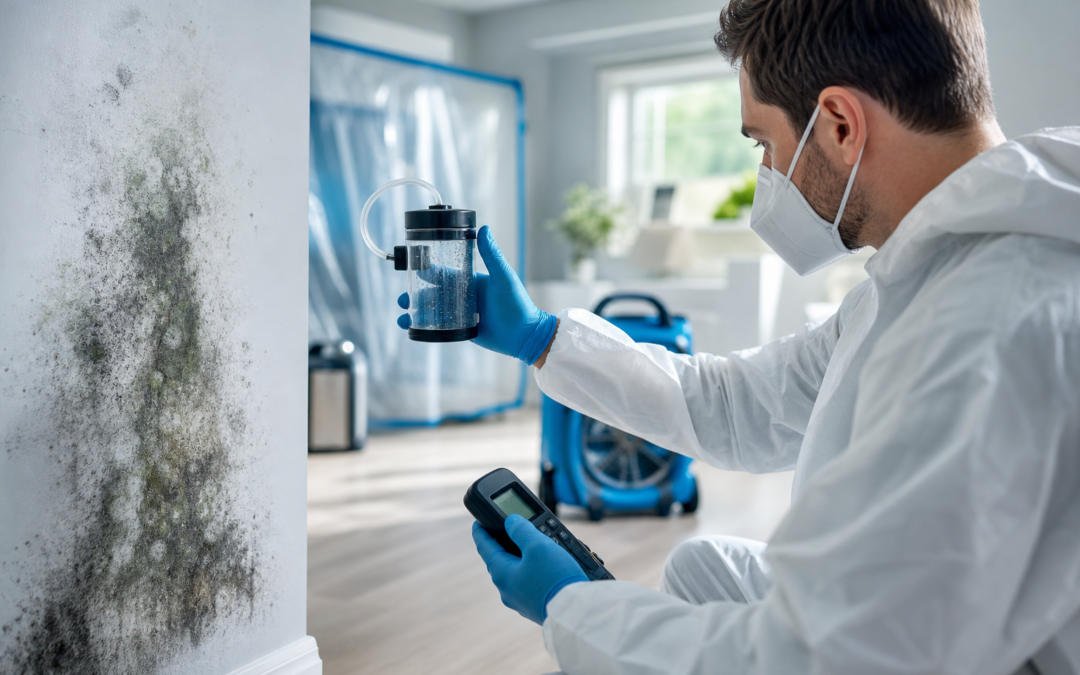
- Perform a visual inspection to confirm all mold growth, debris, and dust are removed to a white-glove standard. No visible growth or residue should remain on any surface inside the affected area.
- Verify moisture levels in remaining building materials are at or below dry-standard targets. Elevated moisture in drywall, wood framing, or subfloor is a sign that conditions still favor regrowth, even if no mold is currently visible.
- Collect air samples inside the containment area and collect a simultaneous outdoor control sample. The outdoor sample establishes the baseline spore count for that day and location.
- Submit samples to an accredited laboratory for spore identification and enumeration. An accredited lab identifies which species are present and at what concentrations.
- Issue a final clearance report confirming that visual, moisture, and air criteria have all been met. This document is your proof of successful remediation.
The indoor-to-outdoor comparison in step three is the core of the air quality test. If indoor spore counts are significantly higher than outdoor counts, or if a species found indoors is absent from the outdoor sample, the property has not cleared. The goal is for indoor air to reflect the same conditions as the air outside, with no unusual species present.
Do Seasonal Changes Affect Pass/Fail Thresholds?
Yes, and this is a detail many homeowners miss. The outdoor baseline spore count shifts throughout the year, and that shift directly affects how indoor results are interpreted.
Zipdo's 2026 report notes that late summer outdoor mold spore counts average around 5,000 spores per cubic meter. In cooler months, outdoor counts drop considerably. Because the indoor-to-outdoor comparison is relative, a test taken in late summer is evaluated against a much higher natural baseline than one taken in January.
In South Florida, this matters year-round. The region's humidity and warm temperatures keep outdoor spore counts elevated even outside peak season, which means the natural baseline a tester measures against is higher here than in most of the country. A clearance test taken right after hurricane season, when outdoor air is already loaded with spores, will produce a higher acceptable indoor threshold than one taken in a drier month. That does not make the test easier to pass; it means the comparison must be made carefully against that day's actual outdoor sample. This is not a reason to delay testing, but it is a reason to use a tester who documents the outdoor control sample and knows how to interpret results against South Florida's elevated year-round baseline.
The pass/fail threshold is not a single universal number. It depends on the testing protocol, the species identified, and the outdoor baseline on the day of the test. There is no fixed spore count that applies to every situation.
Does Your State Require a Licensed Inspector for Clearance Testing?
Licensing requirements for mold inspectors and clearance testers vary significantly by state. Some states require specific mold-related licenses for anyone performing testing or remediation. Others regulate the field under broader contractor or environmental consultant categories. A few have no dedicated mold licensing requirements at all.
Before you hire anyone for post-remediation clearance testing, verify their credentials for your state. Ask for their license number and confirm it with the relevant state agency. You should also ask whether the tester carries errors and omissions insurance, which protects you if the clearance report turns out to be inaccurate. For Florida specifically, understanding how certifications work is worth your time before you hire anyone. The article on how mold remediation certifications work in Florida covers what to look for and why it matters.
When Should You Call a Professional Mold Testing Service Near You?
If you have completed mold remediation and have no clearance report, call a professional now. You are re-occupying a space without documented proof it is safe. That applies whether the remediation was done by a contractor or handled as a DIY project.
Attic mold is a common example in South Florida: by the time you notice staining on ceiling drywall, growth in the attic cavity has often been spreading for months.
The global mold remediation services market was valued at $1.1 billion in 2024. Demand for professional testing has grown alongside it.
A qualified local service handles everything from initial inspection through full remediation and post-remediation verification, and can book appointments online or by phone.
FAQs
How do mold testers test for mold?
A mold tester performs a visual inspection, checks moisture levels with a moisture meter, and collects air samples using spore trap cassettes. Those samples go to an accredited lab, which identifies and counts the spore types present. The tester compares indoor counts to an outdoor control sample collected the same day to determine whether the indoor environment is within an acceptable range.
Is a home considered uninhabitable if mold is found?
Not automatically. The answer depends on the extent of the growth, the species identified, and whether the moisture source has been addressed. Widespread growth from a water-intrusion event, or the confirmed presence of certain species like Stachybotrys, may prompt a recommendation to vacate during remediation. A qualified inspector assesses the scope and advises you on whether temporary relocation is necessary.
How long does mold remediation remain effective?
Remediation removes existing growth, but it does not prevent future growth. If the moisture source returns, mold can take hold again within 24 to 48 hours. Fixing the underlying problem, whether that is a roof leak, HVAC condensation, or a plumbing failure, is what makes the remediation last.
What are the symptoms of toxic mold exposure?
Common symptoms include nasal congestion, coughing, throat irritation, eye irritation, and skin rashes. People with asthma or mold allergies often experience more severe respiratory reactions. Prolonged exposure to certain species, such as Stachybotrys chartarum, has been associated with more serious health effects. If you suspect mold exposure is affecting your health, consult a physician and arrange for a professional inspection of your property.
What happens if a property fails post-remediation clearance testing?
The remediation contractor returns to address whatever caused the failure, whether that is remaining visible growth, elevated moisture, or elevated indoor spore counts. After the additional work is done, a second clearance test is performed. The property cannot be cleared for re-occupancy until it passes all visual, moisture, and air criteria. This is exactly why an independent tester matters: they have no reason to pass a property that should not pass.
Conclusion
Post-remediation mold testing is the only way to confirm that a cleanup actually worked. Remediation removes the visible problem. PRV documents that the air, the surfaces, and the moisture levels in your property all meet clearance criteria, and gives you a report you can use for insurance, real estate, or your own records.
If you have recently had mold remediation done without a clearance test, arrange one before you assume the problem is resolved. Confirm the tester is independent from whoever did the remediation work, then verify their credentials for your state. That combination, independence plus verified credentials, is what makes a clearance result worth having.