
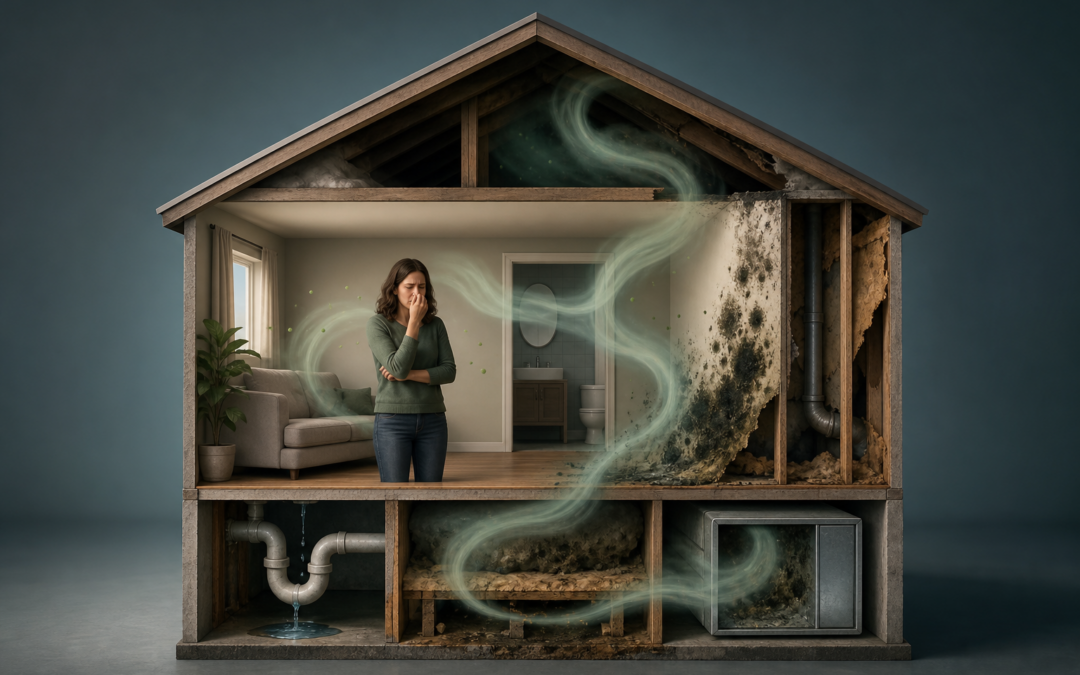
A mould smell is the musty, earthy odor released by gases that growing mold gives off, and it almost always signals hidden moisture. The usual sources are leaks, condensation and high humidity behind walls, under bath panels, in soft materials and inside HVAC systems. Trace the dampness, dry it, and clean or remove what stays contaminated.
You don't need to see mold to know it's there. By the time a patch shows up on a wall, the smell has usually been telling you something for weeks.
This guide explains where that smell comes from, why some buildings hold onto it, and how to trace it to its source in a South Florida home.
What Does Mould Smell Like, and What Does It Mean?
Mould smell is a damp, earthy, stale odor, often compared to wet cardboard, old basement air, or rotting wood. It gets stronger in closed rooms and weaker when you open windows, then returns once the air settles.
The odor is not the mold itself. Growing mold releases microbial volatile organic compounds, or mVOCs. These are gases the organism gives off as it feeds and grows. Volatile means they evaporate easily into the air, which is why you can smell mold you can't see behind drywall or under flooring.
So what is the smell telling you? Two things:
- Moisture is present. Mold needs water to grow. A persistent musty odor means some material in your home is staying damp.
- Something is actively growing. Fresh mVOCs come from living colonies, not just old stains.
The scent varies because mold is not one organism. The Washington State Department of Health notes there are more than 100,000 different species of mold. That variety is why a musty smell can feel earthy in one room and sour in another. It doesn't mean each species has its own signature odor, so don't try to diagnose the type by nose alone.
A faint smell does not mean a small problem. Hidden growth inside a wall cavity can produce a steady odor with nothing visible on the surface.
Why Older Homes Can Smell Moldy: Chloroanisoles and Building Materials
Some buildings smell moldy even after the visible mold is gone. One documented reason is a group of compounds called chloroanisoles. These form when microbes act on chlorophenols, chemicals once used as wood preservatives, in older treated lumber and building materials. The result is a strong, musty odor that can linger in the structure itself.
Most smells in South Florida homes still trace back to plain moisture and active growth.
They are stubborn because your nose picks them up at tiny concentrations. Research published in the International Journal of Environmental Research and Public Health found that the chemical 2,4,6-triCA, which causes a moldy odor, can be detected at 13 ng/m 3 (nanograms per cubic meter of air). That is a vanishingly small amount. In the same 2020 research, air samples from buildings with odor problems showed a mean indoor concentration of 9 ng/m 3 of chloroanisoles. Those levels sit close to the detection point, which helps explain why a house can smell off when nothing looks wrong.
Older construction details make this worse. Crawl spaces, slab edges that wick ground moisture, and wall cavities that can't dry out all hold dampness against wood and drywall. Treated lumber that stays damp gives microbes the conditions to produce these compounds. If your home was built decades ago and the smell survives cleaning, the materials themselves may be holding it.
What Causes a Mould Smell in the House?
Mould smell in a house comes from moisture that stays put long enough for mold to take hold. In South Florida, with humid air and a summer storm season, that happens faster than most people expect.
These are the common moisture sources:
- Plumbing leaks. Slow drips under sinks, behind toilets, and inside walls keep drywall and wood damp for weeks without any visible sign.
- Roof and window leaks. A failed seal or damaged flashing lets storm water into wall cavities and ceilings.
- Condensation. Warm, humid air meets cold surfaces such as air conditioning ducts, cold pipes, and windows, and water forms on them.
- HVAC condensate problems. A clogged drain line or sweating duct feeds moisture into insulation and framing.
- High indoor humidity. Cooking, showers, and unvented dryers load the air with moisture that settles into soft materials.
- Flooding or water damage. Materials that stay wet after a spill or storm become a growth site quickly.
Timing matters. The US EPA states that water-damaged materials and areas must be dried within 24-48 hours to stop mold from growing. After that window, you are no longer preventing mold. You are dealing with it.
Humidity is the other number to watch. Health Canada recommends keeping indoor relative humidity between 30% and 50% to prevent mold. A handheld humidity meter, called a hygrometer, reads this in any room and costs little at a hardware store. If a room sits above that range, you've likely found where the smell begins.
Where the Smell Comes From: A Room-by-Room Guide
Where the smell is strongest points to the likely hidden source. The table matches each location to its usual cause and the first thing to check, so you know where to start.
| Where it smells strongest | Likely hidden source | First thing to check |
|---|---|---|
| Bathroom | Leak behind the vanity, damp grout, or moisture trapped under a bath panel | Look under the sink and behind the bath panel with a flashlight. Press on the wall below the tub for soft spots. |
| Kitchen | Slow leak at the dishwasher, sink supply line, or refrigerator water line | Pull out the appliance and check the floor and cabinet backs for staining or warping. |
| Bedroom or closet | Condensation on an exterior wall, often behind a wardrobe or bed | Move furniture 4 to 6 inches off the wall and check the surface behind it. |
| Wall (no visible mold) | Plumbing leak or roof intrusion inside the cavity | Look for bubbling paint, a stain that returns after cleaning, or a warm, damp patch. |
| Near vents or the air handler | Sweating ducts, a clogged condensate line, or damp insulation | Check the drain pan and the vent covers for dark residue or standing water. |
| Laundry area | Washer hoses, an unvented dryer, or a damp floor behind the machines | Inspect hoses and the floor beneath the washer for moisture. |
| Garage or lower level | Ground moisture wicking through the slab, or stored boxes that absorbed damp | Place cardboard and fabric items on a shelf and check the slab edge for dark staining. |
A few of these deserve a closer look.
Bathroom. What does mold smell like in a bathroom? Usually a sour, wet-towel odor that gets stronger after a shower, because steam carries the gases into the air. A poorly vented bathroom holds that moisture against grout, caulk, and the wall behind them.
Inside walls. What does mould smell like in walls? Earthy and stale, with no visible source. The odor often gets stronger on humid afternoons or when the air conditioning cycles on and pushes air through the cavity. For more on what to watch for, see our guide on mold behind drywall.
Appliances. Dishwashers, washing machines, and refrigerator drip pans collect water and food residue. A smell that begins near an appliance and gets stronger when it runs points there first.
How to Find Hidden Mold Behind the Smell, Step by Step
Follow the smell, then check each place where water gathers or hides. Work in this order, and dry anything wet you find before moving on.
- Follow the smell. Walk through the house with windows closed and the air conditioning off for a few minutes. Note where the odor is strongest. Your nose gets used to a smell fast, so step outside and come back in to reset it.
- Check areas where water is used or plumbing is present. Look under sinks, behind toilets, around tub and shower surfaces, and around the water heater and washer. Check for stains, warped cabinet floors, peeling paint, and any spot that feels soft or cold to the touch.
- Check soft materials and the HVAC system for trapped dampness. Carpet, padding, mattresses, upholstery, and stored cardboard hold water and odor. Then inspect vents, the drain pan, and visible ductwork for moisture or dark buildup.
- Measure humidity. Place a handheld hygrometer in the room where the smell is strongest. Health Canada puts the target between 30% and 50%, so readings above 50% mean the air can feed mold. Take readings at different times of day, since humidity swings in South Florida.
- Protect yourself. If you open walls or disturb damp material, wear a properly fitted N95 respirator. A standard dust mask won't filter mold spores.
- Decide whether to call a professional. If the smell is strong but you can't find the source, or the wet area is larger than you can dry in a day or two, stop searching and get an inspection.
Who do you call for a musty smell in the house? Start with a mold inspector or a remediation company that tests and identifies the moisture source, not a general handyman who may wipe the surface and leave the cause behind. An experienced mold professional in Davie, FL can inspect hidden areas, sample the air, and tell you whether you have active growth or a lingering odor. For a fuller breakdown, read who to call for a musty smell in your house.
How do you test for hidden mold in a house? Visual checks and a hygrometer cover the basics. Moisture meters and air sampling by a technician go further, because they find dampness inside walls where your eyes can't reach.
Does Mold Smell Like Urine?
Mildew, a flat surface growth on damp tile and window sills, smells sharper and sourer than mold, which is deeper and earthier. If the odor fills a room and persists after cleaning, assume the growth reaches into the material. Our article on the mildew smell in your house covers the difference in more detail.
Does mold smell like urine? Sometimes people describe it that way, but mold itself does not produce a true ammonia or urine odor. If you smell something sharp and acrid, look for other causes first:
- Pet accidents soaked into carpet, padding, or subfloor.
- Rodent activity in walls, attics, or crawl spaces.
- Sewer gas from a dry drain trap or a damaged drain line, which smells like rotten eggs or sewage.
A sewage-like smell is a plumbing problem, not mold, so call a plumber.
Is Mould Smell Dangerous to Your Health?
A mould smell is a warning sign, but the smell alone doesn't tell you how dangerous the mold is. The odor comes from gases, and it can't tell you which species is growing or whether it is harming anyone. What the evidence supports is a general link between household mold exposure and breathing problems.
Here is the strongest finding. Harvard Health Publishing reports that 11% of children exposed to household mold had asthma, compared to 7% for those not exposed, in a 2025 report covering over 40,000 children. That is an association, not proof that mold caused each case, but it is a good reason to take a persistent smell seriously, especially with kids in the house.
People react differently. Some notice nothing. Others get stuffy noses, coughing, wheezing, or irritated eyes and skin, and anyone with asthma or allergies may feel it first. If symptoms ease when you leave the house and return when you come back, tell your doctor.
So treat the smell as a reason to find the moisture source, not as a diagnosis. For more on telling what you're dealing with, browse our mold identification and health articles.
How to Get Rid of Mould Smell for Good
You get rid of a mould smell by removing the moisture that feeds it, then cleaning or discarding what mold has already taken over. Cleaning without fixing the water source only buys you a few weeks before the smell returns. Real remediation finds and corrects the moisture source, while a surface wipe-down only hides the smell for a while.
Work through these steps in order:
- Fix the moisture source. Repair the leak, clear the clogged condensate line, seal the window, or correct the ventilation. Nothing else holds until this is done.
- Dry everything within the window. The EPA says water-damaged materials must be dried within 24-48 hours to stop mold from growing. Use fans, open windows when outdoor air is dry, and pull up soaked carpet and padding.
- Bring humidity down. Run a dehumidifier and keep the room in the target range. Check readings with your hygrometer, and empty and clean the dehumidifier's water tank regularly so it doesn't become a mold source itself.
- Clean hard surfaces. Scrub mold off tile, glass, sealed countertops, and other nonporous surfaces. A diluted chlorine bleach solution is one option for hard surfaces only. Never mix bleach with ammonia or any other cleaner, because the fumes are toxic. Wear an N95 respirator and ventilate the room while you work.
- Throw out contaminated porous materials. Bleach does not fix porous materials like drywall, ceiling tiles, insulation, carpet, and padding. Mold roots into them. If they are moldy or stayed wet past the drying window, they have to be removed and replaced.
- Give the room a few days. If the smell returns after you've dried and cleaned, there is more hidden dampness behind a surface. Go back to the tracing steps above.
Know when to stop. If the affected area is large, if the smell persists after drying, or if you suspect mold inside walls or the HVAC system, bring in a professional. Royal Mold Specialist is a mold remediation company that inspects for hidden moisture and mold, then handles remediation and water damage treatment for homes across South Florida.
Prices and plan limits verified as of November 2026.
FAQs
Does mold smell like urine?
Not usually. Mold smells musty and earthy, like damp soil or wet cardboard. A sharp, urine-like odor more often comes from pet accidents, rodents in walls or attics, or a plumbing problem. If you also smell sewage or notice slow drains, call a plumber before assuming it's mold.
Is mould smell dangerous to breathe?
The smell itself comes from gases that growing mold releases, and it signals that moisture and growth are present. Research links household mold exposure with asthma in children, though that is an association rather than proof of cause. If you have asthma, allergies, or symptoms that improve when you leave home, find the source quickly and talk to your doctor.
What is the difference between mildew and mold smell?
Mildew has a sharp, stale, sour smell, like a damp towel left in a bag, and it sits on surfaces such as shower tile. Mold smells deeper and earthier, and it often grows into materials like drywall and wood. A strong odor that survives cleaning points to growth that goes beyond the surface.
Who do I call for a musty smell in my house?
Start with a mold inspector or a remediation company that finds the moisture source, not just someone who wipes surfaces. If the smell comes with a plumbing leak or backup, call a plumber to stop the water first. For hidden mold in South Florida, a local mold specialist can inspect walls, ducts, and other spots you can't reach.
Can you have mold without smelling it?
Yes. A small or newly forming colony may not give off a noticeable odor, and your nose adapts to a smell you live with every day. Signs like water stains, peeling paint, warped materials, and a room that stays humid can reveal mold before any smell does.
How do I test for hidden mold in my house?
Start by following the smell and checking under sinks, around tubs, and near appliances. Measure room humidity with a hygrometer, and check HVAC drain pans and vents for moisture. For mold inside walls or ceilings, a professional can use moisture meters and air sampling to find what you can't see.
Conclusion
A mould smell means gases from growing mold are in your air, and that almost always points to moisture you haven't found yet. The odor can't tell you the species or how harmful it is, but it does tell you where to look: leaks, condensation, humid rooms, soft materials, and the HVAC system.
Start by following the smell and measuring humidity in the strongest room with a hygrometer. Dry anything wet within 24 to 48 hours, discard porous materials that stayed damp, and book an inspection if you can't find the source or the affected area is large.