- What Mold Testing Actually Measures
- How to Read the Numbers in Your Report
- Results That Should Prompt Immediate Action
- Results That May Not Require Remediation
- What South Florida Conditions Mean for Your Results
- What Happens After a Positive Result
- When to Skip the DIY Test Kit
- Frequently Asked Questions
If you've searched "mold testing near me" and booked an inspection, you've already done the hard part. Now you're staring at a report full of spore counts, species names, and lab reference ranges — and you're not sure whether to panic or relax.
Here's what those results actually mean, which numbers deserve your attention, and what to do next based on what the report says.
What Mold Testing Actually Measures
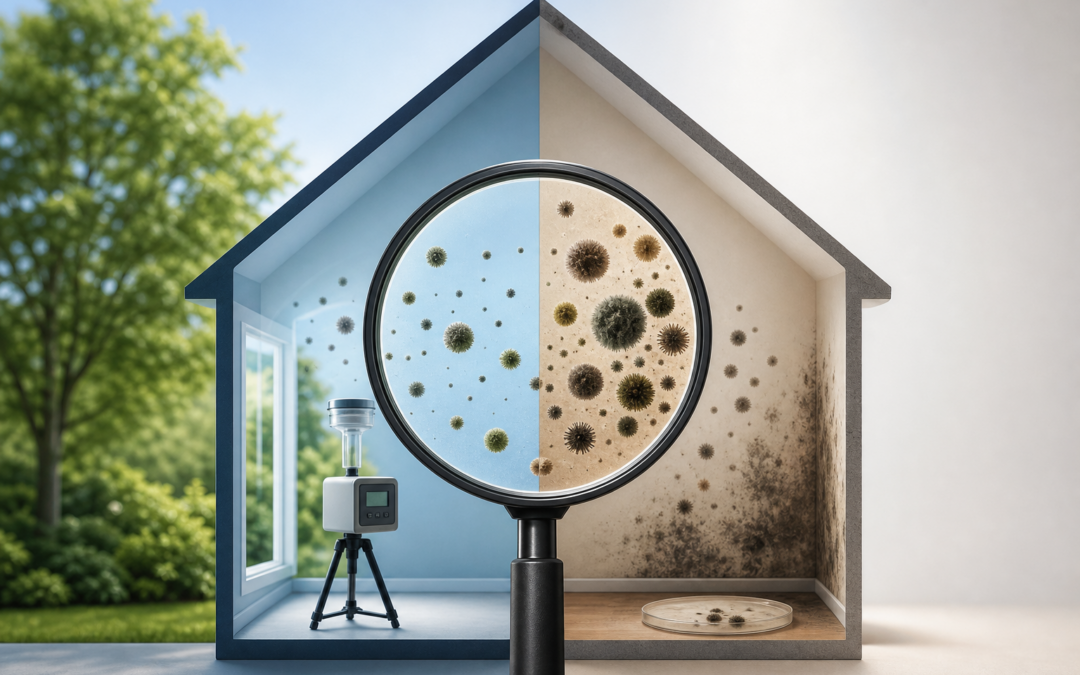
Mold testing doesn't just confirm whether mold is present. Almost every indoor environment contains some spores — that's completely normal. What testing measures is the type of mold, the concentration of spores, and how indoor levels compare to an outdoor baseline.
Most professional tests fall into one of three categories.
Air Sampling
Air samples are the most common method. A technician uses a pump to draw a measured volume of air through a collection cassette, which gets sent to a lab. The lab counts spores and identifies species under a microscope.
Your report will show spore counts per cubic meter of air, listed by room alongside an outdoor baseline reading. That comparison is the most important number on the page.
Surface Sampling (Swab or Tape Lift)
Surface samples target visible growth or stained areas. A swab or adhesive tape is pressed against the surface, sealed, and sent to the lab. The result tells you what species is present at that specific spot — but not how much is circulating in the air or how far it has spread.
Bulk Sampling
Bulk sampling involves removing a small piece of material — drywall, insulation, flooring — for lab analysis. Technicians use this method when they need to confirm whether visible discoloration is actually mold and to identify what species has grown into the building material.
How to Read the Numbers in Your Report
When air sample results come back, you'll see a table with columns for location, spore type, and raw count. Here's how to make sense of it.
The Indoor-to-Outdoor Ratio Is What Matters
A single spore count number means very little on its own. What matters is how your indoor readings compare to the outdoor sample taken at the same time.
If outdoor air shows 500 spores per cubic meter of a given species and your living room shows 450, that's normal. If your living room shows 4,500 of the same species, that's worth investigating.
As a general rule, indoor counts should be at or below outdoor counts for most species. When indoor levels are consistently higher — especially across multiple rooms — that points to an active indoor source.
Species Names and Why They Matter
Your report will list mold by species. Most are common environmental molds that turn up in nearly every home. A few carry more weight.
Stachybotrys chartarum is what most people call "black mold." It's slow-growing and requires sustained moisture to establish. Finding it in an air sample is relatively rare because its spores are heavy and don't become airborne easily. In a surface sample, though, it's a different story — it almost always means there's been prolonged water damage.
Aspergillus and Penicillium are grouped together in most lab reports because they look similar under a microscope. Both are extremely common outdoors, but elevated indoor counts — particularly in a basement, bathroom, or behind walls — often point to a moisture problem.
Cladosporium is one of the most common outdoor molds and usually not a concern at low levels. Elevated indoor counts can indicate poor ventilation or a water-damaged surface.
Chaetomium is less common but significant. It grows on wet cellulose materials like drywall paper and cardboard. Finding it in a sample almost always means water has gotten in somewhere.
What “Elevated” Actually Means
Labs use different reference ranges, and there's no single universal threshold that defines a "safe" spore count. What you're looking for is a pattern: Are indoor counts higher than outdoor counts? Are certain species showing up indoors that aren't present outdoors at all? Are multiple rooms affected?
Elevated counts in one room but not others help localize the source. Elevated counts throughout the house suggest the problem may be in the HVAC system or in a central area — an attic or crawl space — that distributes air everywhere.
Results That Should Prompt Immediate Action
Some findings are clear signals to move quickly.
Any detection of Stachybotrys in a surface or bulk sample warrants professional remediation. This species doesn't appear without a significant, sustained moisture source, and it won't go away on its own.
Chaetomium in an air or surface sample points to water-damaged building materials that need to be removed, not just cleaned.
Indoor spore counts that are three to five times higher than the outdoor baseline — for any species — indicate a meaningful indoor source that needs to be found and eliminated.
When multiple rooms show elevated counts of the same species, the source is likely in a shared air pathway, such as ductwork or an attic.
Results That May Not Require Remediation
Not every elevated reading calls for a full remediation project.
If a single room shows slightly elevated counts of a common species like Cladosporium and the rest of the home is normal, the cause might be straightforward: a bathroom with poor ventilation, a window left open during humid weather, or a houseplant sitting in wet soil. Improving airflow and fixing the moisture source may be enough.
Outdoor counts are also naturally higher during rainy season — which in South Florida is essentially every summer — so indoor counts will follow. Context matters.
This is why a professional inspector's interpretation is as important as the lab data itself. Numbers without context can lead you to either over-react or miss something real.
What South Florida Conditions Mean for Your Results
South Florida's climate creates a testing environment unlike most of the country. High humidity, frequent rain, and minimal seasonal temperature variation mean mold pressure here is elevated year-round. Outdoor spore counts across Miami-Dade, Broward, and Palm Beach Counties run consistently higher than in drier climates, which directly affects how you read the indoor-to-outdoor comparison.
A reading that would look alarming in Phoenix might be within normal range in Fort Lauderdale in August. At the same time, the same sustained humidity that raises outdoor counts also accelerates indoor mold growth the moment any moisture intrusion occurs. A small roof leak that would dry out in a week in an arid climate can produce active mold growth in 24 to 48 hours here.
Local expertise matters when interpreting these results. A technician who works exclusively in South Florida understands the regional baseline in a way that a national lab report alone simply can't convey.
What Happens After a Positive Result
If your results show a problem that needs professional attention, the next step is remediation — not just cleaning.
Wiping surfaces with bleach or other household products does not remove mold from porous materials like drywall, insulation, or wood framing. It may kill surface growth temporarily, but the mycelium embedded in the material stays put, and regrowth is likely unless the affected material is physically removed and the moisture source is corrected.
Professional remediation means containing the affected area to prevent cross-contamination, removing compromised materials, treating surfaces, and addressing the underlying moisture condition. After the work is done, a clearance test — another round of air sampling — confirms that spore counts have returned to normal.
If you're in South Florida and your results show a problem, Royal Mold Specialist handles the full process from inspection through remediation and post-remediation sanitizing, serving more than 20 cities across Broward, Miami-Dade, and Palm Beach Counties. With over 12 years focused exclusively on mold, the team interprets South Florida test results in the context of local conditions every day.
When to Skip the DIY Test Kit
Hardware store test kits are cheap, but their results are hard to interpret and easy to misread. Most use a petri dish you leave open in a room for a set period. The dish will almost always show some growth — because mold spores are everywhere. What the kit can't tell you is the concentration, the species, or whether what you're seeing is elevated relative to outdoor levels.
If you're making a real decision about your home or a property you're buying, a professional air sample analyzed by an accredited lab gives you results you can actually act on.
Frequently Asked Questions
What does it mean if my mold test shows Stachybotrys?
Stachybotrys, often called black mold, requires prolonged moisture to grow. Finding it in a surface or bulk sample is a strong indicator of sustained water damage. It warrants professional remediation rather than surface cleaning — it grows into porous materials and can't be removed by wiping alone.
Is some mold in an air sample normal?
Yes. Mold spores are present in virtually every indoor and outdoor environment. The question isn't whether spores are present but whether indoor counts are elevated compared to the outdoor baseline, and whether any species associated with water damage have shown up.
How many samples does a professional mold test include?
A thorough inspection typically includes at least one outdoor baseline sample and one or more indoor samples, with additional samples in areas of concern. More samples give you a clearer picture of where elevated counts are concentrated.
Can I get a mold test before buying a home?
Yes, and in South Florida it's a reasonable precaution. The climate creates conditions for mold growth year-round, and a pre-purchase mold test can reveal hidden moisture damage that a standard home inspection might not catch.
What is a clearance test and do I need one after remediation?
A clearance test is a post-remediation air sample taken after the work is complete. It confirms that spore counts have returned to normal levels. If you're selling a property or filing an insurance claim, a clearance test provides documented proof that the remediation was successful.
How long does it take to get mold test results back from a lab?
Most professional labs return results within two to five business days. Some offer rush processing for an additional fee. Your inspector should provide a written report that includes the raw data and an interpretation of what the findings mean for your specific property.
What's the difference between mold testing and mold inspection?
A mold inspection is a visual and physical assessment — the inspector looks for visible growth, moisture staining, musty odors, and conditions that favor mold growth. Mold testing involves collecting samples and sending them to a lab for analysis. Many inspections include testing, but a visual inspection alone can identify obvious problems without lab work, while testing can detect elevated spore levels in areas where nothing visible is present.