- Why Fort Lauderdale Properties Are Especially Vulnerable to Mold
- What Mold Remediation in Fort Lauderdale Actually Involves
- Services to Look For in a Fort Lauderdale Mold Company
- Mold Remediation Cost in Fort Lauderdale: What to Expect in 2026
- How to Choose a Mold Remediation Company in Fort Lauderdale
- What Happens If You Delay Mold Remediation
- Booking Mold Remediation in Fort Lauderdale
- Frequently Asked Questions
- Get the Problem Assessed and Fixed
Fort Lauderdale homeowners and property managers searching for mold remediation tend to want the same thing: the problem fixed right the first time. That's a reasonable expectation — and one that's harder to meet here than in most parts of the country. Between the year-round humidity, aging housing stock, and the frequency of water intrusion from storms and plumbing failures, surface treatments rarely hold. If you've spotted visible mold, noticed a persistent musty smell, or dealt with a recent water leak, this guide covers what professional remediation actually involves, what drives the cost, and how to book a qualified specialist in Fort Lauderdale.
Why Fort Lauderdale Properties Are Especially Vulnerable to Mold
Fort Lauderdale sits at roughly 80 percent average relative humidity for most of the year. That alone creates conditions where mold can establish itself in any space that stays damp for more than 24 to 48 hours. Layer in the city's mix of older construction, flat rooflines, and the regular threat of tropical storms pushing water through windows, walls, and foundations, and mold becomes a recurring problem rather than a one-time event.
Common triggers in Fort Lauderdale properties include:
- Roof leaks after heavy rain or hurricane-season storms
- AC condensate line failures, which saturate drywall and insulation quietly over weeks
- Plumbing leaks inside walls or under slabs
- Flooding from storm surge or localized flooding in low-lying neighborhoods
- Sewage backups following heavy rain events that overwhelm municipal systems
The concern most homeowners have is legitimate: a bleach spray or surface wipe-down won't eliminate mold that has grown into drywall, insulation, or wood framing. Professional remediation addresses the root cause, removes contaminated material, and treats the affected area so the problem doesn't come back in the next humidity cycle.
What Mold Remediation in Fort Lauderdale Actually Involves
Professional mold remediation follows a defined process. Understanding each phase makes it easier to spot when a company is cutting corners.
Step 1: Mold Inspection and Assessment
Before any physical work begins, a qualified technician inspects the property to identify the full extent of contamination — visible mold, moisture readings in walls and flooring, and air quality sampling where warranted. The inspection determines the scope of remediation and forms the basis for your quote.
Skipping a proper inspection and going straight to treatment is a red flag. Without identifying the moisture source, remediation is incomplete by definition.
Step 2: Containment
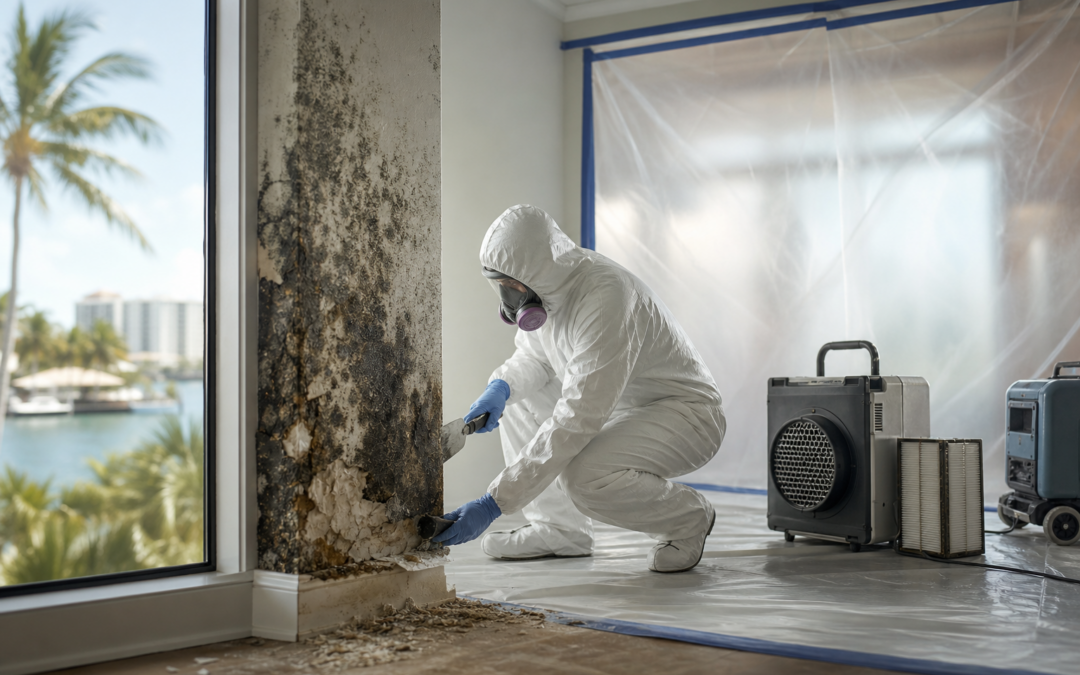
Technicians set up containment barriers — typically plastic sheeting and negative air pressure — to prevent mold spores from spreading to unaffected areas during removal. This step protects the rest of your home or building from cross-contamination.
Step 3: Removal of Contaminated Material
Porous materials that have absorbed mold, such as drywall, insulation, and carpet, are removed and disposed of properly. Non-porous surfaces are cleaned and treated with antimicrobial agents. The goal is physical removal, not surface treatment.
Step 4: HEPA Filtration and Air Scrubbing
Air scrubbers with HEPA filters run throughout the process to capture airborne spores. This step matters especially in Fort Lauderdale, where open windows and central AC systems can distribute spores quickly through a property.
Step 5: Post-Remediation Testing
A responsible remediation company verifies that spore counts have returned to acceptable levels before clearing the property. This may involve clearance air sampling by a third party or the remediation company itself, depending on the scope of the job.
Step 6: Restoration
Depending on how much material was removed, restoration work — replacing drywall, repainting — may follow. Some companies handle this in-house; others coordinate with a separate contractor.
Services to Look For in a Fort Lauderdale Mold Company
Not every mold company in Fort Lauderdale offers the same scope of work. When evaluating providers, confirm they handle the full range of issues that commonly accompany mold in South Florida.
Mold inspection is the diagnostic step. It should be thorough enough to identify hidden moisture sources, not just visible growth.
Mold remediation is the physical removal and treatment process described above. It should follow an established protocol — not a shortcut.
Water damage restoration matters because mold almost always follows water damage. A company that handles both can address the source and the consequence in a single engagement, rather than requiring you to coordinate two separate contractors.
Sewage backup cleanup comes up in Fort Lauderdale more often than homeowners expect. Sewage events introduce Category 3 contamination, which requires a more rigorous treatment protocol than clean water damage.
Sanitizing applies after remediation and water damage work to ensure surfaces are safe for occupants — especially important in homes with children, elderly residents, or anyone with respiratory conditions.
Royal Mold Specialist covers all five of these services and serves Fort Lauderdale as part of a 20-plus city footprint across Broward, Miami-Dade, and Palm Beach Counties.
Mold Remediation Cost in Fort Lauderdale: What to Expect in 2026
Mold remediation pricing isn't one-size-fits-all, and any company quoting a flat rate before seeing the property should raise questions. That said, market data gives you a reasonable frame of reference before you start making calls.
Based on 2026 market data, national average costs run approximately $1,200 to $3,750 per job. Jobs involving larger affected areas, structural material removal, or insurance claims tend to run higher. One local South Florida competitor publishes an estimated range of $1,000 to $6,000 — roughly $10 to $30 per square foot — which reflects the wide variability depending on scope.
Factors that push costs higher in Fort Lauderdale specifically:
- Large affected areas in older homes with original drywall and insulation
- Mold inside HVAC systems, which requires specialized treatment and is common given how hard AC units work in South Florida
- Multiple rooms or floors affected by a single water event
- Sewage-related contamination, which requires more intensive remediation protocols
- Post-storm jobs where multiple systems were compromised at once
Royal Mold Specialist doesn't publish a fixed price list. Quotes are provided after an on-site assessment, which is the only accurate way to price a job where scope varies this much. If you want a sense of what's involved before booking, royalmoldfl.com is a good starting point for understanding the service scope before you schedule.
How to Choose a Mold Remediation Company in Fort Lauderdale
Fort Lauderdale has no shortage of restoration companies, and the difference between them matters more than most homeowners realize until after the job is done.
Specialization vs. Generalist Restoration
National franchise brands like SERVPRO and ServiceMaster handle water, fire, smoke, storm, and mold under one roof. Mold is one line item among many. A company that focuses on mold specifically brings a different level of depth to inspection, containment, and post-remediation verification. When evaluating options, ask whether mold is the company's primary service or one of a dozen.
Local Tenure and Consistency
Franchise operations send whoever is available, and crew quality varies by location and operator. A locally owned company with over 12 years of continuous South Florida operation has a track record you can actually verify through local reviews and referrals. Royal Mold Specialist has worked in this market for over 12 years, which means the technicians who show up understand South Florida construction, Florida building codes, and the specific mold species common to this climate.
Capacity for Your Job Size
Some smaller operations have limited crew capacity — which matters if your job spans multiple rooms or if you're a property manager dealing with a multi-unit building. Confirm the company can handle your scope before committing.
What the Quote Covers
Ask specifically whether the quote includes post-remediation testing, clearance sampling, and any restoration work after material removal. Surprises at the end of a job are common when scope isn't defined clearly upfront.
What Happens If You Delay Mold Remediation
Fort Lauderdale's climate doesn't give mold problems time to stay small. A leak that went undetected for two weeks can produce growth that has penetrated drywall, spread behind baseboards, and reached adjacent rooms by the time you notice it.
Delays have real consequences:
- Health effects accumulate with prolonged exposure, particularly for anyone with asthma, allergies, or a compromised immune system
- Structural damage worsens as mold degrades wood framing and drywall over time
- Remediation scope and cost increase the longer contaminated material stays in place
- Real estate transactions can fall apart if mold is discovered during inspection and remediation hasn't been completed
If you're in the middle of a home sale or purchase in Fort Lauderdale, remediation with documentation is often a requirement before closing. A company with experience working within real estate transaction timelines can help you move quickly when it counts.
Booking Mold Remediation in Fort Lauderdale
The booking process with Royal Mold Specialist is straightforward. You can schedule directly through the form on royalmoldfl.com, which connects to the company's scheduling system. A technician will assess the property on-site and provide a quote based on actual conditions.
There's no obligation to commit before the assessment, and the on-site visit gives you a much clearer picture of what you're dealing with than any phone estimate could.
Fort Lauderdale is one of the company's primary service cities, so scheduling isn't a logistics challenge. The team operates across Broward County and can also serve neighboring cities including Hollywood, Pompano Beach, Deerfield Beach, Dania Beach, Hallandale Beach, and Coral Springs if you have properties in multiple locations.
Frequently Asked Questions
How long does mold remediation take in Fort Lauderdale?
Most residential jobs take one to three days depending on the size of the affected area and how much material needs to be removed. Larger jobs involving multiple rooms, HVAC systems, or structural material can take longer. Your technician will give you a timeline estimate after the on-site assessment.
Is mold remediation covered by homeowners insurance in Florida?
It depends on the cause. If mold resulted from a sudden covered event — a burst pipe or storm damage, for example — your policy may cover remediation. Mold that developed from long-term neglect or gradual leaks is typically excluded. Document the source of the water damage as early as possible and contact your insurer before work begins.
What is the difference between mold removal and mold remediation?
Mold removal refers to physically cleaning or removing visible mold. Remediation is the full process: containment, removal of contaminated materials, air filtration, treatment, and post-remediation verification. Remediation addresses the problem at a structural level rather than just the surface.
Can I stay in my home during mold remediation in Fort Lauderdale?
It depends on the scope and location of the work. For small, isolated areas, temporary relocation may not be necessary. For larger jobs involving significant containment and air scrubbing, your technician will advise whether it's safe to remain on the property. Families with young children or anyone with respiratory conditions should discuss this specifically with the remediation team.
How do I know if mold remediation was successful?
Post-remediation testing — typically air sampling — confirms that spore counts have returned to acceptable levels. Ask your remediation company whether clearance testing is included in the scope or whether you should arrange independent verification. A reputable company won't declare the job complete without confirming the results.
What causes mold to come back after remediation in South Florida?
The most common reason mold returns is that the moisture source wasn't fully addressed. If a roof leak, plumbing issue, or HVAC condensate problem continues after remediation, mold will grow back. A thorough inspection of moisture sources — not just visible mold — is what separates a lasting result from a temporary fix.
How much does mold remediation cost in Fort Lauderdale?
Market data for 2026 puts the national average between $1,200 and $3,750 per job, with local South Florida estimates ranging from $1,000 to $6,000 depending on scope and affected area. The only accurate number for your specific situation comes from an on-site assessment. Royal Mold Specialist provides quotes after inspecting the property rather than offering flat-rate estimates over the phone.
Get the Problem Assessed and Fixed
Mold in a Fort Lauderdale property doesn't improve with time. The humidity, the construction, and the climate all work against you. Getting a qualified specialist on-site quickly is the most direct path to a clean result — and a property that stays that way.
Royal Mold Specialist has served Fort Lauderdale and the surrounding Broward County area for over 12 years. The company focuses on mold, which means every job gets the same level of attention regardless of size. Book an assessment at royalmoldfl.com and get a clear picture of what you're dealing with before making any decisions.