- Why West Palm Beach Properties Are Especially Vulnerable
- When to Schedule a Mold Inspection in West Palm Beach
- What Happens During a Professional Mold Inspection
- How to Read Your Mold Inspection Results
- After the Inspection: Understanding Your Options
- Choosing the Right Inspector and Remediator in West Palm Beach
- Common Questions About Mold Testing in West Palm Beach
- FAQs
- What to Do Next
West Palm Beach homeowners deal with a mold problem that most of the country simply doesn't face at the same intensity. High humidity, frequent rain, aging housing stock, and year-round warmth create near-perfect conditions for mold to grow inside walls, under floors, and inside HVAC systems. If you're searching for a mold inspection in West Palm Beach, you're probably already dealing with something that doesn't feel right — a smell, a stain, or a health symptom that won't go away. This article covers when a professional inspection makes sense, what actually happens during one, and how to read the results so you can make a confident decision about what comes next.
Why West Palm Beach Properties Are Especially Vulnerable
Palm Beach County sits in a subtropical climate zone where indoor relative humidity regularly exceeds 60 percent. Mold needs three things to grow: moisture, a food source (drywall, wood, insulation), and warmth. West Palm Beach provides all three in abundance.
Several local conditions make properties here more susceptible than average:
- Hurricane and storm exposure. Even minor tropical weather events can push water into roof penetrations, window frames, and foundation cracks — often going undetected until mold has already taken hold.
- Older construction. Many West Palm Beach homes were built between the 1960s and 1980s using materials that absorb moisture readily and lack modern vapor barriers.
- Air conditioning systems. Running AC constantly creates condensation. Poorly maintained systems, clogged drain lines, or undersized units cycling on and off can introduce moisture directly into air ducts and the surrounding drywall.
- Flat or low-slope roofs. Common in South Florida architecture, these roofs pool water and are more prone to slow leaks that go unnoticed for months.
Understanding this context matters because it shapes not just whether you should test, but when.
When to Schedule a Mold Inspection in West Palm Beach
Not every situation calls for an immediate inspection, but several scenarios in South Florida warrant one without delay.
You’ve Had a Water Intrusion Event
Any time water gets into a structure — a roof leak, a burst pipe, a flooded bathroom, or storm-driven rain through a window — mold can begin growing within 24 to 48 hours. If the area dried out on its own without professional water extraction, there's a reasonable chance mold is already present inside the wall cavity or under the flooring, even if the surface looks fine.
You Smell Mold But Can’t See It
A persistent musty or earthy odor is one of the most reliable early indicators of hidden mold growth. Mold produces volatile organic compounds as it metabolizes organic material, and those compounds have a distinctive smell. If the odor is concentrated in a specific room, near an HVAC vent, or in a closet against an exterior wall, that's worth investigating professionally.
Someone in the Home Has Unexplained Respiratory Symptoms
Mold exposure doesn't affect everyone the same way, but common responses include persistent coughing, nasal congestion, eye irritation, headaches, and worsening asthma. If symptoms improve when a household member leaves the home and return when they come back, the indoor environment is worth evaluating.
You’re Buying or Selling a Property
Real estate transactions in Palm Beach County increasingly include mold inspections as standard due diligence. Buyers want confirmation before closing. Sellers benefit from a clean report that removes a potential negotiating point. For listing agents and property managers, a pre-listing inspection can prevent surprises during the buyer's due diligence period.
Visible Mold Has Already Appeared
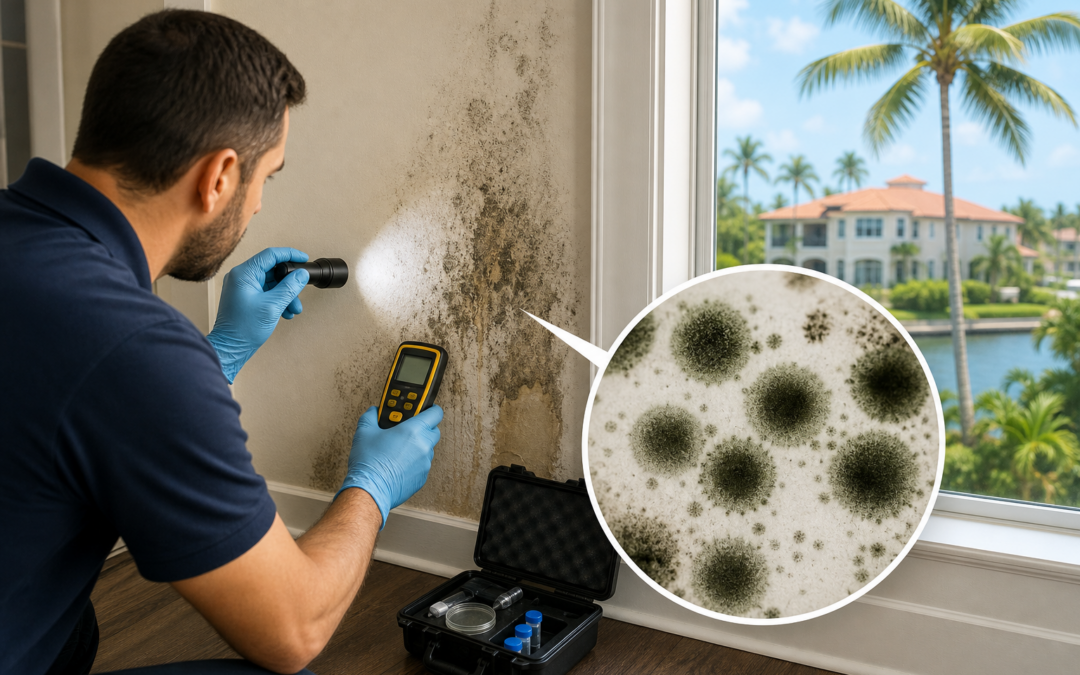
If you can see mold growth — black spots on drywall, greenish discoloration on grout, white fuzzy patches on wood framing — an inspection can determine how far the growth extends beyond what's visible. Surface mold is often just the visible edge of a larger colony behind the wall.
What Happens During a Professional Mold Inspection
A professional mold inspection is not the same as a DIY test kit from a hardware store. Those kits can confirm that mold spores exist in the air (they almost always do at some level), but they can't tell you where the source is, what species is present, or how serious the contamination is. A trained inspector works through the property systematically using tools and methods that produce actionable results.
Visual Assessment
The inspection starts with a thorough visual walkthrough. The inspector looks for visible mold growth, water staining, efflorescence on concrete, deteriorated caulking, discolored drywall, and any signs of past or current moisture intrusion. This phase often surfaces problems the homeowner hadn't noticed or had written off as cosmetic.
Moisture Mapping
Inspectors use moisture meters and thermal imaging cameras to detect elevated moisture levels inside walls, under floors, and above ceilings — without cutting into surfaces. Thermal imaging is particularly useful in West Palm Beach because it can reveal condensation forming inside wall assemblies, a common issue in homes where the AC is set very cold against a humid exterior.
Air Sampling
Air samples are collected using a calibrated pump that draws a measured volume of air through a collection cassette. Samples are typically taken in the suspect area, in a control area of the home, and outdoors. The outdoor sample establishes a baseline, since outdoor mold spore counts are naturally present and vary by season. Results go to an accredited laboratory for analysis.
Surface Sampling
When visible growth is present, the inspector may collect a tape lift or swab sample directly from the mold colony. Surface samples identify the specific species present, which matters — some species, like Stachybotrys chartarum (commonly called black mold), require more aggressive remediation protocols and raise more significant health concerns than common environmental molds.
Bulk Sampling
In some cases, particularly when mold is suspected inside a wall cavity, the inspector may take a small piece of building material — drywall, insulation, or wood — for laboratory analysis. This is less common but useful when air sampling results are inconclusive.
How to Read Your Mold Inspection Results
The laboratory report from your air or surface samples can look technical and confusing. Here's what actually matters.
Spore Types and Counts
The report will list mold species detected and the concentration measured in spores per cubic meter of air. Common genera include Cladosporium, Penicillium, Aspergillus, Alternaria, and Stachybotrys.
The key comparison is between your indoor sample and the outdoor control. If indoor spore counts are significantly higher than outdoor counts, or if species appear indoors that weren't detected outdoors, that's a meaningful finding — it suggests an active indoor source rather than normal ambient spores drifting in from outside.
What “Elevated” Actually Means
There's no single universally accepted threshold that defines a dangerous spore count. Interpretation depends on the species, the indoor-to-outdoor ratio, and the building conditions. A report showing 500 spores per cubic meter of Cladosporium indoors when the outdoor count is 2,000 is generally unremarkable. The same indoor count when the outdoor count is 100 is worth investigating.
Stachybotrys is treated differently. It's a slow-growing mold that requires persistently wet conditions, and it's rarely found in outdoor air samples. Any indoor detection of Stachybotrys is typically treated as significant regardless of count.
What the Report Doesn’t Tell You
A mold inspection report identifies what's present and at what level. It doesn't automatically tell you what to do next. That's where a professional remediation assessment comes in. The inspector or a separate remediation specialist reviews the findings and recommends a scope of work — which areas need to be addressed, what containment is required, and what the remediation process will involve.
After the Inspection: Understanding Your Options
If the inspection finds elevated mold levels or an active source, you have a few paths forward.
Minor localized growth — a small area of surface mold with no indication of structural penetration — may be addressable with targeted cleaning and moisture control. Even so, small visible colonies warrant professional assessment to confirm the full extent.
Moderate to significant growth inside wall cavities, in HVAC systems, or across multiple areas of the home requires professional remediation. This involves containment to prevent spore spread, physical removal of contaminated materials, treatment of affected surfaces, and air scrubbing to reduce airborne spore counts.
Post-remediation verification is an important step that's sometimes skipped. After remediation is complete, a clearance inspection with new air samples confirms that spore counts have returned to normal levels. Without it, you're taking the remediator's word rather than having independent confirmation.
Choosing the Right Inspector and Remediator in West Palm Beach
West Palm Beach falls within Palm Beach County, and the mold industry here ranges from experienced local specialists to generalist contractors who treat mold as one service among many. A few things worth looking for:
- Mold as a primary focus, not a side service. Companies that specialize in mold inspection and remediation tend to have more experience with the specific conditions common in South Florida than general restoration companies where mold is one line item among many.
- Own technicians on every job. Some franchise-model companies use variable crews depending on volume and availability. Knowing the same trained team handles your inspection and remediation creates consistency in scope and outcome.
- Full-service capability. In many West Palm Beach mold cases, the underlying cause is a water intrusion issue. A company that handles inspection, remediation, and water damage restoration in a single engagement avoids the coordination problems that come with using separate vendors.
Royal Mold Specialist has operated in South Florida for over 12 years, serving properties across Palm Beach County and more than 20 cities in the region. The company sends its own trained technicians on every job and handles the full scope — from initial inspection through remediation, water damage treatment, and sanitizing.
Common Questions About Mold Testing in West Palm Beach
Does Florida require mold inspectors to be licensed?
Florida is one of a small number of states that licenses mold assessors and mold remediators separately. Under Florida Statute 468, mold assessors must hold a state license to conduct mold assessments for compensation. When hiring an inspector in West Palm Beach, confirm they hold a current Florida Mold Assessor license. Remediators must hold a separate Mold Remediator license.
Can the same company do the inspection and the remediation?
Florida law prohibits the same licensed individual from performing both the mold assessment and the remediation on the same project. However, a company can employ both licensed assessors and licensed remediators as separate individuals, allowing them to handle both phases under one roof. Confirm this arrangement before booking if you want a single-company engagement.
How long does a mold inspection take?
For a typical single-family home in West Palm Beach, a professional inspection takes two to four hours on-site. Laboratory results for air and surface samples typically return within three to five business days, depending on the lab. Some labs offer rush processing for an additional fee.
FAQs
How much does a mold inspection cost in West Palm Beach in 2026?
Costs vary based on property size, number of samples collected, and whether laboratory analysis is included. Because pricing depends on the specific scope of work, reputable companies provide on-site quotes rather than flat published rates. Contact a licensed mold assessor for an accurate estimate based on your property.
What's the difference between a mold inspection and a mold test?
A mold inspection is a comprehensive professional assessment that includes a visual survey, moisture mapping, and sampling. A mold test typically refers to sample collection and laboratory analysis alone. An inspection without sampling can miss hidden growth, while sampling without a thorough visual assessment can miss the source. A complete inspection includes both.
Can I stay in my home during mold remediation?
It depends on the extent of the contamination and the remediation method. For minor localized work, occupants may be able to remain in unaffected areas of the home. For larger jobs involving containment and air scrubbing, temporary relocation is often recommended — especially for households with children, elderly members, or anyone with respiratory conditions. Your remediator should give you specific guidance based on the scope.
How do I know if my mold problem is covered by homeowners insurance?
Coverage depends on the cause of the mold and your specific policy. Mold resulting from a sudden, covered water event — like a burst pipe — is more likely to be covered than mold from long-term humidity or deferred maintenance. Review your policy and document the cause of the moisture intrusion before filing a claim. An inspection report provides useful documentation for the claims process.
What does black mold actually mean on a report?
"Black mold" is a common term for Stachybotrys chartarum, but not all dark-colored mold is Stachybotrys. Color alone doesn't identify the species — laboratory analysis of a sample is the only reliable way to confirm it. If your report identifies Stachybotrys, work with a licensed remediator to address it promptly. It requires sustained wet conditions to grow, which means a significant moisture problem exists somewhere in the structure.
How soon after a water leak should I get a mold inspection?
Mold can begin colonizing wet materials within 48 to 72 hours of a water intrusion event. If water extraction and drying weren't completed professionally within that window, schedule an inspection as soon as possible. The longer you wait, the more established the growth becomes — and the more materials may need to be removed rather than cleaned.
Do I need a mold inspection before buying a home in West Palm Beach?
A general home inspection may note visible mold or water damage, but it typically doesn't include air sampling or moisture mapping. If the home has any history of water intrusion, visible staining, or a musty odor, a dedicated mold inspection before closing gives you an accurate picture of what you're buying — and what remediation, if any, might be needed.
What to Do Next
If you're dealing with visible mold, a persistent smell, or recent water damage in a West Palm Beach property, the most useful next step is a professional inspection by a licensed mold assessor. A clear report tells you what's present, where it is, and what needs to happen to resolve it. Without that baseline, you're either guessing at the scope of the problem or paying for remediation without confirmation that it worked.
Royal Mold Specialist serves West Palm Beach and the surrounding Palm Beach County area with the same trained team that handles inspections, remediation, water damage restoration, and sanitizing. Book an appointment directly at royalmoldfl.com.