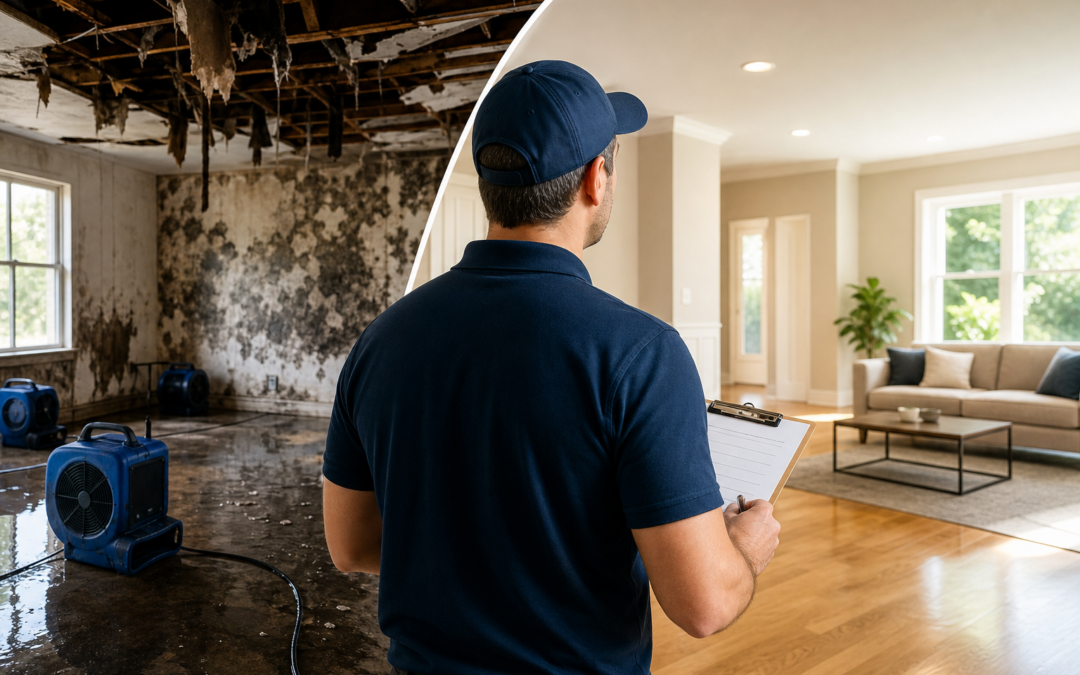
Disaster clean up companies, also called restoration or remediation contractors, handle water, fire, mold, and sewage damage after a property emergency. To pick a reliable one, verify their license and IICRC certifications, confirm insurance coverage, get three written estimates, and review the payment schedule before signing anything. Most homeowners face this decision under pressure, which is exactly when predatory contractors do their best work. A clear, ordered process protects both your property and your insurance claim.
The restoration industry is large and fragmented. According to Proof's 2026 report, the U.S. damage-restoration industry consists of approximately 62,582 firms generating roughly $7.2 billion in annual revenue. Most homeowners have never hired one before the moment they need one. That gap between urgency and preparation is where bad decisions happen.
What Are Disaster Clean Up Companies and What Do They Do?
Disaster clean up companies respond to property damage caused by water, fire, smoke, mold, sewage, and storm events. They stabilize the property, remove damaged materials, dry and decontaminate affected areas, and prepare the structure for rebuilding. That scope sounds straightforward. In practice, the work splits into two distinct phases that not every company handles.
The industry produced those numbers because demand is consistent. The United States experienced 27 separate billion-dollar weather and climate disasters in 2024, resulting in $182.7 billion in total damages. Every one of those events generates restoration work.
Mitigation is emergency response. It covers the first 24 to 72 hours: water extraction, board-up, containment of mold or sewage, and structural drying. The goal is to stop further damage. This phase is time-sensitive.
Reconstruction is what follows. Once the structure is dry and decontaminated, a contractor rebuilds what was removed: drywall, flooring, cabinetry, insulation. Some restoration companies handle both phases. Others hand off reconstruction to a separate general contractor.
When you call a disaster clean up company, ask directly which phase they cover. A company that only does mitigation cannot finish the job. One that rushes into reconstruction before mitigation is complete will leave hidden moisture behind, and by the time mold appears, the damage inside the wall cavity is already done.
The major national franchise networks, including SERVPRO, PuroClean, and ServiceMaster Restore, are among the most widely recognized names in the industry. SERVPRO alone runs a network of over 2,390 locations across the United States. These franchises are independently owned and operated, so quality varies by location even within the same brand.
Local specialists often focus on specific damage types, such as mold or water damage, and may have deeper technical expertise in those areas. Knowing which type of company you need before you call saves time and prevents mismatched scope of work.
Is the Contractor Licensed and Certified for the Work?
A license and a certification are not the same thing, and you need to verify both before any work starts.
Here are the steps to confirm a contractor is qualified for the job:
-
Verify state or local contractor licensure. Licensing requirements vary by state and sometimes by county. In Florida, contractors performing mold remediation on jobs above a certain square footage must hold a state-issued mold remediator license. Check the relevant state licensing board website directly. Do not rely on the contractor's word or a badge on their website.
-
Confirm IICRC certifications for on-site technicians. The IICRC (Institute of Inspection, Cleaning and Restoration Certification) sets the technical standards for the restoration industry. Technicians can hold certifications in water damage restoration (WRT), applied microbial remediation (AMRT), fire and smoke restoration, and other specialties. Ask for the names and certification numbers of the technicians who will actually work on your property, then verify them at iicrc.org. A company may be IICRC-certified at the firm level while sending uncertified workers to your job. For a deeper look at how these certifications apply in Florida specifically, see how mold remediation certifications work in Florida and why they matter when hiring.
-
Audit insurance documentation and request a Certificate of Insurance (COI). This step is covered in its own section below, but it belongs in the verification sequence here.
-
Verify the company's local physical business address. A legitimate contractor has a verifiable office address, not just a phone number and a website. Search the address independently. A P.O. box or a residential address for a commercial operation is a warning sign.
-
Ask whether the company is bonded. A surety bond protects you if the contractor fails to complete the work or causes damage. Bonding is separate from insurance. Not every state requires it, but a reputable contractor carries it.
Skipping any of these steps because you are in a hurry is how homeowners end up with unlicensed work that voids their insurance coverage. Pressure to move fast is a tactic, not a reason.
How Do You Spot a Predatory Storm Chaser?
Storm chasers are contractors who follow disaster events, target affected neighborhoods, and use high-pressure tactics to get homeowners to sign contracts before a legitimate company can compete. They are common after hurricanes, floods, and hailstorms in South Florida.
A 2026 survey found that 76% of homeowners contact their insurance company first following a disaster. The ones who don't are the most vulnerable to this kind of fraud.
Watch for these red flags before you sign anything:
- Unsolicited door-to-door contact. A legitimate restoration company does not knock on your door the day after a storm. If someone shows up uninvited and pushes for a same-day signature, walk away.
- Pressure to sign an Assignment of Benefits (AOB). An AOB transfers your insurance claim rights directly to the contractor. Once signed, you lose control of the claim negotiation. Florida has restricted AOB use, but variations of the tactic still appear.
- No local address or verifiable business history. Storm chasers often operate out of state and move on after the event. If you cannot find a physical address, a state license, or reviews that predate the most recent storm season, that is a problem.
- Unusually low estimates. A bid that comes in far below two others usually means the contractor plans to add costs through change orders once work has started and materials are already removed.
- Requests for full payment upfront. Legitimate contractors do not ask for the full job cost before work begins. A reasonable deposit is normal. Full payment in advance is not.
- Verbal-only agreements. Any contractor who resists putting the scope of work, timeline, and cost in writing is not a contractor you want on your property.
If someone at your door hits more than one of these marks, end the conversation. Take their card, check their license independently, and call your insurer before you call them back.
Does the Company Carry the Right Insurance?
Before any technician sets foot on your property, you need to see proof of insurance. A contractor without proper coverage leaves you financially exposed if a worker is injured on your property or if the work causes additional damage.
Request these three documents before work starts:
-
General liability insurance. This covers property damage the contractor causes during the job. Ask for the policy limits. Ask for the policy limits and confirm the coverage is current.
-
Workers' compensation insurance. If a technician is injured while working on your property and the contractor lacks workers' comp, you could be held liable. This is not a technicality. It is a real financial exposure.
-
A Certificate of Insurance (COI). The COI is a one-page document your contractor's insurer issues directly. It lists the policy types, coverage limits, and expiration dates. Ask the contractor to have their insurer send the COI to you directly, not to the contractor who then forwards it to you. That step confirms the document is current and unaltered.
According to Mordor Intelligence's 2026 report, insurance-funded restoration work accounted for 51.84% of industry spending in 2026. That means your insurer likely has a stake in this job. A contractor who cannot produce a COI on request is a contractor your insurer will not want on the claim.
Bonding is a separate question. A surety bond protects you if the contractor abandons the job or fails to perform. Ask whether the company is bonded and request the bond number so you can verify it independently.
How Do Written Estimates and Moisture Documentation Protect Your Claim?
Written estimates and moisture logs are not paperwork formalities. They are the evidence trail that supports your insurance claim and holds the contractor accountable if the scope of work changes.
Get three written, itemized estimates before work begins. Each estimate should break down labor, materials, equipment rental, and disposal costs as separate line items. A lump-sum figure tells you nothing about where the money goes or what you would be disputing if something goes wrong. When estimates differ significantly, the gap usually reveals a difference in scope. One contractor may be quoting mitigation only while another includes reconstruction. You cannot compare them without line items.
Moisture documentation matters just as much. Proper water damage restoration depends on drying the structure to measurable standards, not just until it looks dry. Ask any contractor how they will document the drying process. The answer should involve moisture meters and psychrometric readings taken at regular intervals, recorded in moisture logs that become part of your claim file.
Your insurer may require moisture logs to confirm that drying met industry standards before approving payment for reconstruction. If a contractor cannot show you a completed moisture log at the end of the job, you have no proof the structure was dried correctly. Hidden moisture leads to mold growth, and by the time mold appears, the damage is already done inside the wall cavity.
For South Florida properties specifically, where humidity stays high year-round and storm season runs from June through November, thorough moisture documentation matters more than in drier climates. A contractor who skips it is cutting a corner that will cost you later. If water damage is part of your situation, the water damage treatment and restoration services page covers what a complete remediation process should include.
What Payment Terms Are Reasonable, and What Should You Refuse?
A legitimate disaster clean up company does not need full payment before the work starts. Understanding the standard payment structure protects you from contractors who collect money and disappear.
A reasonable payment schedule ties each installment to a completed phase of work. For example, a structure might call for a small deposit at signing, a larger payment when mitigation is complete and documented, and the remainder after the job passes final inspection. That ties each payment to a delivered result. The contractor gets paid as they perform, and you retain financial control until the work is done.
What you should refuse is a demand for full payment upfront. No legitimate contractor requires this. A large advance payment removes your leverage entirely. Once the money is gone, your only recourse is legal action, which is slow and costly.
Some states set legal limits on how much a contractor can collect before work begins. Requirements vary by state, so check your state's contractor licensing board or consumer protection office for the rules that apply where you live. If your contractor quotes terms that exceed what your state allows, that is a violation you can report.
A public adjuster works for you, not the contractor or the insurer, to negotiate the value of your claim. A restoration contractor estimates and performs the physical work. These are different services. Some contractors blur this line by offering to "handle the insurance claim" on your behalf, but that is not their role. Agreeing to it can complicate your claim or expose you to an Assignment of Benefits arrangement. Keep the two functions separate.
Who Pays for Disaster Cleanup, You or Your Insurer?
The answer depends on your policy and the cause of the damage. According to Mordor Intelligence's 2026 report, insurance-funded restoration work accounted for 51.84% of industry spending in 2026. That means roughly half of all restoration jobs run through an insurer, but it also means the other half does not.
Standard homeowners insurance typically covers sudden, accidental damage, such as a burst pipe or storm-driven water intrusion. It usually excludes gradual damage, flooding from rising water, and maintenance-related failures. Read your policy before you assume coverage exists.
A 2026 survey found that 76% of homeowners contact their insurance company first following a disaster. That is the right instinct. File the claim early, document everything before cleanup begins, and keep copies of every estimate and moisture log. Your insurer will send an adjuster to assess the damage, and that assessment determines what they pay.
A public adjuster is a licensed professional who negotiates the claim on your behalf, not on the contractor's or insurer's behalf. If your claim is large or disputed, hiring one can result in a higher settlement. A restoration contractor performs the physical work. They are not the same role, and you should not let a contractor fill both.
When insurance does not cover the full cost, you pay the difference out of pocket. Get the written estimate before work starts so you know your exposure.
When Should You Call a Local Specialist Instead of a National Chain?
National franchise networks like SERVPRO, PuroClean, and ServiceMaster Restore operate across many markets and are familiar names to most insurance adjusters. SERVPRO operates more than 2,390 locations across the United States. That scale can mean faster mobilization after a major regional disaster.
The trade-off is consistency. Each franchise location is independently owned and operated, so the quality of the crew, the equipment on the truck, and the responsiveness of the office varies by location. A brand name does not guarantee the same experience across markets.
Local specialists often concentrate on specific damage types and build deeper technical expertise in those areas. In South Florida, where humidity is persistent, storm season runs June through November, and mold follows water damage within 24 to 48 hours, that specialization matters. A contractor who works this climate every day understands the drying conditions, the building stock, and the local permitting requirements in ways a rotating franchise crew may not.
Royal Mold Specialist is a mold remediation and water damage company that has served more than 20 cities across South Florida for over 15 years. For mold inspection, full remediation, water damage treatment, and sewage backup cleanup in this region, a specialist with that local track record is worth a call alongside any national option you are considering. For a direct comparison of how national chains and local companies approach this work, see Florida mold removal companies: how national chains compare to local specialists.
Prices and plan limits verified as of October 2026.
FAQs
How long does disaster cleanup typically take?
Mitigation, the emergency phase covering water extraction, drying, and containment, usually takes three to five days for a standard water damage event. Reconstruction can take weeks or months depending on how much structural material was removed. Mold remediation timelines depend on the size of the affected area and the materials involved. Ask your contractor for a written timeline broken into phases before work starts.
Can I stay in my home during restoration work?
It depends on the damage type and scope. Minor water damage in one room may allow you to stay. Sewage backup, significant mold growth, or structural damage typically requires you to leave until that phase is complete. Containment barriers and negative air pressure systems, which use fans and sealed barriers to prevent spores or contaminants from spreading to clean areas, make some sections of the home temporarily uninhabitable. Ask your contractor directly, and ask your insurer whether temporary housing costs are covered.
What is the difference between a restoration contractor and a public adjuster?
A restoration contractor inspects, cleans, dries, and rebuilds your property. A public adjuster is a licensed professional who negotiates the value of your insurance claim on your behalf. They are separate roles. Some contractors offer to "handle your claim," but that is not their function and can create conflicts of interest. If your claim is large or your insurer disputes the scope, a public adjuster works solely in your interest.
Do disaster clean up companies work directly with insurance adjusters?
Most do. Established restoration companies are familiar with the claims process and can submit documentation, moisture logs, and scope-of-work reports directly to your insurer. Working with your insurer directly does not mean the contractor represents your interests in the claim. They represent their own scope of work. Keep your own copies of every document the contractor submits.
What certifications should I look for beyond IICRC?
The IICRC is the primary standard-setting body for the restoration industry, but additional credentials add value depending on the damage type. For mold work in Florida, look for a state-issued mold remediator license. The RIA (Restoration Industry Association) also offers training and credentialing. For health and safety compliance on larger jobs, ask whether any technicians hold OSHA 10 or OSHA 30 cards. Each certification tells you something specific about what that technician is qualified to do.
Conclusion
Picking a reliable disaster clean up company comes down to verification, not gut feeling. Confirm the license, check IICRC certifications for the actual technicians doing the work, request a Certificate of Insurance before anyone starts, and get three itemized written estimates. Know which phase you are hiring for, mitigation or reconstruction, and make sure the payment schedule ties to completed phases rather than a lump sum upfront.
Before you call anyone, file your insurance claim and document the damage yourself with photos and video. Then check your state's contractor licensing board to verify any company you are considering. If you are in South Florida and mold or water damage is part of the picture, start with a contractor who specializes in this climate and has a verifiable local history.