
- Why Drywall Mold Jobs Are Priced Differently
- What Black Mold Removal from Drywall Typically Costs
- The Line Items That Drive the Final Quote
- When Can Drywall Be Cleaned Instead of Replaced?
- Hidden Mold Behind the Wall: The Price Multiplier
- Permits, Asbestos, and Older Homes
- Does Homeowner's Insurance Cover Black Mold on Drywall?
- How to Compare Quotes for a Drywall Mold Job
- Frequently Asked Questions
Black mold removal from drywall is one of the most common cost questions homeowners ask after spotting dark patches on a wall or ceiling—and the answer is more specific than most general mold guides let on. The total price depends on whether the drywall can be cleaned or has to come out, how far the contamination has spread behind the surface, and what it costs to put the wall back together afterward. This guide breaks down each of those line items so you know exactly what you're paying for.
Why Drywall Mold Jobs Are Priced Differently
Most cost articles treat mold remediation as a single flat category. Drywall jobs are different because the material is porous. Once moisture saturates the paper facing and gypsum core, mold colonies embed into the substrate rather than sitting on the surface. That changes both the remediation approach and the price.
A non-porous surface like tile or painted concrete can often be cleaned with antimicrobial agents and HEPA vacuuming. Drywall rarely gets that option once growth is visible. The real question isn't just how much mold is present—it's how deep it has gone and how much of the wall needs to be demolished and rebuilt.
What Black Mold Removal from Drywall Typically Costs
According to UseCalcPro's 2026 data, professional mold removal runs $1,200 to $3,750 for a typical residential job, with a national average of $2,368. currentcost.org puts the range wider in 2026, listing $1,500 on the low end, $4,000 as an average, and up to $15,000 for severe cases.
On a per-square-foot basis, UseCalcPro reports $10 to $25 per square foot in 2026, while currentcost.org lists $6 to $25 with $12 as the midpoint. That spread reflects how differently contractors price labor, containment, and disposal.
For drywall-specific jobs, the per-square-foot figure is the more useful number. A bathroom wall with two contaminated sheets is a very different scope than a finished basement where mold has spread across an entire wall cavity.
Small Patch vs. Full-Room Drywall Removal
A small patch repair—one to two sheets of drywall in a bathroom or laundry room—sits at the lower end of the range. The remediation cost itself may be modest, but the rebuild adds to the invoice. After demo, someone has to hang new board, tape, mud, sand, prime, and paint. That finish work is often quoted separately and can add several hundred dollars to a job that looked simple at first glance.
A full-room gut, where mold has spread across multiple walls or into the ceiling, pushes costs toward the higher end of the national range and sometimes beyond it. When insulation behind the drywall is also contaminated, that material has to be bagged, removed, and replaced—adding both labor and materials to the total.
The Line Items That Drive the Final Quote
Understanding what a contractor is charging for helps you compare quotes accurately. A drywall mold remediation invoice typically includes several distinct components.
Inspection and testing. Before any work begins, the scope has to be defined. Angi's 2026 data puts mold testing at $250 to $350. Some companies bundle a visual inspection into the quote; others charge separately. Post-remediation clearance testing—which confirms the job is actually complete—is a separate cost and a step worth requiring in your contract.
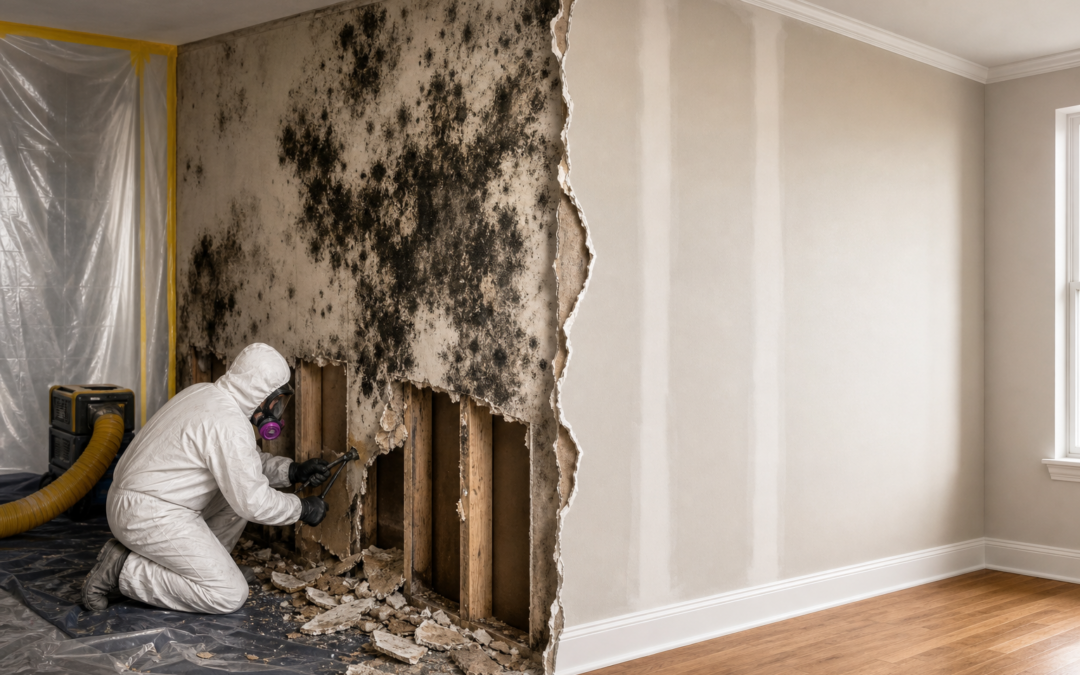
Containment setup. Mold spores become airborne the moment drywall is cut. A proper job uses plastic sheeting to isolate the work area, negative air pressure machines with HEPA filtration to capture airborne spores, and full PPE for the crew. This isn't optional labor padding—it's what prevents cross-contamination to the rest of the home.
Demolition and disposal. Cutting out contaminated drywall, bagging it, and hauling it off is billable labor. The more panels involved, the higher this line item. Access matters too. An exposed wall in a garage is faster to demo than a finished wall in a master bedroom with baseboards, trim, and built-ins.
Antimicrobial treatment. After demo, the framing, subfloor, and any remaining surfaces get treated with EPA-registered antimicrobial agents. This step addresses residual spores on structural members that are staying in place.
Drywall replacement and finishing. This is the line item most homeowners underestimate. Hanging new drywall is straightforward. Getting it to match existing texture, paint, and finish is where the labor hours accumulate—especially in rooms with custom textures or older paint colors that are difficult to match.
Moisture source repair. No remediation holds without fixing what caused the moisture in the first place. A leaking pipe, failed window seal, or roof intrusion has to be addressed before or during the job. Contractors who skip this step are setting you up for a return visit.
When Can Drywall Be Cleaned Instead of Replaced?
The short answer: rarely, and only under specific conditions. If mold growth is caught very early, covers a small surface area, and hasn't penetrated beyond the paper facing, some contractors will attempt surface treatment. This requires confirmation that the drywall is structurally sound and that the moisture source is already resolved.
In practice, if you can see visible black mold on drywall in South Florida, the heat and humidity here mean the contamination has almost certainly gone deeper than the surface. The safe call is removal. A contractor who tells you a quick spray will handle it without opening the wall is not offering a reliable fix.
Hidden Mold Behind the Wall: The Price Multiplier
This is the factor that most often turns a mid-range quote into a high-range invoice. Mold grows in wall cavities where it isn't visible until the wall is opened. A persistent musty smell without visible growth is a common sign. So is a history of water intrusion—even one that appeared to dry out on its own.
When a crew opens a wall and finds contamination has spread into the cavity, the scope expands immediately. Insulation removal, treatment of structural framing, and additional drywall demo all get added to the job. Getting a quote that includes a contingency for hidden mold—or that is structured as a time-and-materials estimate rather than a fixed price—protects you from sticker shock mid-job.
Permits, Asbestos, and Older Homes
In homes built before 1980, drywall removal can trigger an asbestos concern. Joint compound used in older construction sometimes contained asbestos, and disturbing it without testing is a code violation in most Florida jurisdictions. If your home falls in that age range, expect the contractor to require an asbestos test before demo begins. That adds cost and time, but it's not negotiable under Florida building codes.
Permit requirements for drywall work vary by municipality. In some South Florida cities, a permit is required when structural members are exposed or when the scope exceeds a certain square footage. A contractor who skips the permit question is a risk to your homeowner's insurance and your ability to sell the home later.
Does Homeowner’s Insurance Cover Black Mold on Drywall?
Sometimes—but the details matter. Most standard homeowner's policies cover mold damage only when it results from a sudden and accidental water event, such as a burst pipe. Gradual leaks, flooding, and humidity-related growth are typically excluded or subject to a sublimit.
Florida policies vary significantly on mold coverage caps. Some impose a $10,000 sublimit on mold remediation regardless of actual damage. Others exclude mold entirely unless you've purchased a mold endorsement. Before filing a claim, review your policy's mold language carefully. If the damage resulted from a covered water event, document everything before any work begins: photos, moisture readings, and the contractor's written scope.
How to Compare Quotes for a Drywall Mold Job
Get at least two written quotes and make sure each one itemizes the scope. A quote that gives you a single number without breaking out inspection, containment, demo, treatment, and rebuild isn't a quote you can evaluate fairly.
Ask specifically whether the price includes post-remediation clearance testing. Ask whether drywall replacement and finishing are included or billed separately. Ask how the contractor handles scope changes if hidden mold is found. Those three questions will tell you more about the quality of the company than any marketing claim.
Working with a mold specialist rather than a general restoration contractor matters here. A company focused exclusively on mold—not fire, water, storm, and smoke as a rotating menu of services—brings a different level of attention to scope assessment and remediation planning. Royal Mold Specialist has focused exclusively on mold inspection and remediation across South Florida for over 12 years, serving homeowners in more than 20 cities across Broward, Miami-Dade, and Palm Beach Counties with the same licensed local team on every job.
Frequently Asked Questions
How much does black mold removal from drywall cost on average?
Based on 2026 national data from UseCalcPro, most professional mold removal jobs run $1,200 to $3,750, with a national average around $2,368. Drywall-specific jobs vary based on how many panels are affected, whether hidden mold is found, and the cost of rebuild and finishing work after demo.
Can black mold on drywall be cleaned without removing it?
Only in very limited cases where growth is caught early, covers a small area, and hasn't penetrated beyond the paper surface. In South Florida's climate, visible black mold on drywall almost always requires removal rather than surface treatment to prevent regrowth.
What does mold remediation cost per square foot for drywall?
UseCalcPro's 2026 figures put the range at $10 to $25 per square foot. currentcost.org lists $6 to $25 with $12 as the midpoint. The variation reflects labor rates, containment requirements, and whether rebuild work is included in the per-square-foot figure.
Does homeowner's insurance pay for black mold removal from drywall?
It depends on the cause and your policy's mold language. Mold resulting from a sudden covered water event, like a burst pipe, is more likely to be covered than mold from gradual leaks or humidity. Many Florida policies impose a sublimit on mold remediation. Review your policy before filing a claim.
What adds the most cost to a drywall mold job?
Hidden mold behind the wall is the biggest price driver. When a crew opens the wall and finds contamination in the cavity, insulation, or framing, the scope expands significantly. Older homes may also require asbestos testing before demo, and finishing work to match existing textures and paint adds labor hours.
How much does mold testing add to the total cost?
According to Angi's 2026 data, mold testing runs $250 to $350. Post-remediation clearance testing is a separate cost that confirms the job is complete. Both are worth including in your budget and requiring in your contract.
How do I know if a mold remediation company is doing the job correctly?
Look for written scope documentation, containment setup with negative air pressure and HEPA filtration, antimicrobial treatment of exposed framing, and a post-remediation clearance test. A contractor who skips containment or fails to address the moisture source is not delivering a complete job.