- Why Florida Attics Are So Vulnerable to Mold
- What Attic Mold Actually Looks Like
- The Health and Structural Risks
- How Attic Mold Removal Works
- What to Do If You Find Attic Mold in South Florida
- Preventing Attic Mold from Coming Back
- Frequently Asked Questions
If you've poked your head into your attic and spotted dark staining on the sheathing, or noticed a musty smell drifting into your living space, you're not imagining things. Attic mold is one of the most common and most overlooked mold problems in South Florida homes. Because most homeowners rarely go up there, it can go undetected for months — sometimes years.
Florida's climate makes attics a near-perfect environment for mold growth. Understanding why, what to look for, and how proper attic mold removal actually works can save you from a much larger problem down the road.
Why Florida Attics Are So Vulnerable to Mold
In most parts of the country, attic mold follows a single event — a burst pipe, a flood, a roof leak. In South Florida, mold can develop without any obvious water intrusion at all. The climate does most of the work on its own.
Heat and Humidity Create Ideal Conditions
South Florida sits in a subtropical zone where outdoor humidity regularly climbs above 80% and summer temperatures push well past 90 degrees. Attics trap that heat. Without adequate airflow, the temperature inside can reach 130 to 150 degrees during the day, then drop sharply at night. That swing causes moisture to condense on wood surfaces — and condensation is all mold needs to get started.
When outdoor air is more humid than the air inside your attic, moisture moves inward. If ventilation is undersized or blocked, that moisture has nowhere to go.
HVAC Systems Make It Worse
Most South Florida homes run central air conditioning year-round. If your air handler or ductwork runs through the attic, any duct leaks release cold, conditioned air into a hot space. Cold air hitting warm wood creates condensation. This is one of the most common triggers for attic mold in this region, and it's frequently missed during a standard home inspection.
Bathroom exhaust fans that vent into the attic rather than through the roof are another frequent culprit. Instead of pushing humid air outside, they dump it directly into the attic cavity.
Roof Leaks and Poor Drainage
Even a slow, intermittent roof leak — one that only shows up during heavy rain — can saturate sheathing and rafters enough to sustain mold growth. With South Florida's rainy season running roughly from June through September, that means repeated wetting cycles. Wood that never fully dries between rains becomes a reliable mold habitat.
What Attic Mold Actually Looks Like
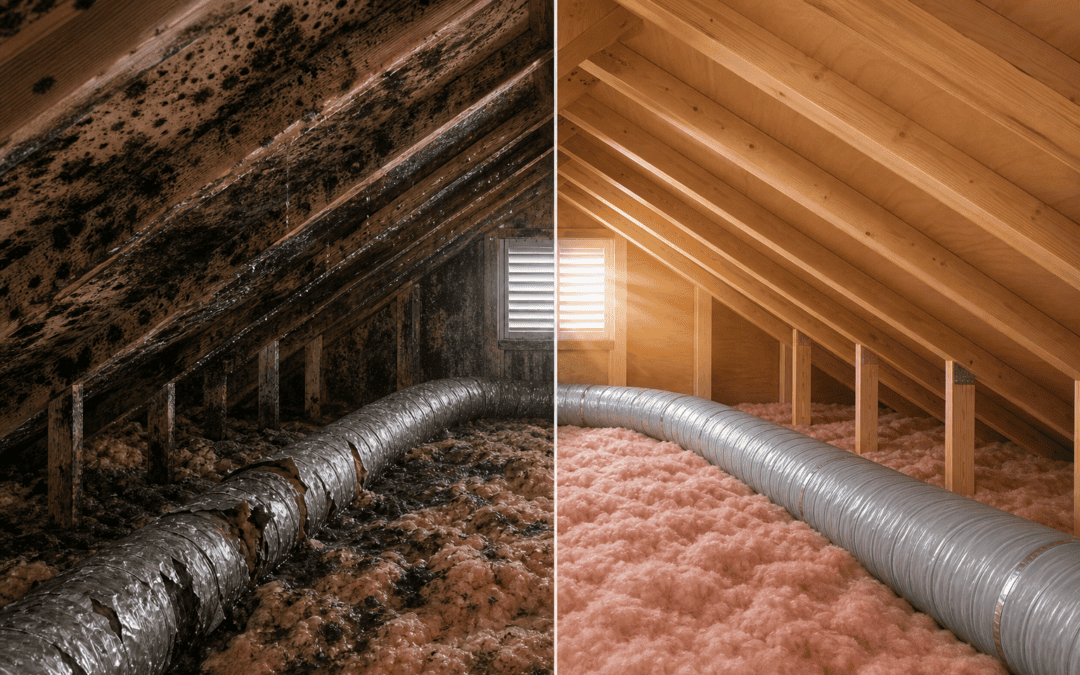
Attic mold doesn't always show up as the dramatic black patches most people picture. Early-stage growth often looks like:
- Gray or greenish discoloration on the underside of roof sheathing
- Dark streaking along rafters that follows the wood grain
- A fine, powdery white or gray coating on wood surfaces
- Black or dark brown staining spreading across large sections of sheathing
The musty smell is often the first thing homeowners notice, because it migrates down through ceiling penetrations, recessed lights, and attic hatches into the living area below.
The Health and Structural Risks
Attic mold isn't just a cosmetic issue. Spores released in the attic can circulate through your HVAC system and into the air your family breathes. Prolonged exposure to elevated spore counts is associated with respiratory irritation, worsened asthma symptoms, and allergic reactions.
Structurally, mold actively breaks down the organic material in wood. Roof sheathing with significant mold growth can become soft and weakened — and at that point, you're looking at replacement, not treatment. Catching it early makes a real difference in both cost and scope.
How Attic Mold Removal Works
Attic mold removal is not a DIY project for most homeowners, and it's nothing like wiping mold off a bathroom tile. The confined space, the heat, the need for containment, and the type of surfaces involved all require a specific approach.
Step 1: Inspection and Assessment
Before any work begins, a proper inspection identifies the full extent of the growth, locates the moisture source, and determines what materials are affected. Treating mold without finding the source is the most common reason it comes back. A thorough inspection covers ventilation, ductwork condition, bathroom exhaust routing, and the roof system itself.
Step 2: Moisture Source Correction
No remediation holds if the moisture problem isn't fixed first. That might mean repairing a roof leak, resealing or replacing leaky ducts, redirecting bathroom exhaust fans to vent outside, or improving attic ventilation with additional soffit or ridge vents. This step is non-negotiable.
Step 3: Containment and Protection
During removal, technicians contain the work area to prevent spores from spreading into the living space below. Proper protective equipment is used throughout. This isn't a step that gets skipped to save time.
Step 4: Physical Removal and Treatment
Heavily affected materials may need to come out entirely. Surfaces that can be treated are cleaned with appropriate antimicrobial agents and, in many cases, sanded or wire-brushed to remove embedded growth from the wood grain. A sealant or encapsulant is typically applied to treated wood as a final protective layer.
Step 5: Post-Remediation Verification
After the work is complete, a clearance inspection or air quality test confirms that spore counts have returned to acceptable levels. This is what separates a thorough job from one that simply looks clean.
What to Do If You Find Attic Mold in South Florida
If you've spotted signs of mold in your attic — or you're picking up a persistent musty smell and can't trace the source — the right move is to get a professional inspection before the problem spreads further.
Royal Mold Specialist has been handling mold inspections and remediation across South Florida for over 12 years. Their own trained technicians, not subcontractors, handle every job from initial inspection through full remediation and post-treatment verification. They serve homeowners and property managers across more than 20 cities in Broward, Miami-Dade, and Palm Beach Counties, including Miami, Fort Lauderdale, Boca Raton, Hollywood, Coral Springs, Pompano Beach, Davie, Weston, and Doral.
You can book an inspection directly at royalmoldfl.com. Getting eyes on the problem early is almost always less expensive and less disruptive than waiting.
Preventing Attic Mold from Coming Back
Once your attic has been properly remediated, keeping it mold-free comes down to controlling moisture and maintaining airflow.
Check your attic ventilation. Most building codes require a minimum ratio of net free ventilation area to attic floor space. If your home was built before stricter standards, or has had insulation added over time, your ventilation may no longer be adequate.
Inspect your roof annually. After every hurricane season, look for damaged shingles, lifted flashing, or any signs of water intrusion. South Florida's storm season runs June through November, and small leaks left unaddressed through winter tend to become significant mold problems by spring.
Verify your bathroom exhaust fans vent outside. Pull back insulation near the fan housing and confirm the duct runs to a roof cap or soffit vent — not just into the attic cavity.
Have your ductwork inspected. If your air handler is in the attic, leaky ducts are a frequent and underappreciated moisture source. A duct inspection can identify gaps or separations contributing to condensation.
Keep attic access sealed. Hatches that don't seal properly allow conditioned air to escape upward and humid attic air to drift down. A weatherstripped, insulated hatch cover makes a meaningful difference.
Frequently Asked Questions
How do I know if I have mold in my attic if I can't see it?
The most common sign is a musty smell in rooms directly below the attic, especially bedrooms or hallways with ceiling penetrations or recessed lights. You might also notice allergy-like symptoms that improve when you leave the house. A professional inspection is the only reliable way to confirm mold presence and pinpoint its location.
Is attic mold dangerous?
It can be. Spores from the attic can enter your living space through ceiling gaps, recessed lights, and HVAC systems. Prolonged exposure can irritate the respiratory system and worsen conditions like asthma. The risk depends on the type of mold, the extent of growth, and how well the attic is sealed from the living area.
Can I treat attic mold myself?
Small, isolated spots on non-porous surfaces are sometimes manageable with the right safety equipment and cleaning products. But attic mold in South Florida typically covers large areas of wood sheathing and rafters — which requires professional equipment, containment, and treatment methods. Improper handling can spread spores into the living space and leave underlying growth behind.
Does homeowner's insurance cover attic mold removal?
It depends on the cause. If the mold resulted from a sudden, covered event like storm-related roof damage, your policy may cover remediation. Mold caused by long-term moisture buildup or ventilation issues is typically excluded. Review your policy and document the moisture source before filing a claim.
How long does attic mold removal take?
Most residential attic mold jobs take one to three days, depending on the size of the affected area and whether any materials need to be removed. Jobs that also require roof repairs or duct work as part of the moisture correction may take longer.
Will the mold come back after treatment?
If the moisture source is corrected and the remediation is done properly, recurrence is unlikely. Mold returns when the underlying conditions — humidity, leaks, poor ventilation — aren't addressed. That's why identifying and fixing the source is the most important step in the entire process.
How much does attic mold removal cost in South Florida?
The cost varies based on the size of the affected area, the materials involved, and whether moisture source repairs are needed. Royal Mold Specialist provides on-site quotes after inspection. You can book an assessment at royalmoldfl.com to get an accurate picture of what your specific situation requires.
Attic mold in South Florida is common, but it's not inevitable — and it's not something you have to live with. The combination of heat, humidity, and year-round AC use creates conditions that demand attention. Catching it early, fixing the source, and working with a company that treats mold as its primary focus rather than a side service is the most reliable path to a clean, healthy attic.