- What Is an Air Scrubber?
- How Air Scrubbers Fit Into the Remediation Process
- Why Air Scrubbers Matter for Your Health
- South Florida Conditions Make Air Scrubbers Even More Important
- What to Ask a Remediation Contractor About Air Scrubbers
- Air Scrubbers and the Difference Between Surface Treatment and Real Remediation
- Frequently Asked Questions
- The Bottom Line
If you've watched a mold remediation crew set up their equipment, you've probably noticed large machines humming in the background. Those are air scrubbers, and on any serious air scrubber mold remediation job, they're not optional extras. They're what separates a thorough remediation from a surface wipe-down that leaves your air quality exactly where it started.
This article covers what air scrubbers actually do, how they function inside a containment zone, why they matter for your health and your home, and what to ask before hiring anyone to remediate mold on your property.
What Is an Air Scrubber?
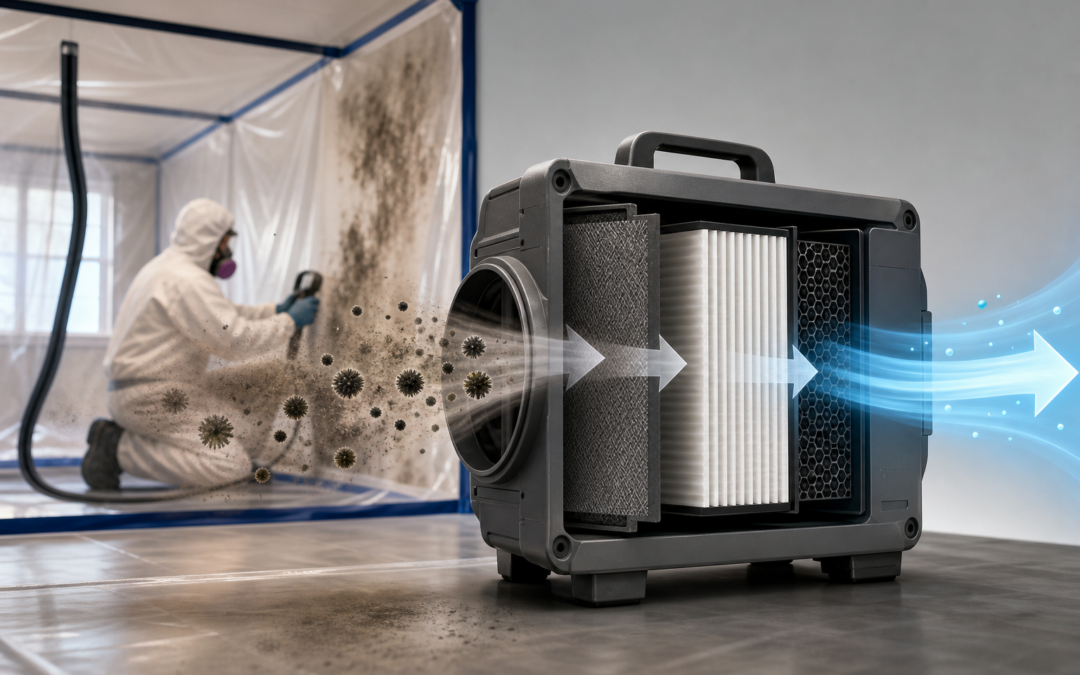
An air scrubber is a portable filtration machine that draws contaminated air in, passes it through a series of filters, and exhausts clean air back into the space or outside the building. During mold remediation, the goal is to capture airborne mold spores before they can settle on unaffected surfaces or circulate through your HVAC system.
The machine itself looks like a large rectangular box with a fan, intake vents, and an exhaust port. Crews typically attach flexible ducting to the exhaust so contaminated air gets directed outside rather than recirculated indoors.
The Filter Stack That Does the Work
Most professional-grade air scrubbers used in mold remediation run air through at least two, often three, filter stages:
Pre-filter. This first layer catches larger particles — dust, debris, and visible mold fragments — protecting the more expensive filters downstream from clogging prematurely.
HEPA filter. High-Efficiency Particulate Air filters are the critical stage. A true HEPA filter captures 99.97% of particles at 0.3 microns in diameter. Mold spores typically range from 1 to 30 microns, which means a properly functioning HEPA filter catches them reliably. This is the filter that matters most for mold.
Activated carbon filter. Some units include a carbon layer that adsorbs volatile organic compounds (VOCs) and the gases responsible for musty odors — the smell that often lingers even after visible mold is gone.
How Air Scrubbers Fit Into the Remediation Process
Air scrubbers don't work in isolation. They're one component of a controlled remediation protocol that also includes physical containment, negative air pressure, and moisture control. Understanding how these elements interact helps you evaluate whether a contractor is actually doing the job right.
Containment Comes First
Before any demolition or scrubbing begins, a professional crew seals off the affected area with plastic sheeting and tape. This containment barrier keeps mold spores disturbed during removal from migrating into clean areas of the home. Air scrubbers are positioned inside this containment zone so they're capturing spores at the source.
Negative Air Pressure
When an air scrubber exhausts air outside the building, it creates negative air pressure inside the containment zone. Air flows into the contaminated area rather than out of it, so any spores that approach the containment barrier get pulled back in rather than drifting into your living room. Negative air pressure is a standard requirement in professional mold remediation, and the air scrubber is what makes it possible.
Running Time Matters
Air scrubbers need enough time to cycle the air in a space multiple times. Professionals calculate air changes per hour (ACH) based on the machine's CFM (cubic feet per minute) rating and the volume of the containment zone. Running the scrubber for a few hours during active demo and then shutting it off isn't enough. Machines typically run continuously throughout the project and for a period after physical remediation ends to capture any spores that were disturbed and became airborne.
Post-Remediation Clearance
After remediation, a reputable contractor will conduct or arrange a post-remediation verification test — an air quality test confirming that spore counts inside the treated area have returned to normal levels. The air scrubber's performance during the job directly affects whether the property passes that clearance test.
Why Air Scrubbers Matter for Your Health
Mold spores are microscopic. You can't see them floating in the air, but you can inhale them. When mold is physically disturbed during removal, spore counts in the immediate area spike dramatically. Without an air scrubber running and containment in place, those spores spread through the home and settle on furniture, clothing, and HVAC filters — creating new growth sites.
For people with asthma, allergies, or compromised immune systems, elevated airborne spore counts during and after a remediation job can cause real respiratory symptoms. Even for healthy adults, prolonged exposure to high spore concentrations isn't something to dismiss.
An air scrubber doesn't eliminate the need to physically remove the mold. It protects the rest of the home while that removal is happening and cleans up what the process inevitably stirs into the air.
South Florida Conditions Make Air Scrubbers Even More Important
South Florida's year-round humidity makes mold remediation more demanding than in drier climates. Relative humidity regularly sits above 70%, which is the threshold at which mold growth accelerates on organic materials. Across Miami-Dade, Broward, and Palm Beach Counties, mold commonly turns up not just in bathrooms and under sinks, but inside walls, behind baseboards, and in HVAC air handlers.
When remediation involves opening walls or disturbing materials that have been wet for an extended period, the spore load released into the air is higher. A properly sized air scrubber, matched to the volume of the containment zone, handles that load. An undersized machine or one running with a clogged HEPA filter does not.
The same humidity that causes mold in the first place also means any moisture left behind after remediation can restart the cycle. Addressing the moisture source is just as important as running the air scrubber. Cleaning the air in a room that still has an active leak or unresolved condensation problem only delays the next outbreak.
What to Ask a Remediation Contractor About Air Scrubbers
The equipment a contractor uses — and how they use it — tells you a lot about their process. Here are specific questions worth asking:
What size air scrubber will you use, and how is it matched to the containment area? A contractor who can explain CFM ratings and ACH calculations is thinking about the job correctly. One who just says "we use air scrubbers" without specifics may not be.
Will you establish negative air pressure in the containment zone? The answer should be yes. If a contractor plans to remove mold without sealing off the area and creating negative pressure, spores will spread.
How long will the air scrubber run? It should run throughout the job and for a period after physical work ends. Shutting it off early is a shortcut that compromises air quality.
Do you use true HEPA filters? "HEPA-type" filters are not the same as certified HEPA filters. That distinction matters when you're dealing with mold spores.
Will you arrange a post-remediation air quality test? This is the only objective way to confirm the job was successful. A contractor confident in their work should have no objection to clearance testing.
Air Scrubbers and the Difference Between Surface Treatment and Real Remediation
Here's the distinction that matters most for homeowners: a surface treatment removes what you can see. A proper remediation removes the mold, addresses the moisture source, and cleans the air of what the removal process disturbed.
Air scrubbers are part of what makes the second approach different from the first. Without them, you can have a visually clean surface and an air quality problem that persists for days or weeks after the crew leaves. With them — running correctly inside a properly contained space — you have a documented process that protects the rest of your home during the most disruptive part of the job.
This matters especially in South Florida, where the humidity means mold problems tend to recur if the underlying conditions aren't resolved. A contractor who uses air scrubbers correctly is also likely thinking about moisture control, root cause, and long-term prevention — not just the visible patch in front of them.
If you're dealing with mold in a home or property across Broward, Miami-Dade, or Palm Beach County, Royal Mold Specialist has been handling mold inspection and remediation in South Florida for over 12 years. The team covers more than 20 cities and handles everything from inspection through full remediation, water damage restoration, and sanitizing. You can book an appointment directly on the site.
Frequently Asked Questions
Can an air scrubber remove black mold from the air?
An air scrubber with a true HEPA filter captures airborne mold spores, including those from black mold species like Stachybotrys, as air passes through the machine. It does not remove mold from surfaces — physical removal of the mold growth and affected materials is still required. The air scrubber handles what becomes airborne during and after that removal process.
How long should an air scrubber run during mold remediation?
Air scrubbers should run continuously from the start of physical remediation through the end of the project, and typically for a period afterward while the containment zone is still sealed. The exact duration depends on the size of the space, the machine's CFM rating, and the spore load from the job. Shutting it off early is a common shortcut that reduces effectiveness.
Is an air scrubber the same as an air purifier?
They serve similar filtration functions but are built for different contexts. Consumer air purifiers are designed for ongoing residential use under normal conditions. Professional air scrubbers are built for higher airborne particle loads, continuous operation, and use in construction or remediation environments. They also move significantly more air per minute and are designed to be ducted for negative pressure applications.
Do I need an air scrubber if the mold area is small?
Even small mold areas release a disproportionate number of spores when physically disturbed. Professional remediation protocols call for containment and air scrubbing based on the risk of cross-contamination, not just the visible size of the mold patch. A small area near an HVAC return or in a high-traffic part of the home warrants the same precautions as a larger job.
What is negative air pressure and why does it matter?
Negative air pressure means the air pressure inside the containment zone is lower than the pressure outside it. This causes air to flow into the contaminated area rather than out of it, preventing spores from migrating to clean parts of the home. Air scrubbers create this condition by exhausting air outside the containment zone. It's a standard requirement in professional mold remediation.
How do I know if an air scrubber was used properly during my remediation?
The most reliable indicator is a post-remediation air quality test showing that indoor spore counts have returned to normal levels. You can also ask the contractor for documentation of the equipment used, including filter specifications and runtime. A reputable company should be able to provide this without hesitation.
Can I rent an air scrubber and handle mold remediation myself?
Rental air scrubbers are available, but running one without proper containment, negative pressure setup, and an understanding of filter sizing and ACH calculations limits its effectiveness significantly. More importantly, DIY mold removal without proper containment can spread spores to unaffected areas. For anything beyond a very small, isolated surface mold issue, professional remediation is the safer approach for your home and your health.
The Bottom Line
Air scrubbers are not a marketing add-on. They're a functional part of mold remediation that protects your home's air quality while the physical work is happening. The HEPA filtration captures what you can't see, the negative pressure setup keeps spores from spreading, and the runtime after the job ends cleans up what the removal process stirred into the air.
When you're vetting a mold remediation company, the questions you ask about air scrubbers will tell you quickly whether you're talking to someone who follows a real protocol or someone who's going to wipe a surface and call it done. In South Florida's climate, that difference matters more than it does almost anywhere else.